

66
GAUGE FIELDS AND STRINGS
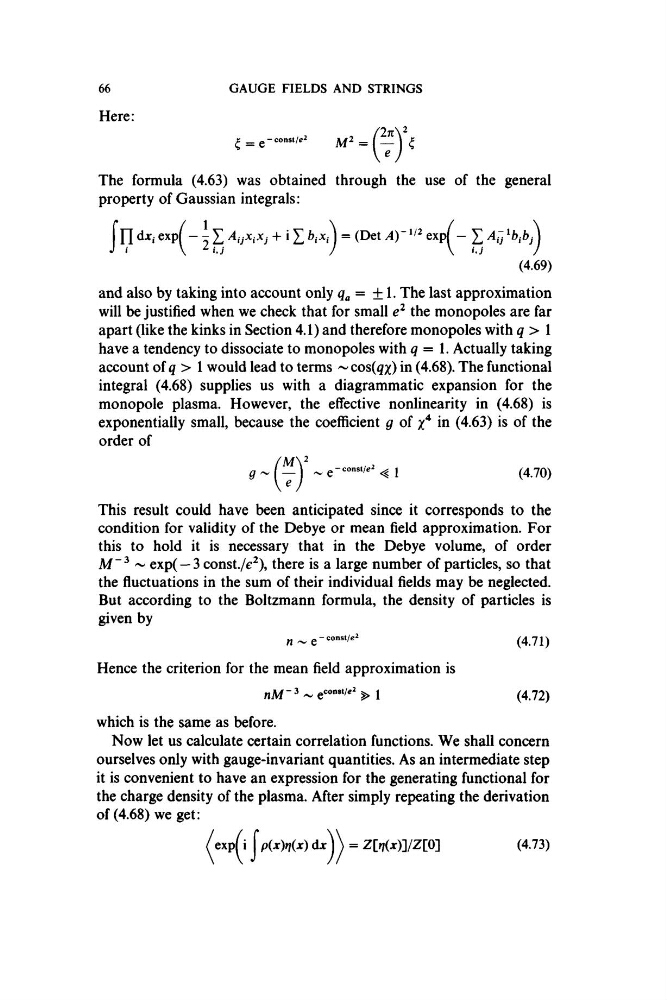
Here:
_ p — const/e^
i = e
The formula (4.63) was obtained through the use of the general
property of Gaussian integrals:
I n d-if
^ Z ^ijXiXj + i X biX^ = (D et Ay^'^ exp ^ - ^ A ,}
(4.69)
and also by taking into account only q^— ±1. The last approximation
will be justified when we check that for small the monopoles are far
apart (like the kinks in Section 4.1) and therefore monopoles with q> \
have a tendency to dissociate to monopoles with ^ = 1. Actually taking
account of ^ > 1 would lead to terms ^ cos{qx) in (4.68). The functional
integral (4.68) supplies us with a diagrammatic expansion for the
monopole plasma. However, the effective nonlinearity in (4.68) is
exponentially small, because the coefficient g of
in (4.63) is of the
order of
1
(4.70)
This result could have been anticipated since it corresponds to the
condition for validity of the Debye or mean field approximation. For
this to hold it is necessary that in the Debye volume, of order
M “ ^ ~ exp( —3 const./c^), there is a large number of particles, so that
the fiuctuations in the sum of their individual fields may be neglected.
But according to the Boltzmann formula, the density of particles is
given by
„_g-const/e2
(4.71)
Hence the criterion for the mean field approximation is
1
nM~^ ^
;
(4.72)
which is the same as before.
Now let us calculate certain correlation functions. We shall concern
ourselves only with gauge-invariant quantities. As an intermediate step
it is convenient to have an expression for the generating functional for
the charge density of the plasma. After simply repeating the derivation
of (4.68) we get:
expj^i I p(xMx)
= Z[^,(x)]/Z[0]
(4.73)
GAUGE FIELDS AND STRINGS
Here:
_ p — const/e^
i = e
The formula (4.63) was obtained through the use of the general
property of Gaussian integrals:
I n d-if
^ Z ^ijXiXj + i X biX^ = (D et Ay^'^ exp ^ - ^ A ,}
(4.69)
and also by taking into account only q^— ±1. The last approximation
will be justified when we check that for small the monopoles are far
apart (like the kinks in Section 4.1) and therefore monopoles with q> \
have a tendency to dissociate to monopoles with ^ = 1. Actually taking
account of ^ > 1 would lead to terms ^ cos{qx) in (4.68). The functional
integral (4.68) supplies us with a diagrammatic expansion for the
monopole plasma. However, the effective nonlinearity in (4.68) is
exponentially small, because the coefficient g of
in (4.63) is of the
order of
1
(4.70)
This result could have been anticipated since it corresponds to the
condition for validity of the Debye or mean field approximation. For
this to hold it is necessary that in the Debye volume, of order
M “ ^ ~ exp( —3 const./c^), there is a large number of particles, so that
the fiuctuations in the sum of their individual fields may be neglected.
But according to the Boltzmann formula, the density of particles is
given by
„_g-const/e2
(4.71)
Hence the criterion for the mean field approximation is
1
nM~^ ^
;
(4.72)
which is the same as before.
Now let us calculate certain correlation functions. We shall concern
ourselves only with gauge-invariant quantities. As an intermediate step
it is convenient to have an expression for the generating functional for
the charge density of the plasma. After simply repeating the derivation
of (4.68) we get:
expj^i I p(xMx)
= Z[^,(x)]/Z[0]
(4.73)