

INSTANTONS IN ABELIAN SYSTEMS
65
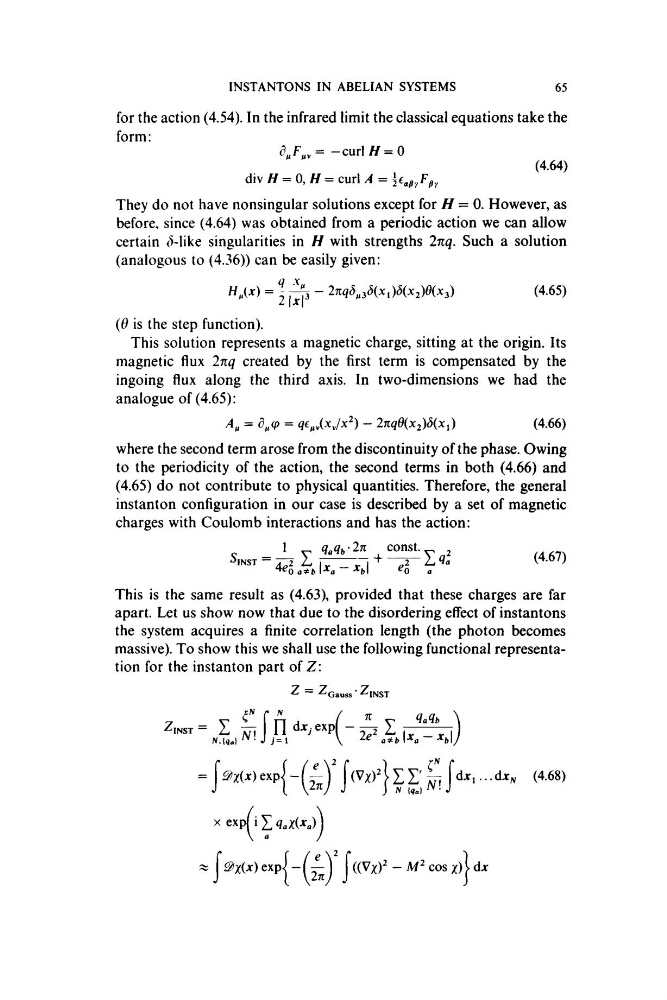
for the action (4.54). In the infrared limit the classical equations take the
form:
- curl H =0
(4.64)
div
= 0, / / = curl A =
They do not have nonsingular solutions except for H =0. However, as
before, since (4.64) was obtained from a periodic action we can allow
certain SAikc singularities in H with strengths 2nq. Such a solution
(analogous to (4.36)) can be easily given:
2 Ul‘
2nqS^3{Xi)S{x2)0{x^)
(4.65)
(0 is the step function).
This solution represents a magnetic charge, sitting at the origin. Its
magnetic flux 2nq created by the first term is compensated by the
ingoing flux along the third axis. In two-dimensions we had the
analogue of (4.65):
= q^nvi^Jx^) - 2nqe{x2)S(x^)
(4.66)
where the second term arose from the discontinuity of the phase. Owing
to the periodicity of the action, the second terms in both (4.66) and
(4.65) do not contribute to physical quantities. Therefore, the general
instanton configuration in our case is described by a set of magnetic
charges with Coulomb interactions and has the action:
1
q,q,-2n
const
(4.67)
This is the same result as (4.63), provided that these charges are far
apart. Let us show now that due to the disordering effect of instantons
the system acquires a finite correlation length (the photon becomes
massive). To show this we shall use the following functional representation for the instanton part of Z:
^ ~ -^Gauss ‘ -^INST
(
n
q^q,
^INST- Z
n dJi^ expl
2 Z I
N,{qa) ■ J j=l
\
a^b\*a ^
= I Six{x) ex p jI(V x )^ l Z L' ^ | d x , ... dA:;v (4.68)
X exp(i X qaXixJ
2> X{x)
((VxY
cos z ) U .r
65
for the action (4.54). In the infrared limit the classical equations take the
form:
- curl H =0
(4.64)
div
= 0, / / = curl A =
They do not have nonsingular solutions except for H =0. However, as
before, since (4.64) was obtained from a periodic action we can allow
certain SAikc singularities in H with strengths 2nq. Such a solution
(analogous to (4.36)) can be easily given:
2 Ul‘
2nqS^3{Xi)S{x2)0{x^)
(4.65)
(0 is the step function).
This solution represents a magnetic charge, sitting at the origin. Its
magnetic flux 2nq created by the first term is compensated by the
ingoing flux along the third axis. In two-dimensions we had the
analogue of (4.65):
= q^nvi^Jx^) - 2nqe{x2)S(x^)
(4.66)
where the second term arose from the discontinuity of the phase. Owing
to the periodicity of the action, the second terms in both (4.66) and
(4.65) do not contribute to physical quantities. Therefore, the general
instanton configuration in our case is described by a set of magnetic
charges with Coulomb interactions and has the action:
1
q,q,-2n
const
(4.67)
This is the same result as (4.63), provided that these charges are far
apart. Let us show now that due to the disordering effect of instantons
the system acquires a finite correlation length (the photon becomes
massive). To show this we shall use the following functional representation for the instanton part of Z:
^ ~ -^Gauss ‘ -^INST
(
n
q^q,
^INST- Z
n dJi^ expl
2 Z I
N,{qa) ■ J j=l
\
a^b\*a ^
= I Six{x) ex p jI(V x )^ l Z L' ^ | d x , ... dA:;v (4.68)
X exp(i X qaXixJ
2> X{x)
((VxY
cos z ) U .r