

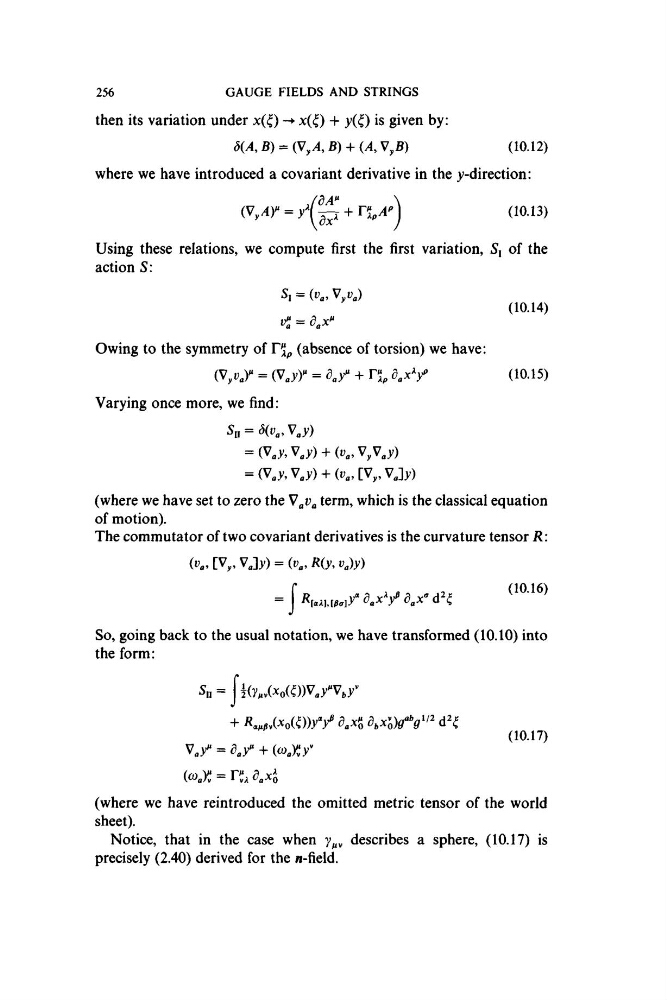
then its variation under x(^) x (^ -1- y(^) is given by:
S(A, B) = (VyA, B) + (A, V,B)
(10.12)
where we have introduced a covariant derivative in the y-direction:
256
GAUGE FIELDS AND STRINGS
JdA^
(10.13)
Using these relations, we compute first the first variation, S, of the
action S:
(10.14)
Si = (Va, VyVj
Owing to the symmetry of
(absence of torsion) we have:
(VyVj^ = (V.yr =
+ n , a,xV
(10.15)
Varying once more, we find:
V„y)
= (V«y, V,y) -h (V,, V,V,y)
= (V«y, V^y) + (v^, [V,,, V Jy)
(where we have set to zero the
term, which is the classical equation
of motion).
The commutator of two co variant derivatives is the curvature tensor R:
(i^a,[V,,VJy) = (i;„R(y, vJy)
I
(10.16)
So, going back to the usual notation, we have transformed (10.10) into
the form:
5,1 = J i(7.v(^o(0)V .y-V ,y^
V.y^ = a.y'^ + {(o X f
(coj; = r ;, d X
(10.17)
(where we have reintroduced the omitted metric tensor of the world
sheet).
Notice, that in the case when
describes a sphere, (10.17) is
precisely (2.40) derived for the n-field.
S(A, B) = (VyA, B) + (A, V,B)
(10.12)
where we have introduced a covariant derivative in the y-direction:
256
GAUGE FIELDS AND STRINGS
JdA^
(10.13)
Using these relations, we compute first the first variation, S, of the
action S:
(10.14)
Si = (Va, VyVj
Owing to the symmetry of
(absence of torsion) we have:
(VyVj^ = (V.yr =
+ n , a,xV
(10.15)
Varying once more, we find:
V„y)
= (V«y, V,y) -h (V,, V,V,y)
= (V«y, V^y) + (v^, [V,,, V Jy)
(where we have set to zero the
term, which is the classical equation
of motion).
The commutator of two co variant derivatives is the curvature tensor R:
(i^a,[V,,VJy) = (i;„R(y, vJy)
I
(10.16)
So, going back to the usual notation, we have transformed (10.10) into
the form:
5,1 = J i(7.v(^o(0)V .y-V ,y^
V.y^ = a.y'^ + {(o X f
(coj; = r ;, d X
(10.17)
(where we have reintroduced the omitted metric tensor of the world
sheet).
Notice, that in the case when
describes a sphere, (10.17) is
precisely (2.40) derived for the n-field.