

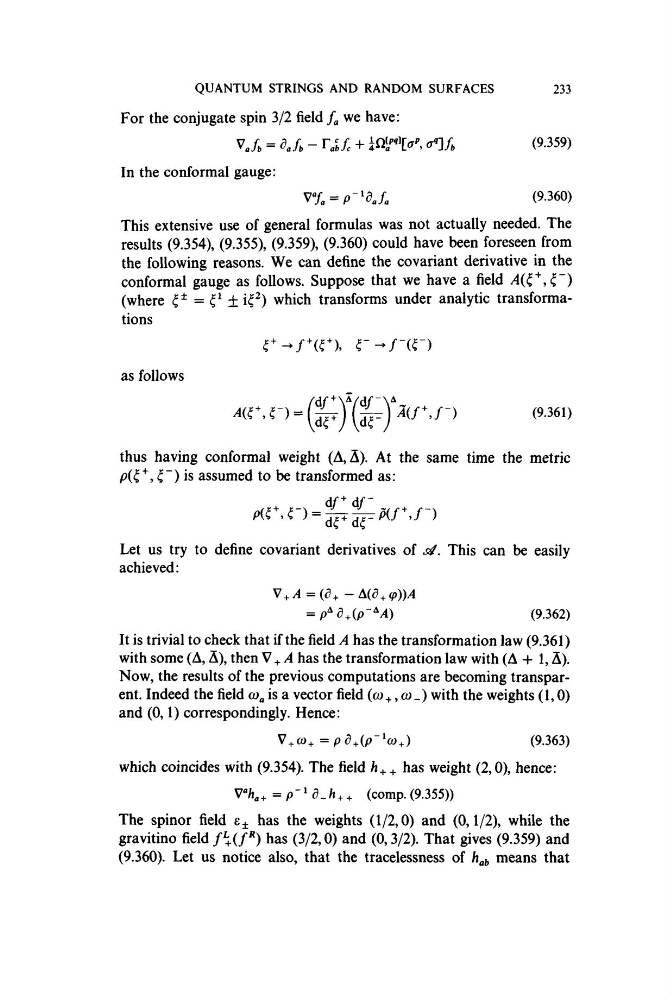
For the conjugate spin 3/2 field we have:
V«A = daft - U A +
^^A
(9.359)
In the conformal gauge:
=
(9-360)
This extensive use of general formulas was not actually needed. The
results (9.354), (9.355), (9.359), (9.360) could have been foreseen from
the following reasons. We can define the covariant derivative in the
conformal gauge as follows. Suppose that we have a field A(^'*’,^~)
(where
±
which transforms under analytic transformations
r - / - ( D
QUANTUM STRINGS AND RANDOM SURFACES
233
as follows
(9.361)
thus having conformal weight (A,l). At the same time the metric
p(i^,
is assumed to be transformed as:
df
) = ^ ^ p ( / V )
Let us try to define covariant derivatives of s/. This can be easily
achieved:
V^A = {d^-A(d^
(9.362)
It is trivial to check that if the field A has the transformation law (9.361)
with some (A, A), then V + A has the transformation law with (A + 1, A).
Now, the results of the previous computations are becoming transparent. Indeed the field co^ is a vector field (co+, co_) with the weights (1,0)
and (0,1) correspondingly. Hence:
V+CO+=p5+(p-‘« J
(9.363)
which coincides with (9.354). The field h++ has weight (2,0), hence:
+ = p - ‘ a _ 1) + + (comp. (9.355))
The spinor field e± has the weights (1/2,0) and (0,1/2), while the
gravitino field/+ ( /* ) has (3/2,0) and (0,3/2). That gives (9.359) and
(9.360). Let us notice also, that the tracelessness of
means that
V«A = daft - U A +
^^A
(9.359)
In the conformal gauge:
=
(9-360)
This extensive use of general formulas was not actually needed. The
results (9.354), (9.355), (9.359), (9.360) could have been foreseen from
the following reasons. We can define the covariant derivative in the
conformal gauge as follows. Suppose that we have a field A(^'*’,^~)
(where
±
which transforms under analytic transformations
r - / - ( D
QUANTUM STRINGS AND RANDOM SURFACES
233
as follows
(9.361)
thus having conformal weight (A,l). At the same time the metric
p(i^,
is assumed to be transformed as:
df
) = ^ ^ p ( / V )
Let us try to define covariant derivatives of s/. This can be easily
achieved:
V^A = {d^-A(d^
(9.362)
It is trivial to check that if the field A has the transformation law (9.361)
with some (A, A), then V + A has the transformation law with (A + 1, A).
Now, the results of the previous computations are becoming transparent. Indeed the field co^ is a vector field (co+, co_) with the weights (1,0)
and (0,1) correspondingly. Hence:
V+CO+=p5+(p-‘« J
(9.363)
which coincides with (9.354). The field h++ has weight (2,0), hence:
+ = p - ‘ a _ 1) + + (comp. (9.355))
The spinor field e± has the weights (1/2,0) and (0,1/2), while the
gravitino field/+ ( /* ) has (3/2,0) and (0,3/2). That gives (9.359) and
(9.360). Let us notice also, that the tracelessness of
means that