

232
GAUGE FIELDS AND STRINGS
Now, our aim is to express the determinants entering in these
formulas in terms of the fields / and p from (9.349). In the bosonic case
we have already performed this task. However, it will be convenient to
repeat everything again, using a somewhat different method, in the
present situation, in order to see the close connection between bosons
and fermions.
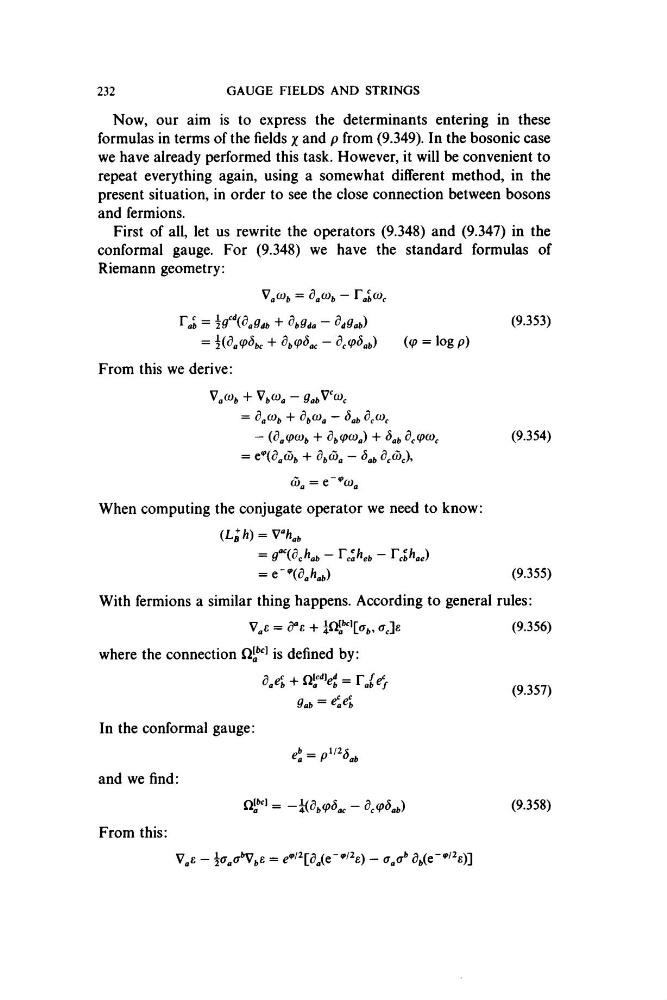
First of all, let us rewrite the operators (9.348) and (9.347) in the
conformal gauge. For (9.348) we have the standard formulas of
Riemann geometry:
r/b = W\^a9db + ^b9da - ^dGab)
= 2{^aG>hc + ^bG > ^ac ~ ^cG > ^ab)
(9.353)
{(p = log p)
From this we derive:
= ^a^b + ^b^a - ^ab
- {d^ipcOf, + di,(p(o^) +
d,(pco,
=
+ dt,cb^ - 3^1,
rn =
(9.354)
When computing the conjugate operator we need to know:
(L^h) =
= g^VXb - r;Xb - ^ciKe)
= e-V a ^ a b )
(9.355)
With fermions a similar thing happens. According to general rules:
where the connection
is defined by:
= r/,ey
Gab =
(9.356)
(9.357)
In the conformal gauge:
and we find:
ilL”" = -^Sb(P^ac - ScV^ab)
(9.358)
From this:
GAUGE FIELDS AND STRINGS
Now, our aim is to express the determinants entering in these
formulas in terms of the fields / and p from (9.349). In the bosonic case
we have already performed this task. However, it will be convenient to
repeat everything again, using a somewhat different method, in the
present situation, in order to see the close connection between bosons
and fermions.
First of all, let us rewrite the operators (9.348) and (9.347) in the
conformal gauge. For (9.348) we have the standard formulas of
Riemann geometry:
r/b = W\^a9db + ^b9da - ^dGab)
= 2{^aG>hc + ^bG > ^ac ~ ^cG > ^ab)
(9.353)
{(p = log p)
From this we derive:
= ^a^b + ^b^a - ^ab
- {d^ipcOf, + di,(p(o^) +
d,(pco,
=
+ dt,cb^ - 3^1,
rn =
(9.354)
When computing the conjugate operator we need to know:
(L^h) =
= g^VXb - r;Xb - ^ciKe)
= e-V a ^ a b )
(9.355)
With fermions a similar thing happens. According to general rules:
where the connection
is defined by:
= r/,ey
Gab =
(9.356)
(9.357)
In the conformal gauge:
and we find:
ilL”" = -^Sb(P^ac - ScV^ab)
(9.358)
From this: