

230
GAUGE FIELDS AND STRINGS
One would like to derive (9.343) directly from the superspace formalism. Unfortunately, this becomes rather clumsy. It is much easier to
check that (9.343) has the desired covariance. In this formula we
denoted by o' the usual Pauli matrices, e"‘(0 is a “Zweibein” field
connected with
by
X a is the gravitino field with
vector index a and suppressed spinor index. In the limit of weak
graviton and gravitino fields, the action (9.343) will go to (9.341) plus a
graviton coupled to T{T) and a gravitino to
The last term in
(9.343) is a correction to the supercurrent produced by the /-field. We
have used a non-covariant derivative acting on ij/^ in the second term
since for Majorana spinors the spin connection gives zero contribution.
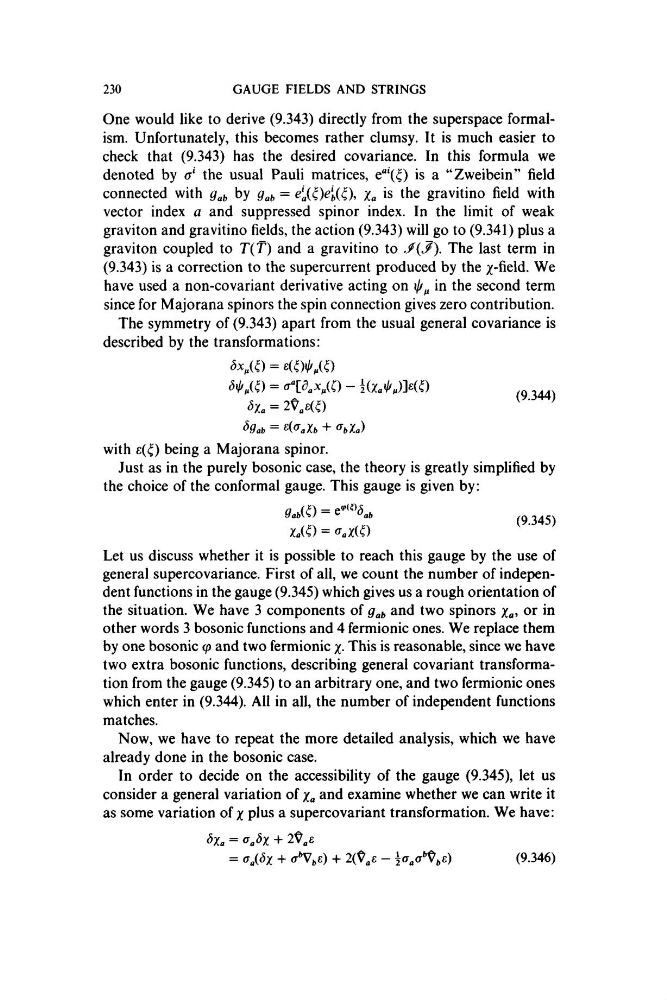
The symmetry of (9.343) apart from the usual general covariance is
described by the transformations:
ha = 2^ A O
hab = £(< ^aXb + < ^bX a)
with 6(^) being a Majorana spinor.
Just as in the purely bosonic case, the theory is greatly simplified by
the choice of the conformal gauge. This gauge is given by:
Xaii) = ^aXii)
(9.344)
(9.345)
Let us discuss whether it is possible to reach this gauge by the use of
general supercovariance. First of all, we count the number of independent functions in the gauge (9.345) which gives us a rough orientation of
the situation. We have 3 components of g^fj and two spinors
or in
other words 3 bosonic functions and 4 fermionic ones. We replace them
by one bosonic q> and two fermionic /. This is reasonable, since we have
two extra bosonic functions, describing general covariant transformation from the gauge (9.345) to an arbitrary one, and two fermionic ones
which enter in (9.344). All in all, the number of independent functions
matches.
Now, we have to repeat the more detailed analysis, which we have
already done in the bosonic case.
In order to decide on the accessibility of the gauge (9.345), let us
consider a general variation of Xa
examine whether we can write it
as some variation of / plus a supercovariant transformation. We have:
^Xa = (^a^X +
(9.346)
GAUGE FIELDS AND STRINGS
One would like to derive (9.343) directly from the superspace formalism. Unfortunately, this becomes rather clumsy. It is much easier to
check that (9.343) has the desired covariance. In this formula we
denoted by o' the usual Pauli matrices, e"‘(0 is a “Zweibein” field
connected with
by
X a is the gravitino field with
vector index a and suppressed spinor index. In the limit of weak
graviton and gravitino fields, the action (9.343) will go to (9.341) plus a
graviton coupled to T{T) and a gravitino to
The last term in
(9.343) is a correction to the supercurrent produced by the /-field. We
have used a non-covariant derivative acting on ij/^ in the second term
since for Majorana spinors the spin connection gives zero contribution.
The symmetry of (9.343) apart from the usual general covariance is
described by the transformations:
ha = 2^ A O
hab = £(< ^aXb + < ^bX a)
with 6(^) being a Majorana spinor.
Just as in the purely bosonic case, the theory is greatly simplified by
the choice of the conformal gauge. This gauge is given by:
Xaii) = ^aXii)
(9.344)
(9.345)
Let us discuss whether it is possible to reach this gauge by the use of
general supercovariance. First of all, we count the number of independent functions in the gauge (9.345) which gives us a rough orientation of
the situation. We have 3 components of g^fj and two spinors
or in
other words 3 bosonic functions and 4 fermionic ones. We replace them
by one bosonic q> and two fermionic /. This is reasonable, since we have
two extra bosonic functions, describing general covariant transformation from the gauge (9.345) to an arbitrary one, and two fermionic ones
which enter in (9.344). All in all, the number of independent functions
matches.
Now, we have to repeat the more detailed analysis, which we have
already done in the bosonic case.
In order to decide on the accessibility of the gauge (9.345), let us
consider a general variation of Xa
examine whether we can write it
as some variation of / plus a supercovariant transformation. We have:
^Xa = (^a^X +
(9.346)