

QUANTUM STRINGS AND RANDOM SURFACES
229
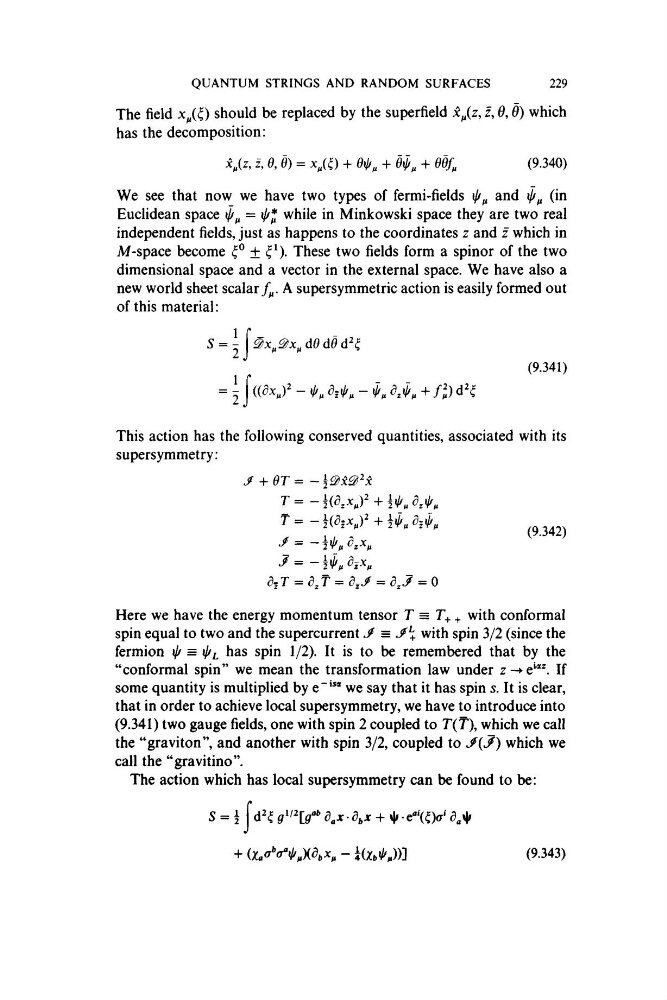
The field
should be replaced by the superfield x^(z, z, 0,6) which
has the decomposition:
i^(z, z, 0, è) =
+ O ip^ + é{¡/^ + eof^
(9.340)
We see that now we have two types of fermi-fields
and \j/^ (in
Euclidean space i¡/^ = ij/* while in Minkowski space they are two real
independent fields, just as happens to the coordinates z and z which in
M-space become
±^^). These two fields form a spinor of the two
dimensional space and a vector in the external space. We have also a
new world sheet scalar /^. A supersymmetric action is easily formed out
of this material:
1
^ = 2
_ 1
~2
dO dèd^^
{{dx^f -
+ fl) d^i
(9.341)
This action has the following conserved quantities, associated with its
supersymmetry:
d.T = d j =
= d^J = 0
(9.342)
Here we have the energy momentum tensor T =
with conformal
spin equal to two and the supercurrent J
with spin 3/2 (since the
fermion — ì/'l has spin 1/2). It is to be remembered that by the
“conformal spin” we mean the transformation law under z -► e‘® ^. If
some quantity is multiplied by e"**® we say that it has spin s. It is clear,
that in order to achieve local supersymmetry, we have to introduce into
(9.341) two gauge fields, one with spin 2 coupled to T(T\ which we call
the “graviton”, and another with spin 3/2, coupled to J(J) which we
call the “gravitino”.
The action which has local supersymmetry can be found to be:
5 = i Jd^i
-I-1|| •
+
(9.343)
229
The field
should be replaced by the superfield x^(z, z, 0,6) which
has the decomposition:
i^(z, z, 0, è) =
+ O ip^ + é{¡/^ + eof^
(9.340)
We see that now we have two types of fermi-fields
and \j/^ (in
Euclidean space i¡/^ = ij/* while in Minkowski space they are two real
independent fields, just as happens to the coordinates z and z which in
M-space become
±^^). These two fields form a spinor of the two
dimensional space and a vector in the external space. We have also a
new world sheet scalar /^. A supersymmetric action is easily formed out
of this material:
1
^ = 2
_ 1
~2
dO dèd^^
{{dx^f -
+ fl) d^i
(9.341)
This action has the following conserved quantities, associated with its
supersymmetry:
d.T = d j =
= d^J = 0
(9.342)
Here we have the energy momentum tensor T =
with conformal
spin equal to two and the supercurrent J
with spin 3/2 (since the
fermion — ì/'l has spin 1/2). It is to be remembered that by the
“conformal spin” we mean the transformation law under z -► e‘® ^. If
some quantity is multiplied by e"**® we say that it has spin s. It is clear,
that in order to achieve local supersymmetry, we have to introduce into
(9.341) two gauge fields, one with spin 2 coupled to T(T\ which we call
the “graviton”, and another with spin 3/2, coupled to J(J) which we
call the “gravitino”.
The action which has local supersymmetry can be found to be:
5 = i Jd^i
-I-1|| •
+
(9.343)