

QUANTUM STRINGS AND RANDOM SURFACES
221
This can be confirmed by examining the norms of physical states for
^ > 26: one chain of oscillators will become ghosts.
The main result of our analysis is that for ® = 26 the simple
Koba-Nielsen amplitude has only one flaw—a tachyon. In the next
section we will show how this flaw is corrected in the case of fermionic
strings with ^ = 10. After that, we return to the noncritical strings and
discuss many interesting possibilities which arise there.
Appendix to 9.10
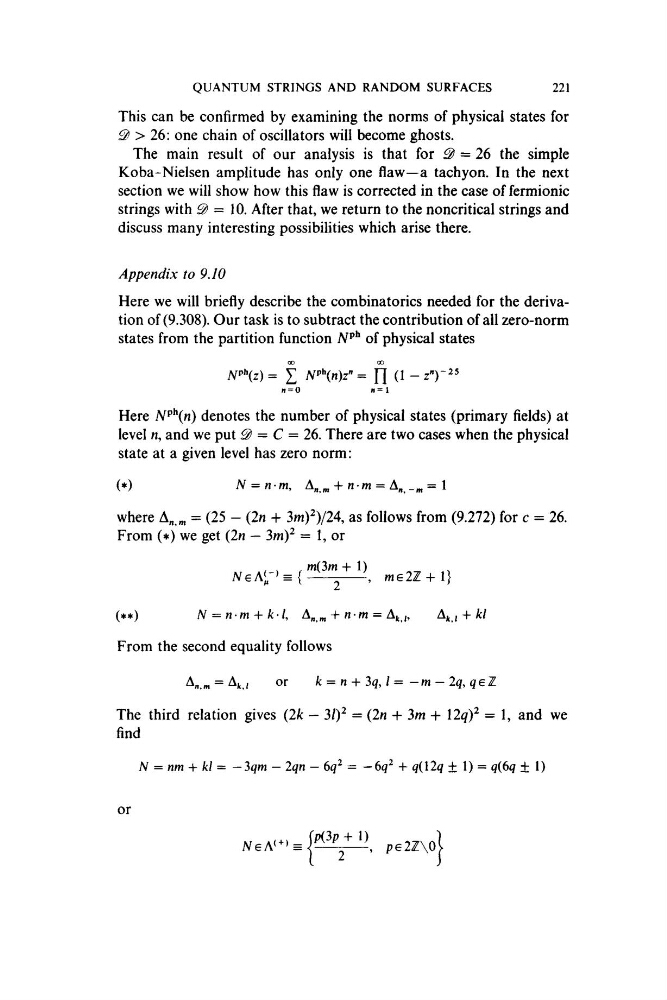
Here we will briefly describe the combinatorics needed for the derivation of (9.308). Our task is to subtract the contribution of all zero-norm
states from the partition function
of physical states
00
00
JVP"(z)= X No\n)z"= n (1 -z " )'^ ’
n = 0
n = 1
Here N^\n) denotes the number of physical states (primary fields) at
level n, and we put ^ = C = 26. There are two cases when the physical
state at a given level has zero norm:
(*)
N = n m, A„ „, + n-m = A„
1
where A„^ = (25 — (2n -h 3m)^)/24, as follows from (9.272) for c = 26.
From (*) we get (2n — 3m)^ = 1, or
, ,
, m(3m H - 1)
N g\ [ ^ = { ------------- , me2Z -(- 1}
(♦♦)
N = n-m + k A, A„^ -I- «• m = A^ „
A^, -h kl
From the second equality follows
A„^ = A,^ ,
or
k = n 3q, I = —m — 2q, qeZ
The third relation gives (2k — 3/)^ = (2n + 3m -h 12^)^ = 1, and we
find
= nm + kl = —3qm — 2qn — 6q^ = —6q^
q(l2q ± 1) = q(6q ± 1)
or
=
p e2 I\0
221
This can be confirmed by examining the norms of physical states for
^ > 26: one chain of oscillators will become ghosts.
The main result of our analysis is that for ® = 26 the simple
Koba-Nielsen amplitude has only one flaw—a tachyon. In the next
section we will show how this flaw is corrected in the case of fermionic
strings with ^ = 10. After that, we return to the noncritical strings and
discuss many interesting possibilities which arise there.
Appendix to 9.10
Here we will briefly describe the combinatorics needed for the derivation of (9.308). Our task is to subtract the contribution of all zero-norm
states from the partition function
of physical states
00
00
JVP"(z)= X No\n)z"= n (1 -z " )'^ ’
n = 0
n = 1
Here N^\n) denotes the number of physical states (primary fields) at
level n, and we put ^ = C = 26. There are two cases when the physical
state at a given level has zero norm:
(*)
N = n m, A„ „, + n-m = A„
1
where A„^ = (25 — (2n -h 3m)^)/24, as follows from (9.272) for c = 26.
From (*) we get (2n — 3m)^ = 1, or
, ,
, m(3m H - 1)
N g\ [ ^ = { ------------- , me2Z -(- 1}
(♦♦)
N = n-m + k A, A„^ -I- «• m = A^ „
A^, -h kl
From the second equality follows
A„^ = A,^ ,
or
k = n 3q, I = —m — 2q, qeZ
The third relation gives (2k — 3/)^ = (2n + 3m -h 12^)^ = 1, and we
find
= nm + kl = —3qm — 2qn — 6q^ = —6q^
q(l2q ± 1) = q(6q ± 1)
or
=
p e2 I\0