

220
GAUGE FIELDS AND STRINGS
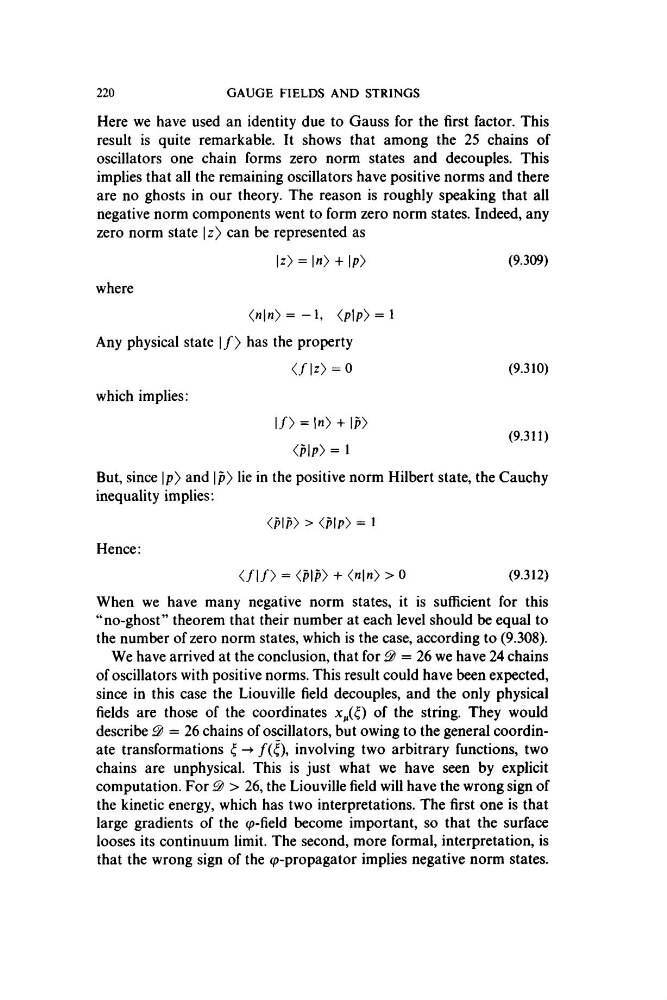
Here we have used an identity due to Gauss for the first factor. This
result is quite remarkable. It shows that among the 25 chains of
oscillators one chain forms zero norm states and decouples. This
implies that all the remaining oscillators have positive norms and there
are no ghosts in our theory. The reason is roughly speaking that all
negative norm components went to form zero norm states. Indeed, any
zero norm state |z> can be represented as
\z} = \n} + \p}
(9.309)
where
=-l, < p | p > = l
Any physical state |/> has the property
= 0
which implies:
l/> = l^i> + |p>
= 1
(9.310)
(9.311)
But, since |p> and |p> lie in the positive norm Hilbert state, the Cauchy
inequality implies:
Hence:
> = 1
< /! /> = + <«!"> > 0
(9.312)
When we have many negative norm states, it is sufficient for this
“no-ghost” theorem that their number at each level should be equal to
the number of zero norm states, which is the case, according to (9.308).
We have arrived at the conclusion, that for ^ = 26 we have 24 chains
of oscillators with positive norms. This result could have been expected,
since in this case the Liouville field decouples, and the only physical
fields are those of the coordinates x^(0 of the string. They would
describe 3) = 16 chains of oscillators, but owing to the general coordinate transformations (^ -► / (|), involving two arbitrary functions, two
chains are unphysical. This is just what we have seen by explicit
computation. For ^ > 26, the Liouville field will have the wrong sign of
the kinetic energy, which has two interpretations. The first one is that
large gradients of the cp-field become important, so that the surface
looses its continuum limit. The second, more formal, interpretation, is
that the wrong sign of the (p-propagator implies negative norm states.
GAUGE FIELDS AND STRINGS
Here we have used an identity due to Gauss for the first factor. This
result is quite remarkable. It shows that among the 25 chains of
oscillators one chain forms zero norm states and decouples. This
implies that all the remaining oscillators have positive norms and there
are no ghosts in our theory. The reason is roughly speaking that all
negative norm components went to form zero norm states. Indeed, any
zero norm state |z> can be represented as
\z} = \n} + \p}
(9.309)
where
Any physical state |/> has the property
= 0
which implies:
l/> = l^i> + |p>
(9.310)
(9.311)
But, since |p> and |p> lie in the positive norm Hilbert state, the Cauchy
inequality implies:
Hence:
< /! /> =
(9.312)
When we have many negative norm states, it is sufficient for this
“no-ghost” theorem that their number at each level should be equal to
the number of zero norm states, which is the case, according to (9.308).
We have arrived at the conclusion, that for ^ = 26 we have 24 chains
of oscillators with positive norms. This result could have been expected,
since in this case the Liouville field decouples, and the only physical
fields are those of the coordinates x^(0 of the string. They would
describe 3) = 16 chains of oscillators, but owing to the general coordinate transformations (^ -► / (|), involving two arbitrary functions, two
chains are unphysical. This is just what we have seen by explicit
computation. For ^ > 26, the Liouville field will have the wrong sign of
the kinetic energy, which has two interpretations. The first one is that
large gradients of the cp-field become important, so that the surface
looses its continuum limit. The second, more formal, interpretation, is
that the wrong sign of the (p-propagator implies negative norm states.