

QUANTUM STRINGS AND RANDOM SURFACES
201
the standard dual model). We see from (9.224) that two tachyons may
coalesce into a single one and the amplitude for such a process satisfies
the factorization condition. The derivation of (9.224) shows a simple
mechanism which transforms the operator product expansion in the
underlying two dimensional field theory (the theory on the world sheet
of the string) into a ^-dimensional factorization of poles. We have
considered only the simplest example to demonstrate the idea and now
it is necessary to go further.
Staying in ^ = 26, we can look at the remaining poles of the
amplitude. They will correspond to higher operators in the OPE. By the
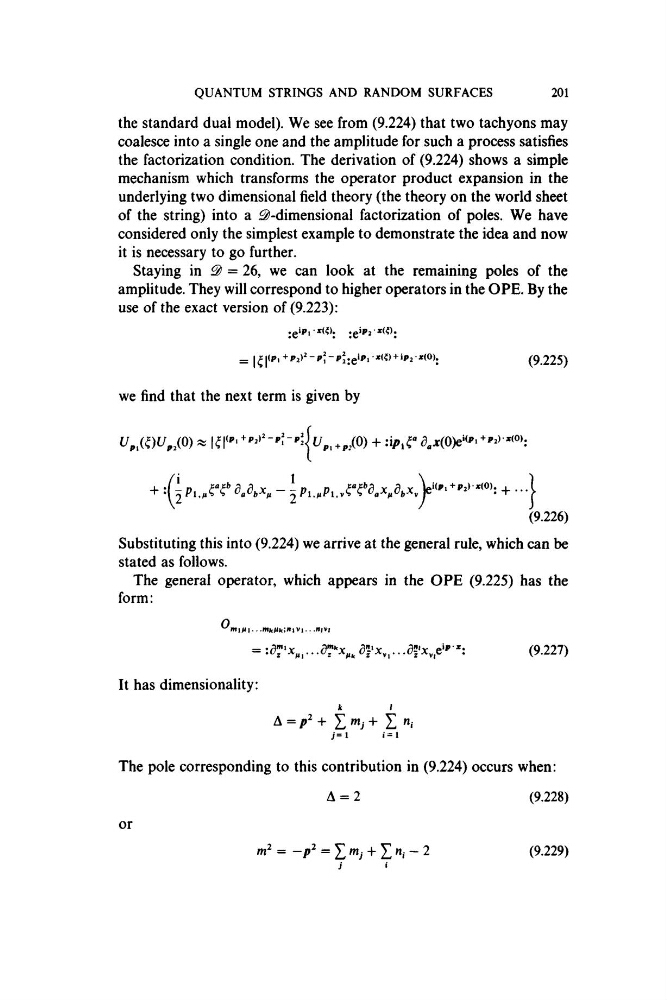
use of the exact version of (9.223):
.gipi •*(<;).
=
+P2)^"PÍ~P2:e*'*' •*(«?)+»P2*(0)j
(9.225)
we find that the next term is given by
(9.226)
Substituting this into (9.224) we arrive at the general rule, which can be
stated as follows.
The general operator, which appears in the OPE (9.225) has the
form:
0. tini.. .mkHk;niVi.. Mivi
(9.227)
It has dimensionality:
k
I
rrij +
j= l
i= l
A=/>^+
Z "i
The pole corresponding to this contribution in (9.224) occurs when:
A = 2
(9.228)
or
= -p^ =
+ Z
- 2
(9 .2 2 9 )
201
the standard dual model). We see from (9.224) that two tachyons may
coalesce into a single one and the amplitude for such a process satisfies
the factorization condition. The derivation of (9.224) shows a simple
mechanism which transforms the operator product expansion in the
underlying two dimensional field theory (the theory on the world sheet
of the string) into a ^-dimensional factorization of poles. We have
considered only the simplest example to demonstrate the idea and now
it is necessary to go further.
Staying in ^ = 26, we can look at the remaining poles of the
amplitude. They will correspond to higher operators in the OPE. By the
use of the exact version of (9.223):
.gipi •*(<;).
=
+P2)^"PÍ~P2:e*'*' •*(«?)+»P2*(0)j
(9.225)
we find that the next term is given by
(9.226)
Substituting this into (9.224) we arrive at the general rule, which can be
stated as follows.
The general operator, which appears in the OPE (9.225) has the
form:
0. tini.. .mkHk;niVi.. Mivi
(9.227)
It has dimensionality:
k
I
rrij +
j= l
i= l
A=/>^+
Z "i
The pole corresponding to this contribution in (9.224) occurs when:
A = 2
(9.228)
or
= -p^ =
+ Z
- 2
(9 .2 2 9 )