

200
GAUGE FIELDS AND STRINGS
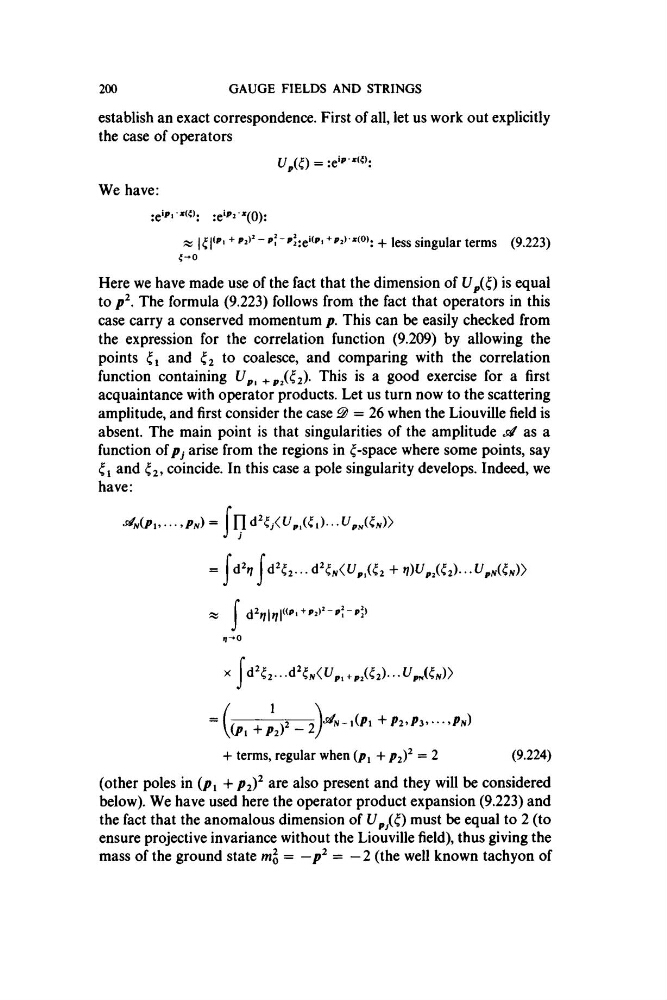
establish an exact correspondence. First of all, let us work out explicitly
the case of operators
We have:
;eip. *(i);
*(0):
- |^|(P. + p.)^-pi-p^;ei(p.+P2) x(0). ^ jggg singular terms (9.223)
Here we have made use of the fact that the dimension of t/p(0 is equal
to p^. The formula (9.223) follows from the fact that operators in this
case carry a conserved momentum p. This can be easily checked from
the expression for the correlation function (9.209) by allowing the
points (^1 and ^ 2
coalesce, and comparing with the correlation
function containing
This is a good exercise for a first
acquaintance with operator products. Let us turn now to the scattering
amplitude, and first consider the case — 26 when the Liouville field is
absent. The main point is that singularities of the amplitude
as a
function of pj arise from the regions in ^-space where some points, say
(^1 and ^2» coincide. In this case a pole singularity develops. Indeed, we
have:
• • • .Pn) = | n
I
n— o
X
,...
I/,,,
j)...
■N-\(P\ + Pl^
' ^Pn)
((/»I + P2Ÿ - 2) “'
i.O'i + P2Ÿ - 2
4- terms, regular when (jf^ -h P2Ÿ = 2
(9.224)
(other poles in (/?i + P2Ÿ are also present and they will be considered
below). We have used here the operator product expansion (9.223) and
the fact that the anomalous dimension of
must be equal to 2 (to
ensure projective invariance without the Liouville field), thus giving the
mass of the ground state ml = —p^= —2 (the well known tachyon of
GAUGE FIELDS AND STRINGS
establish an exact correspondence. First of all, let us work out explicitly
the case of operators
We have:
;eip. *(i);
*(0):
- |^|(P. + p.)^-pi-p^;ei(p.+P2) x(0). ^ jggg singular terms (9.223)
Here we have made use of the fact that the dimension of t/p(0 is equal
to p^. The formula (9.223) follows from the fact that operators in this
case carry a conserved momentum p. This can be easily checked from
the expression for the correlation function (9.209) by allowing the
points (^1 and ^ 2
coalesce, and comparing with the correlation
function containing
This is a good exercise for a first
acquaintance with operator products. Let us turn now to the scattering
amplitude, and first consider the case — 26 when the Liouville field is
absent. The main point is that singularities of the amplitude
as a
function of pj arise from the regions in ^-space where some points, say
(^1 and ^2» coincide. In this case a pole singularity develops. Indeed, we
have:
• • • .Pn) = | n
I
n— o
X
,...
I/,,,
j)...
■N-\(P\ + Pl^
' ^Pn)
((/»I + P2Ÿ - 2) “'
i.O'i + P2Ÿ - 2
4- terms, regular when (jf^ -h P2Ÿ = 2
(9.224)
(other poles in (/?i + P2Ÿ are also present and they will be considered
below). We have used here the operator product expansion (9.223) and
the fact that the anomalous dimension of
must be equal to 2 (to
ensure projective invariance without the Liouville field), thus giving the
mass of the ground state ml = —p^= —2 (the well known tachyon of