

196
GAUGE FIELDS AND STRINGS
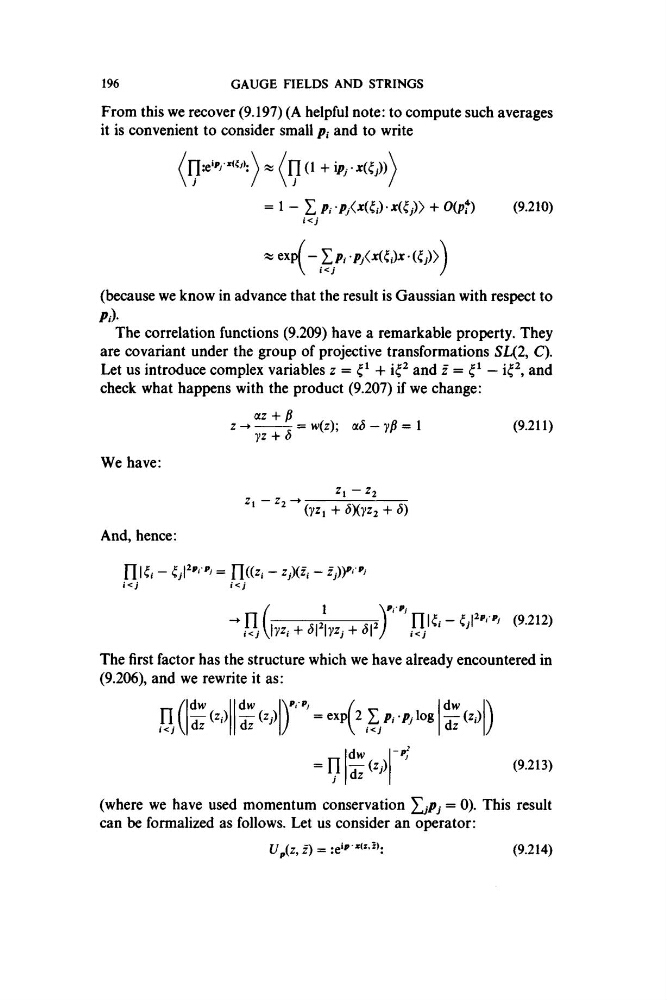
From this we recover (9.197) (A helpful note: to compute such averages
it is convenient to consider small Pi and to write
(9.210)
■
j
(because we know in advance that the result is Gaussian with respect to
a )The correlation functions (9.209) have a remarkable property. They
are covariant under the group of projective transformations SL(2, C).
Let us introduce complex variables z =
+ i(^^ and z =
— i(^^, and
check what happens with the product (9.207) if we change:
CLZ B
z -► -------r = w(z); ccS — yP = 1
yz + 0
(9.211)
We have:
z, — z, -►
(yzi + S){yz2 + S)
And, hence:
nii.- -
= n((^i -
i
(9.206), and we rewrite it as:
^ / dw
dw
f ^
dw
\
n ( di w 5 <''>) - “v ,?/'
T z
)
-n
dw
-i-f
(9.213)
(where we have used momentum conservation Y^jPj = 0). This result
can be formalized as follows. Let us consider an operator:
U .(z, z) =
(9.214)
GAUGE FIELDS AND STRINGS
From this we recover (9.197) (A helpful note: to compute such averages
it is convenient to consider small Pi and to write
(9.210)
■
j
(because we know in advance that the result is Gaussian with respect to
a )The correlation functions (9.209) have a remarkable property. They
are covariant under the group of projective transformations SL(2, C).
Let us introduce complex variables z =
+ i(^^ and z =
— i(^^, and
check what happens with the product (9.207) if we change:
CLZ B
z -► -------r = w(z); ccS — yP = 1
yz + 0
(9.211)
We have:
z, — z, -►
(yzi + S){yz2 + S)
And, hence:
nii.- -
= n((^i -
i
(9.206), and we rewrite it as:
^ / dw
dw
f ^
dw
\
n ( di w 5 <''>) - “v ,?/'
T z
)
-n
dw
-i-f
(9.213)
(where we have used momentum conservation Y^jPj = 0). This result
can be formalized as follows. Let us consider an operator:
U .(z, z) =
(9.214)