

QUANTUM STRINGS AND RANDOM SURFACES
195
where we have used momentum conservation. By its construction 9)'
has correct transformation properties, but we need not bother to
replace 9 by 9' in the previous formulas.
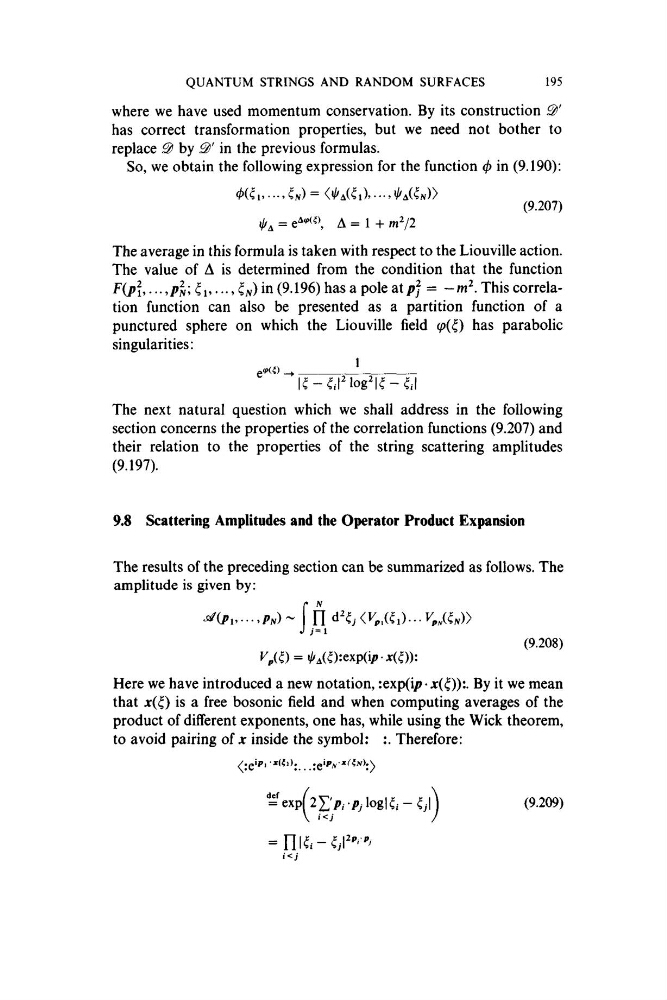
So, we obtain the following expression for the function (j) in (9.190):
A = 1 + m^l2
(9.207)
The average in this formula is taken with respect to the Liouville action.
The value of A is determined from the condition that the function
F{Pu
• ••»
in (9.196) has a pole a tp] - —m^. This correlation function can also be presented as a partition function of a
punctured sphere on which the Liouville field (p(^) has parabolic
singularities:
1
The next natural question which we shall address in the following
section concerns the properties of the correlation functions (9.207) and
their relation to the properties of the string scattering amplitudes
(9.197).
9.8 Scattering Amplitudes and the Operator Product Expansion
The results of the preceding section can be summarized as follows. The
amplitude is given by:
nd% .
Tp(i) = «A^(i):exp(i/i.jc(i)):
(9.208)
Here we have introduced a new notation, :exp(i/? • jc(<^)):. By it we mean
that jc((^) is a free bosonic field and when computing averages of the
product of different exponents, one has, while using the Wick theorem,
to avoid pairing of x inside the symbol: :. Therefore:
='exp( 2 ^> , pj log]
V ■
195
where we have used momentum conservation. By its construction 9)'
has correct transformation properties, but we need not bother to
replace 9 by 9' in the previous formulas.
So, we obtain the following expression for the function (j) in (9.190):
A = 1 + m^l2
(9.207)
The average in this formula is taken with respect to the Liouville action.
The value of A is determined from the condition that the function
F{Pu
• ••»
in (9.196) has a pole a tp] - —m^. This correlation function can also be presented as a partition function of a
punctured sphere on which the Liouville field (p(^) has parabolic
singularities:
1
The next natural question which we shall address in the following
section concerns the properties of the correlation functions (9.207) and
their relation to the properties of the string scattering amplitudes
(9.197).
9.8 Scattering Amplitudes and the Operator Product Expansion
The results of the preceding section can be summarized as follows. The
amplitude is given by:
nd% .
Tp(i) = «A^(i):exp(i/i.jc(i)):
(9.208)
Here we have introduced a new notation, :exp(i/? • jc(<^)):. By it we mean
that jc((^) is a free bosonic field and when computing averages of the
product of different exponents, one has, while using the Wick theorem,
to avoid pairing of x inside the symbol: :. Therefore:
='exp( 2 ^> , pj log]
V ■