

QUANTUM STRINGS AND RANDOM SURFACES
189
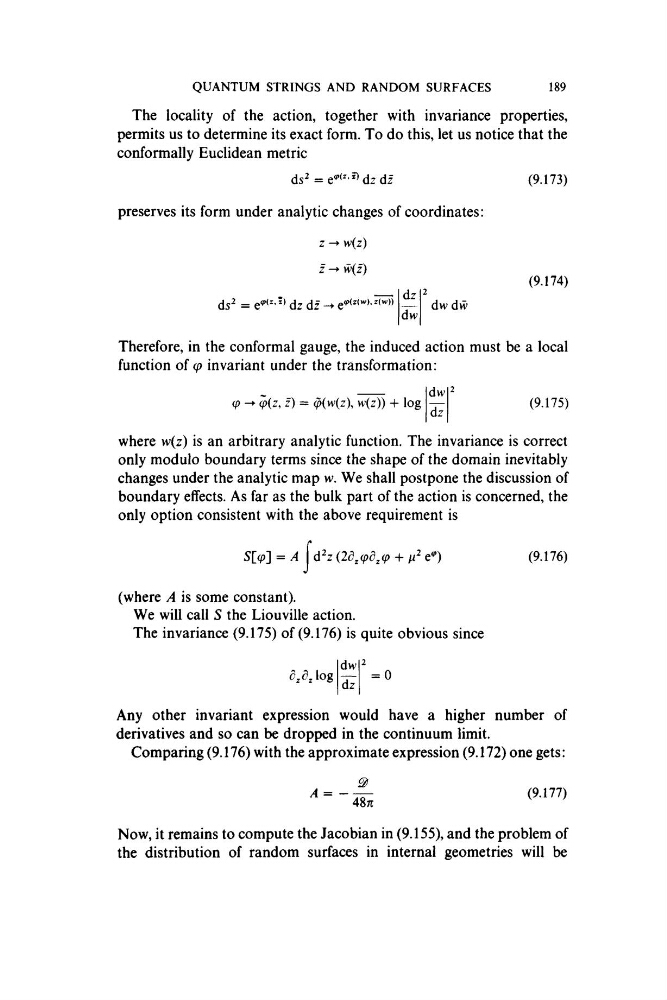
The locality of the action, together with invariance properties,
permits us to determine its exact form. To do this, let us notice that the
conformally Euclidean metric
dz dz
(9.173)
preserves its form under analytic changes of coordinates:
z -► w(z)
z -► w(z)
dz
(9.174)
(1^2 ^
g
dw dw
Therefore, in the conformal gauge, the induced action must be a local
function of cp invariant under the transformation:
(p -► cp{z, z) = 0{w{z\ w(z)) + log
dw
dz
(9.175)
where w(z) is an arbitrary analytic function. The invariance is correct
only modulo boundary terms since the shape of the domain inevitably
changes under the analytic map w. We shall postpone the discussion of
boundary effects. As far as the bulk part of the action is concerned, the
only option consistent with the above requirement is
S[(p] = A d^z {Id^cpd^cp -(- e*^)
(9.176)
(where A is some constant).
We will call S the Liouville action.
The invariance (9.175) of (9.176) is quite obvious since
d,d,lo g
= 0
Any other invariant expression would have a higher number of
derivatives and so can be dropped in the continuum limit.
Comparing (9.176) with the approximate expression (9.172) one gets:
A = -
9
4 ^
(9.177)
Now, it remains to compute the Jacobian in (9.155), and the problem of
the distribution of random surfaces in internal geometries will be
189
The locality of the action, together with invariance properties,
permits us to determine its exact form. To do this, let us notice that the
conformally Euclidean metric
dz dz
(9.173)
preserves its form under analytic changes of coordinates:
z -► w(z)
z -► w(z)
dz
(9.174)
(1^2 ^
g
dw dw
Therefore, in the conformal gauge, the induced action must be a local
function of cp invariant under the transformation:
(p -► cp{z, z) = 0{w{z\ w(z)) + log
dw
dz
(9.175)
where w(z) is an arbitrary analytic function. The invariance is correct
only modulo boundary terms since the shape of the domain inevitably
changes under the analytic map w. We shall postpone the discussion of
boundary effects. As far as the bulk part of the action is concerned, the
only option consistent with the above requirement is
S[(p] = A d^z {Id^cpd^cp -(- e*^)
(9.176)
(where A is some constant).
We will call S the Liouville action.
The invariance (9.175) of (9.176) is quite obvious since
d,d,lo g
= 0
Any other invariant expression would have a higher number of
derivatives and so can be dropped in the continuum limit.
Comparing (9.176) with the approximate expression (9.172) one gets:
A = -
9
4 ^
(9.177)
Now, it remains to compute the Jacobian in (9.155), and the problem of
the distribution of random surfaces in internal geometries will be