

188
GAUGE FIELDS AND STRINGS
the condition that the induced action is generally covariant. The
(9.167)
transformation law for
is:
^ab ^ab + ^a^b + ^b^a
which in the linearized approximation takes the form:
-►/!++ + 2q^w^(q)
/i__ ~^h__ 2q _ C O _(q)
/i+_ -►/!+_ + q^co_(q) + q-(o^{q)
(9.168)
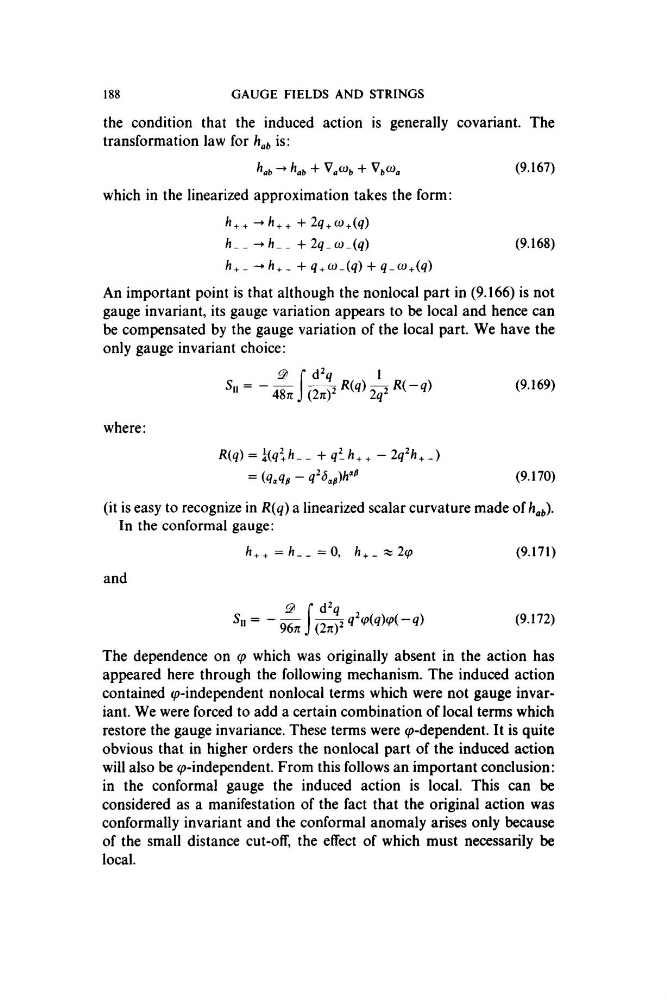
An important point is that although the nonlocal part in (9.166) is not
gauge invariant, its gauge variation appears to be local and hence can
be compensated by the gauge variation of the local part. We have the
only gauge invariant choice:
d^q
9
{2nY
2q^
(9.169)
where:
^( - 2q^h^_)
(9.170)
(it is easy to recognize in R{q) a linearized scalar curvature made of /i^^,).
In the conformal gauge:
/i++=/i__=0, h^_ ^ 2(p
and
d^q
(2nY
q^(p(q)(p(-q)
(9.171)
(9.172)
The dependence on cp which was originally absent in the action has
appeared here through the following mechanism. The induced action
contained (^-independent nonlocal terms which were not gauge invariant. We were forced to add a certain combination of local terms which
restore the gauge invariance. These terms were (^-dependent. It is quite
obvious that in higher orders the nonlocal part of the induced action
will also be cp-independent. From this follows an important conclusion:
in the conformal gauge the induced action is local. This can be
considered as a manifestation of the fact that the original action was
conformally invariant and the conformal anomaly arises only because
of the small distance cut-off, the effect of which must necessarily be
local.
GAUGE FIELDS AND STRINGS
the condition that the induced action is generally covariant. The
(9.167)
transformation law for
is:
^ab ^ab + ^a^b + ^b^a
which in the linearized approximation takes the form:
-►/!++ + 2q^w^(q)
/i__ ~^h__ 2q _ C O _(q)
/i+_ -►/!+_ + q^co_(q) + q-(o^{q)
(9.168)
An important point is that although the nonlocal part in (9.166) is not
gauge invariant, its gauge variation appears to be local and hence can
be compensated by the gauge variation of the local part. We have the
only gauge invariant choice:
d^q
9
{2nY
2q^
(9.169)
where:
^( - 2q^h^_)
(9.170)
(it is easy to recognize in R{q) a linearized scalar curvature made of /i^^,).
In the conformal gauge:
/i++=/i__=0, h^_ ^ 2(p
and
d^q
(2nY
q^(p(q)(p(-q)
(9.171)
(9.172)
The dependence on cp which was originally absent in the action has
appeared here through the following mechanism. The induced action
contained (^-independent nonlocal terms which were not gauge invariant. We were forced to add a certain combination of local terms which
restore the gauge invariance. These terms were (^-dependent. It is quite
obvious that in higher orders the nonlocal part of the induced action
will also be cp-independent. From this follows an important conclusion:
in the conformal gauge the induced action is local. This can be
considered as a manifestation of the fact that the original action was
conformally invariant and the conformal anomaly arises only because
of the small distance cut-off, the effect of which must necessarily be
local.