

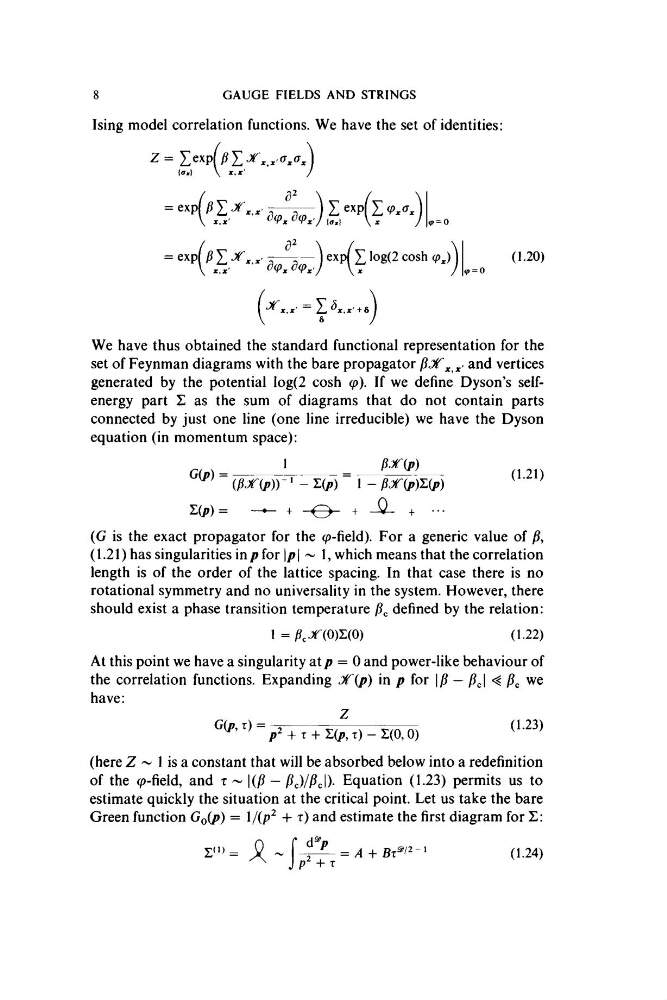
Ising model correlation functions. We have the set of identities:
{
X,X'
8
GAUGE FIELDS AND STRINGS
= exp(pY.'^x.xdcpx d(p,.J
< / ) = 0
dip, dip.
I exp X
exp( Y, log(2 cosh q>^)
( 1.20)
•^x,x'= px.x'
We have thus obtained the standard functional representation for the
set of Feynman diagrams with the bare propagator
vertices
generated by the potential log(2 cosh cp). If we define Dyson’s selfenergy part Z as the sum of diagrams that do not contain parts
connected by just one line (one line irreducible) we have the Dyson
equation (in momentum space):
G(p) = -
1
P^ip)
iPJfip))-' - Tip)
1 - pjf{p)T{p)
2(p)=
- ^ +
+ - ^ + •••
( 1.21)
(G is the exact propagator for the (p-fidd). For a generic value of
(1.21) has singularities inp for \p\ ^ 1, which means that the correlation
length is of the order of the lattice spacing. In that case there is no
rotational symmetry and no universality in the system. However, there
should exist a phase transition temperature defined by the relation:
1 = jr(0)i(0)
( 1.22)
At this point we have a singularity at p = 0 and power-like behaviour of
the correlation functions. Expanding Jt(p) in p (or \p — PJ p^ we
have:
G(p, t) = p + r Tip, i) - 1 (0, 0)
(here Z ^ 1 is a constant that will be absorbed below into a redefinition
of the (p-field, and t ^ \iP — PcVPcW Equation (1.23) permits us to
estimate quickly the situation at the critical point. Let us take the bare
Green function Go(/>) = l/(p^ + t) and estimate the first diagram for Z:
r ( i ) -
d®/>
+ T
= A +
(1.24)
{
X,X'
8
GAUGE FIELDS AND STRINGS
= exp(pY.'^x.xdcpx d(p,.J
< / ) = 0
dip, dip.
I exp X
exp( Y, log(2 cosh q>^)
( 1.20)
•^x,x'= px.x'
We have thus obtained the standard functional representation for the
set of Feynman diagrams with the bare propagator
vertices
generated by the potential log(2 cosh cp). If we define Dyson’s selfenergy part Z as the sum of diagrams that do not contain parts
connected by just one line (one line irreducible) we have the Dyson
equation (in momentum space):
G(p) = -
1
P^ip)
iPJfip))-' - Tip)
1 - pjf{p)T{p)
2(p)=
- ^ +
+ - ^ + •••
( 1.21)
(G is the exact propagator for the (p-fidd). For a generic value of
(1.21) has singularities inp for \p\ ^ 1, which means that the correlation
length is of the order of the lattice spacing. In that case there is no
rotational symmetry and no universality in the system. However, there
should exist a phase transition temperature defined by the relation:
1 = jr(0)i(0)
( 1.22)
At this point we have a singularity at p = 0 and power-like behaviour of
the correlation functions. Expanding Jt(p) in p (or \p — PJ p^ we
have:
G(p, t) = p + r Tip, i) - 1 (0, 0)
(here Z ^ 1 is a constant that will be absorbed below into a redefinition
of the (p-field, and t ^ \iP — PcVPcW Equation (1.23) permits us to
estimate quickly the situation at the critical point. Let us take the bare
Green function Go(/>) = l/(p^ + t) and estimate the first diagram for Z:
r ( i ) -
d®/>
+ T
= A +
(1.24)