

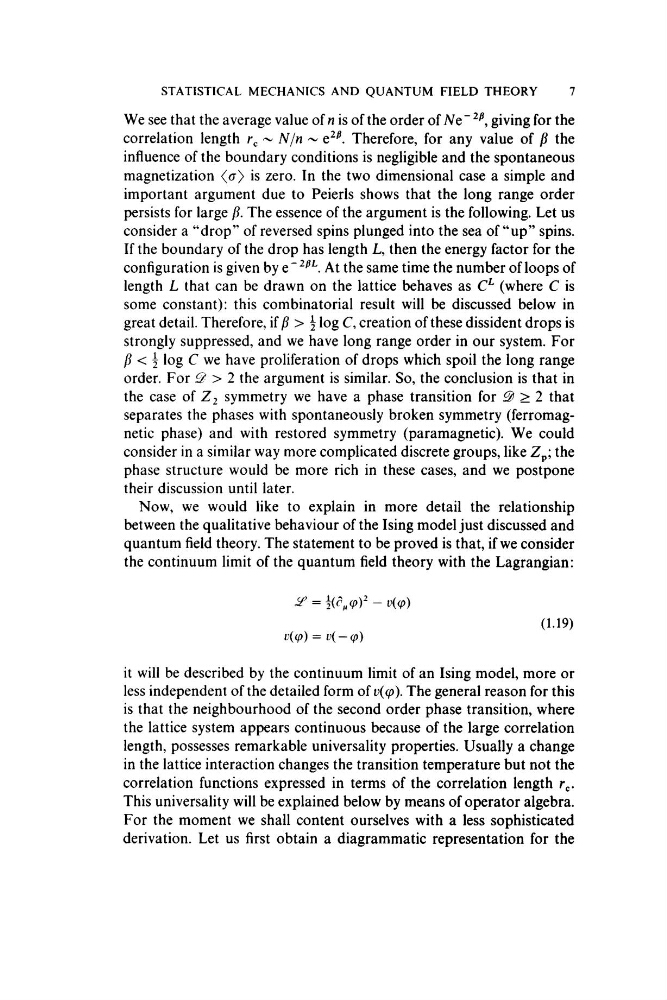
We see that the average value of n is of the order of
giving for the
correlation length ^ N/n ^ e^^. Therefore, for any value of jS the
influence of the boundary conditions is negligible and the spontaneous
magnetization <ìt> is zero. In the two dimensional case a simple and
important argument due to Peierls shows that the long range order
persists for large jS. The essence of the argument is the following. Let us
consider a “drop” of reversed spins plunged into the sea of “up” spins.
If the boundary of the drop has length L, then the energy factor for the
configuration is given by
At the same time the number of loops of
length L that can be drawn on the lattice behaves as
(where C is
some constant): this combinatorial result will be discussed below in
great detail. Therefore, if jS > | log C, creation of these dissident drops is
strongly suppressed, and we have long range order in our system. For
log C we have proliferation of drops which spoil the long range
order. For ^ > 2 the argument is similar. So, the conclusion is that in
the case of Z 2 symmetry we have a phase transition for ^ > 2 that
separates the phases with spontaneously broken symmetry (ferromagnetic phase) and with restored symmetry (paramagnetic). We could
consider in a similar way more complicated discrete groups, like
the
phase structure would be more rich in these cases, and we postpone
their discussion until later.
Now, we would like to explain in more detail the relationship
between the qualitative behaviour of the Ising model just discussed and
quantum field theory. The statement to be proved is that, if we consider
the continuum limit of the quantum field theory with the Lagrangian:
STATISTICAL MECHANICS AND QUANTUM FIELD THEORY
7
^
- v{(p)
v(cp) = v {-(p )
(1.19)
it will be described by the continuum limit of an Ising model, more or
less independent of the detailed form of v((p). The general reason for this
is that the neighbourhood of the second order phase transition, where
the lattice system appears continuous because of the large correlation
length, possesses remarkable universality properties. Usually a change
in the lattice interaction changes the transition temperature but not the
correlation functions expressed in terms of the correlation length
This universality will be explained below by means of operator algebra.
For the moment we shall content ourselves with a less sophisticated
derivation. Let us first obtain a diagrammatic representation for the
giving for the
correlation length ^ N/n ^ e^^. Therefore, for any value of jS the
influence of the boundary conditions is negligible and the spontaneous
magnetization <ìt> is zero. In the two dimensional case a simple and
important argument due to Peierls shows that the long range order
persists for large jS. The essence of the argument is the following. Let us
consider a “drop” of reversed spins plunged into the sea of “up” spins.
If the boundary of the drop has length L, then the energy factor for the
configuration is given by
At the same time the number of loops of
length L that can be drawn on the lattice behaves as
(where C is
some constant): this combinatorial result will be discussed below in
great detail. Therefore, if jS > | log C, creation of these dissident drops is
strongly suppressed, and we have long range order in our system. For
log C we have proliferation of drops which spoil the long range
order. For ^ > 2 the argument is similar. So, the conclusion is that in
the case of Z 2 symmetry we have a phase transition for ^ > 2 that
separates the phases with spontaneously broken symmetry (ferromagnetic phase) and with restored symmetry (paramagnetic). We could
consider in a similar way more complicated discrete groups, like
the
phase structure would be more rich in these cases, and we postpone
their discussion until later.
Now, we would like to explain in more detail the relationship
between the qualitative behaviour of the Ising model just discussed and
quantum field theory. The statement to be proved is that, if we consider
the continuum limit of the quantum field theory with the Lagrangian:
STATISTICAL MECHANICS AND QUANTUM FIELD THEORY
7
^
- v{(p)
v(cp) = v {-(p )
(1.19)
it will be described by the continuum limit of an Ising model, more or
less independent of the detailed form of v((p). The general reason for this
is that the neighbourhood of the second order phase transition, where
the lattice system appears continuous because of the large correlation
length, possesses remarkable universality properties. Usually a change
in the lattice interaction changes the transition temperature but not the
correlation functions expressed in terms of the correlation length
This universality will be explained below by means of operator algebra.
For the moment we shall content ourselves with a less sophisticated
derivation. Let us first obtain a diagrammatic representation for the