

QUANTUM STRINGS AND RANDOM SURFACES
w here w e h a v e u sed th e sta n d a rd rep resen ta tio n :
169
1
AB
dx
( ^ x -I- B(1 — x))^
The derivation we have given serves as a check that all normalizations, measures etc. in the path integrals were correctly chosen because
at the end it produced the standard answer for the amplitude (9.69). In
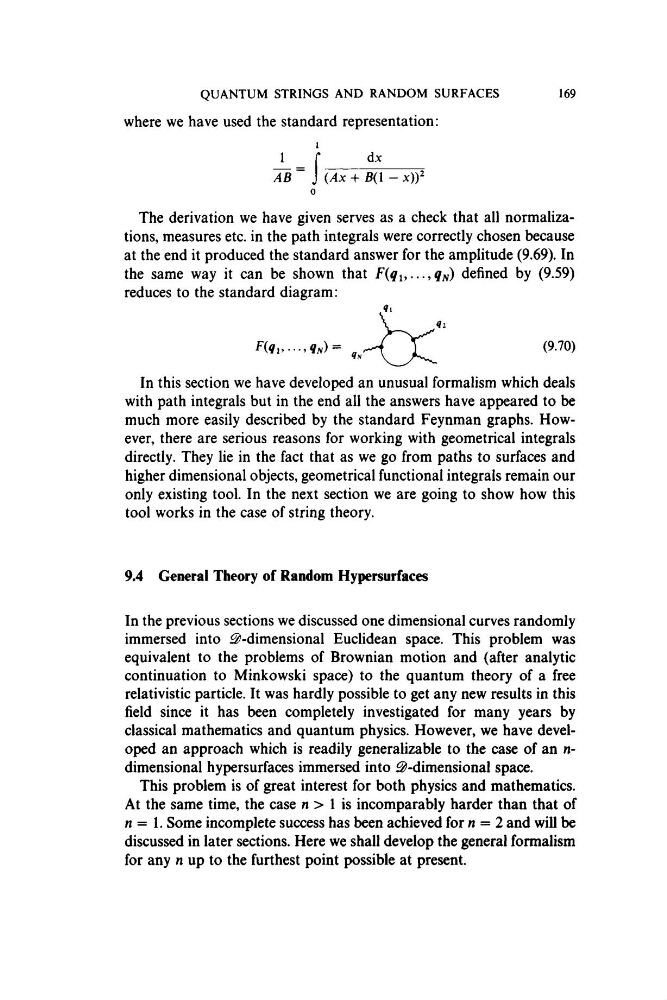
the same way it can be shown that
defined by (9.59)
reduces to the standard diagram:
. . - b e "
(9.70)
In this section we have developed an unusual formalism which deals
with path integrals but in the end all the answers have appeared to be
much more easily described by the standard Feynman graphs. However, there are serious reasons for working with geometrical integrals
directly. They lie in the fact that as we go from paths to surfaces and
higher dimensional objects, geometrical functional integrals remain our
only existing tool. In the next section we are going to show how this
tool works in the case of string theory.
9.4 General Theory of Random Hypersurfaces
In the previous sections we discussed one dimensional curves randomly
immersed into ^-dimensional Euclidean space. This problem was
equivalent to the problems of Brownian motion and (after analytic
continuation to Minkowski space) to the quantum theory of a free
relativistic particle. It was hardly possible to get any new results in this
field since it has been completely investigated for many years by
classical mathematics and quantum physics. However, we have developed an approach which is readily generalizable to the case of an ndimensional hypersurfaces immersed into ^-dimensional space.
This problem is of great interest for both physics and mathematics.
At the same time, the case n > 1 is incomparably harder than that of
n = 1. Some incomplete success has been achieved for n = 2 and will be
discussed in later sections. Here we shall develop the general formalism
for any n up to the furthest point possible at present.
w here w e h a v e u sed th e sta n d a rd rep resen ta tio n :
169
1
AB
dx
( ^ x -I- B(1 — x))^
The derivation we have given serves as a check that all normalizations, measures etc. in the path integrals were correctly chosen because
at the end it produced the standard answer for the amplitude (9.69). In
the same way it can be shown that
defined by (9.59)
reduces to the standard diagram:
. . - b e "
(9.70)
In this section we have developed an unusual formalism which deals
with path integrals but in the end all the answers have appeared to be
much more easily described by the standard Feynman graphs. However, there are serious reasons for working with geometrical integrals
directly. They lie in the fact that as we go from paths to surfaces and
higher dimensional objects, geometrical functional integrals remain our
only existing tool. In the next section we are going to show how this
tool works in the case of string theory.
9.4 General Theory of Random Hypersurfaces
In the previous sections we discussed one dimensional curves randomly
immersed into ^-dimensional Euclidean space. This problem was
equivalent to the problems of Brownian motion and (after analytic
continuation to Minkowski space) to the quantum theory of a free
relativistic particle. It was hardly possible to get any new results in this
field since it has been completely investigated for many years by
classical mathematics and quantum physics. However, we have developed an approach which is readily generalizable to the case of an ndimensional hypersurfaces immersed into ^-dimensional space.
This problem is of great interest for both physics and mathematics.
At the same time, the case n > 1 is incomparably harder than that of
n = 1. Some incomplete success has been achieved for n = 2 and will be
discussed in later sections. Here we shall develop the general formalism
for any n up to the furthest point possible at present.