

168
GAUGE FIELDS AND STRINGS
In order to elucidate its meaning, we shall consider the case of the two
point function with
= —9i = 9- Let us compute, first of all, the
^-function. We have:
_ exp(i^yl„(t — t'))
4 n ^ n ^
^ (T |0 = Z
= T2
-df^{T\x') = SÌT - t' ) - \/T
(9.66)
(where the second terms in the r.h.s. follows from the constraint n # 0 in
the definition of the ^-function). Since the ^-function on a circle
depends on s = |i — t'| we can trivially solve (9.66), finding the result:
5 ( 7 - 5)
^ (t|t') = ----- ------- 1 - const, for 0 < 5 < 7
(9.67)
27
Therefore:
m =
r d 7
^
^
r
Y ~ ^12 Q -m ^T/2 dr
J 7
Q-q^siT-s)l2T
0
0
T
dT
Q-rn^TU ds Q -
=H
0
0
1
~^/2 Q-m^TI2 Q-q^x(l -x)T/2
dx
+ q^x{{ -x )]
(9.68)
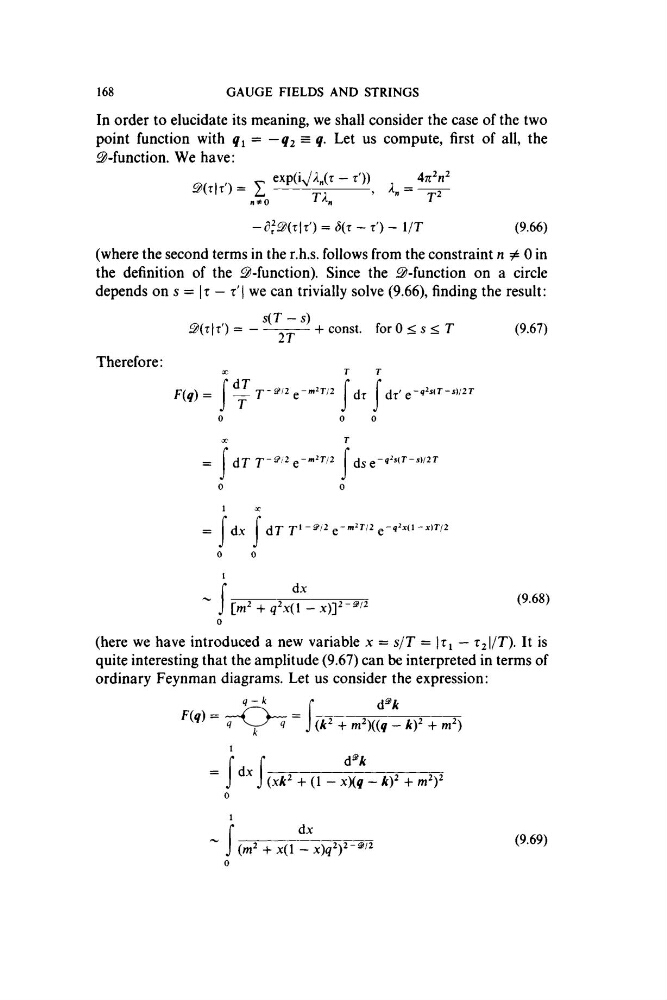
(here we have introduced a new variable x = s/T = |ti — T2 I/L). It is
quite interesting that the amplitude (9.67) can be interpreted in terms of
ordinary Feynman diagrams. Let us consider the expression:
F(q) =
q - k
d^k
dx
H - m^){{q - kY m^)
d^k
{xk^ -H (1 - x)(q - ky -h m^y
dx
(m^ -f x(l - x)q^y
(9.69)
GAUGE FIELDS AND STRINGS
In order to elucidate its meaning, we shall consider the case of the two
point function with
= —9i = 9- Let us compute, first of all, the
^-function. We have:
_ exp(i^yl„(t — t'))
4 n ^ n ^
^ (T |0 = Z
= T2
-df^{T\x') = SÌT - t' ) - \/T
(9.66)
(where the second terms in the r.h.s. follows from the constraint n # 0 in
the definition of the ^-function). Since the ^-function on a circle
depends on s = |i — t'| we can trivially solve (9.66), finding the result:
5 ( 7 - 5)
^ (t|t') = ----- ------- 1 - const, for 0 < 5 < 7
(9.67)
27
Therefore:
m =
r d 7
^
^
r
Y ~ ^12 Q -m ^T/2 dr
J 7
Q-q^siT-s)l2T
0
0
T
dT
Q-rn^TU ds Q -
=H
0
0
1
~^/2 Q-m^TI2 Q-q^x(l -x)T/2
dx
+ q^x{{ -x )]
(9.68)
(here we have introduced a new variable x = s/T = |ti — T2 I/L). It is
quite interesting that the amplitude (9.67) can be interpreted in terms of
ordinary Feynman diagrams. Let us consider the expression:
F(q) =
q - k
d^k
dx
H - m^){{q - kY m^)
d^k
{xk^ -H (1 - x)(q - ky -h m^y
dx
(m^ -f x(l - x)q^y
(9.69)