

QUANTUM STRINGS AND RANDOM SURFACES
159
Here d>(f) = dw/d/, and the relation w(l) = (u(0) = 0 has been used
(which follows from the conditions /( I ) = 1 and /(O) = 0).
As the next step let us determine the measure and the metric in the
space of diffeomorphisms. Just as in the case of ordinary groups
there is only one metric invariant under left and right multiplication
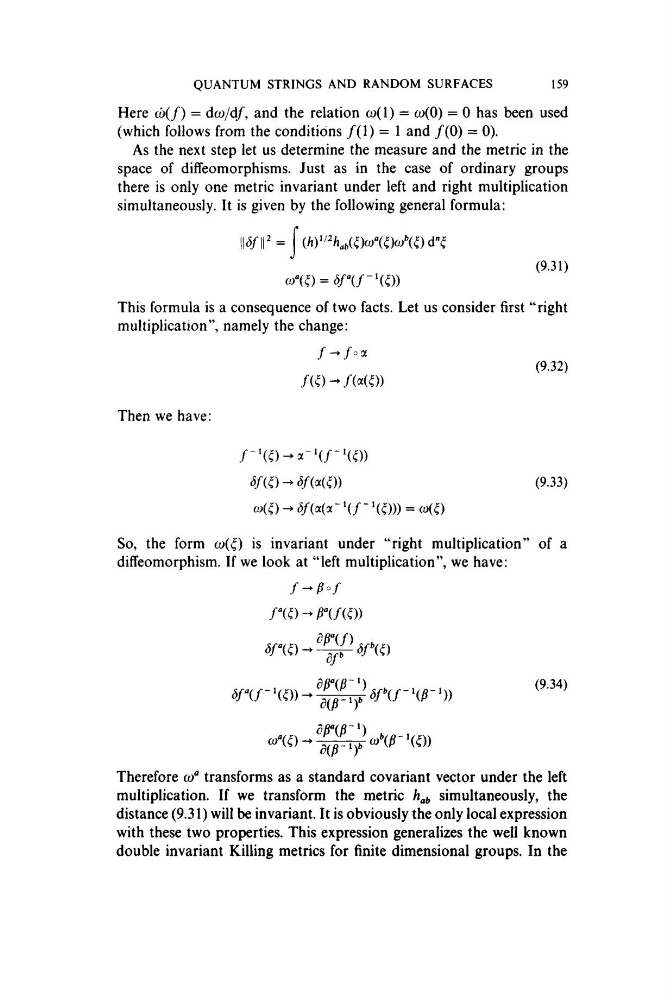
simultaneously. It is given by the following general formula:
«“(0 = W
‘(0)
(9.31)
This formula is a consequence of two facts. Let us consider first “right
multiplication”, namely the change:
/ ( 0 - / ( a ( 0 )
(9.32)
Then we have:
/ - ‘( 0 - a " ‘( / ‘ ‘(i))
d m ^ s m o )
« ( 0 - ¿ /( a (a " ‘( / ‘ ‘(0)) = o)(0
(9.33)
So, the form a>(^) is invariant under “right multiplication” of a
diffeomorphism. If we look at “left multiplication”, we have:
Sp’if) .
W i O ) -
co%0W )
■ d ir ^ f
d n r ' )
(9.34)
Therefore co“ transforms as a standard covariant vector under the left
multiplication. If we transform the metric
simultaneously, the
distance (9.31) will be invariant. It is obviously the only local expression
with these two properties. This expression generalizes the well known
double invariant Killing metrics for finite dimensional groups. In the
159
Here d>(f) = dw/d/, and the relation w(l) = (u(0) = 0 has been used
(which follows from the conditions /( I ) = 1 and /(O) = 0).
As the next step let us determine the measure and the metric in the
space of diffeomorphisms. Just as in the case of ordinary groups
there is only one metric invariant under left and right multiplication
simultaneously. It is given by the following general formula:
«“(0 = W
‘(0)
(9.31)
This formula is a consequence of two facts. Let us consider first “right
multiplication”, namely the change:
/ ( 0 - / ( a ( 0 )
(9.32)
Then we have:
/ - ‘( 0 - a " ‘( / ‘ ‘(i))
d m ^ s m o )
« ( 0 - ¿ /( a (a " ‘( / ‘ ‘(0)) = o)(0
(9.33)
So, the form a>(^) is invariant under “right multiplication” of a
diffeomorphism. If we look at “left multiplication”, we have:
Sp’if) .
W i O ) -
co%0W )
■ d ir ^ f
d n r ' )
(9.34)
Therefore co“ transforms as a standard covariant vector under the left
multiplication. If we transform the metric
simultaneously, the
distance (9.31) will be invariant. It is obviously the only local expression
with these two properties. This expression generalizes the well known
double invariant Killing metrics for finite dimensional groups. In the