

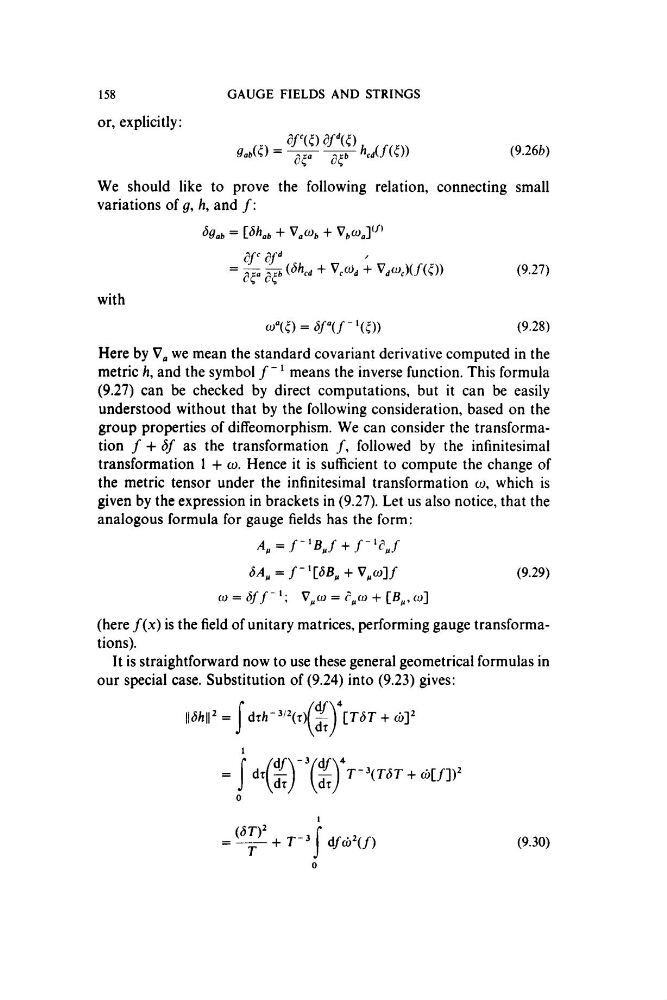
or, explicitly:
158
GAUGE FIELDS AND STRINGS
,,, d r n )d m ), ,,, ,, ,
dabiO =
KdifiO)
{9.26b)
We should like to prove the following relation, connecting small
variations of g, h, and / :
with
co^{i) = s r { f- \o )
(9.27)
(9.28)
Here by we mean the standard covariant derivative computed in the
metric /i, and the symbol / “ ^ means the inverse function. This formula
(9.27) can be checked by direct computations, but it can be easily
understood without that by the following consideration, based on the
group properties of diffeomorphism. We can consider the transformation / + ¿/ as the transformation / , followed by the infinitesimal
transformation 1 + co. Hence it is suificient to compute the change of
the metric tensor under the infinitesimal transformation co, which is
given by the expression in brackets in (9.27). Let us also notice, that the
analogous formula for gauge fields has the form:
CO =
V ^ c o = c ^ c o +
(9.29)
(here / (x) is the field of unitary matrices, performing gauge transformations).
It is straightforward now to use these general geometrical formulas in
our special case. Substitution of (9.24) into (9.23) gives:
\\Shf =
[TST + w f
dtl
r-^(T ó r + c¿[/])"
dt J
(ST)^
+ T1
'Í
(9.30)
158
GAUGE FIELDS AND STRINGS
,,, d r n )d m ), ,,, ,, ,
dabiO =
KdifiO)
{9.26b)
We should like to prove the following relation, connecting small
variations of g, h, and / :
with
co^{i) = s r { f- \o )
(9.27)
(9.28)
Here by we mean the standard covariant derivative computed in the
metric /i, and the symbol / “ ^ means the inverse function. This formula
(9.27) can be checked by direct computations, but it can be easily
understood without that by the following consideration, based on the
group properties of diffeomorphism. We can consider the transformation / + ¿/ as the transformation / , followed by the infinitesimal
transformation 1 + co. Hence it is suificient to compute the change of
the metric tensor under the infinitesimal transformation co, which is
given by the expression in brackets in (9.27). Let us also notice, that the
analogous formula for gauge fields has the form:
CO =
V ^ c o = c ^ c o +
(9.29)
(here / (x) is the field of unitary matrices, performing gauge transformations).
It is straightforward now to use these general geometrical formulas in
our special case. Substitution of (9.24) into (9.23) gives:
\\Shf =
[TST + w f
dtl
r-^(T ó r + c¿[/])"
dt J
(ST)^
+ T1
'Í
(9.30)