

QUANTUM STRINGS AND RANDOM SURFACES
155
final answer could have been foreseen without this computation. We
have:
^x(t) exp
x{T) = x'
x(0) = x
I
- ja(t)x^(t)j
Tit
dx, exp
Tit
-z«,
(Xj +1 Xj) ]
exp{i/»(jc - x')) n I
dp
{Inf
= const.[
a,
exp
(x' - x f
(9.16)
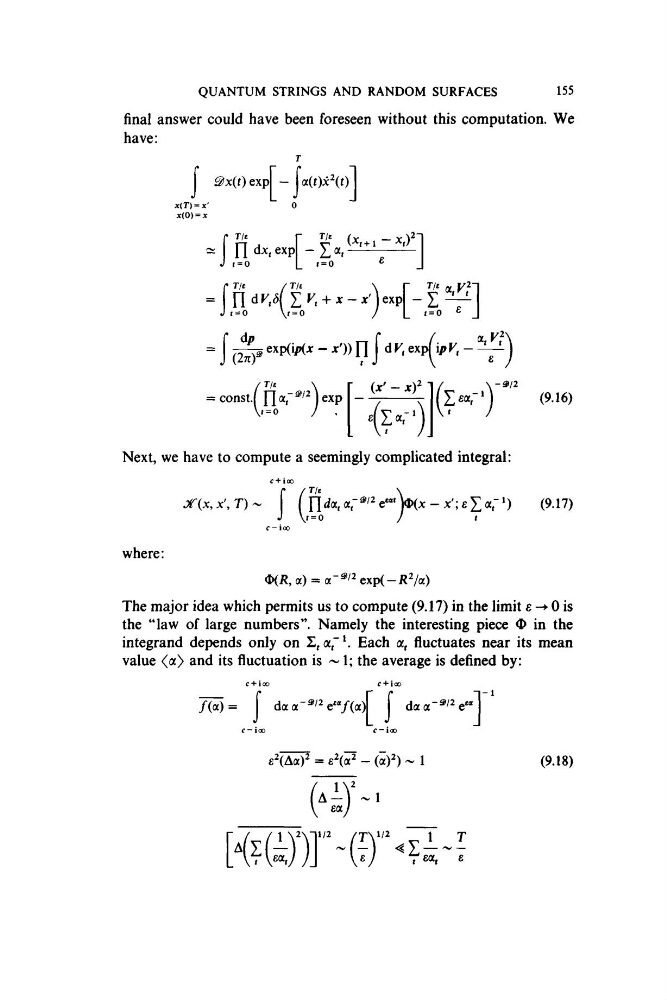
Next, we have to compute a seemingly complicated integral:
c + ioo
Jf(x,x’,T)~ j
(9.17)
c - ioo
where:
^ ex p (-R V a )
The major idea which permits us to compute (9.17) in the limit e -► 0 is
the “law of large numbers”. Namely the interesting piece O in the
integrand depends only on 2 ,« " ^ Each a, fluctuates near its mean
value and its fluctuation is ^ 1; the average is defined by:
c + ioo
c + ioo
/ ( a ) = J* da
e**/(oi)j^ J daa"®^^e*“J
£^(Aar = e^(a^ — (a)^) 1
(9.18)
155
final answer could have been foreseen without this computation. We
have:
^x(t) exp
x{T) = x'
x(0) = x
I
- ja(t)x^(t)j
Tit
dx, exp
Tit
-z«,
(Xj +1 Xj) ]
exp{i/»(jc - x')) n I
dp
{Inf
= const.[
a,
exp
(x' - x f
(9.16)
Next, we have to compute a seemingly complicated integral:
c + ioo
Jf(x,x’,T)~ j
(9.17)
c - ioo
where:
The major idea which permits us to compute (9.17) in the limit e -► 0 is
the “law of large numbers”. Namely the interesting piece O in the
integrand depends only on 2 ,« " ^ Each a, fluctuates near its mean
value and its fluctuation is ^ 1; the average is defined by:
c + ioo
c + ioo
/ ( a ) = J* da
e**/(oi)j^ J daa"®^^e*“J
£^(Aar = e^(a^ — (a)^) 1
(9.18)