

QUANTUM STRINGS AND RANDOM SURFACES
153
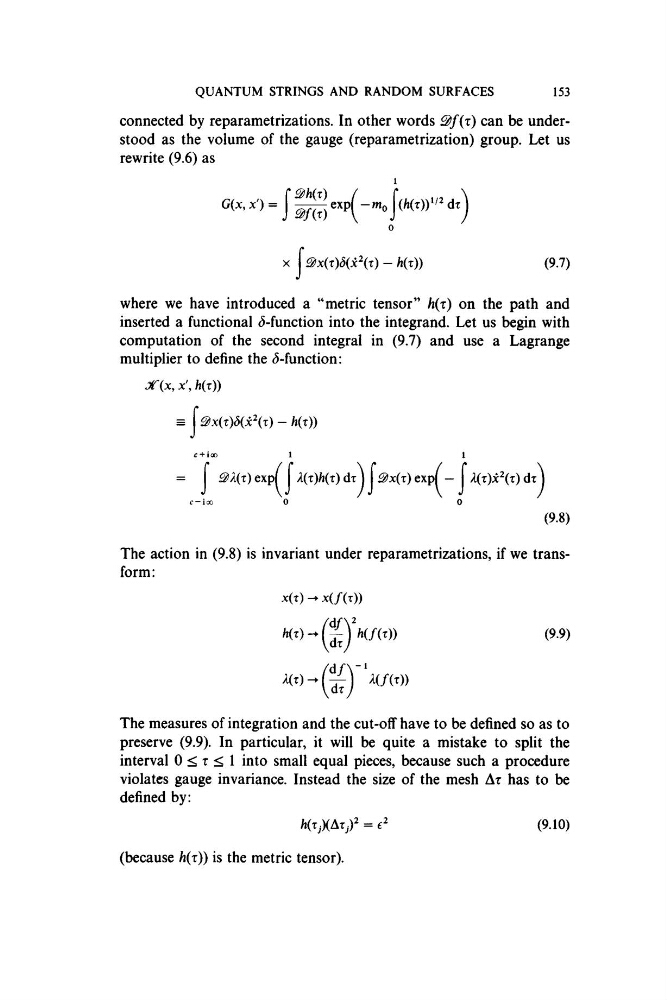
connected by reparametrizations. In other words ^ / ( t) can be understood as the volume of the gauge (reparametrization) group. Let us
rewrite (9.6) as
G(x, x') =
f ^h(x)
exp -m o
^/(t)
X J
— h(j))
{ K x ) y i ^ áx
(9.7)
where we have introduced a “metric tensor” h(x) on the path and
inserted a functional ¿-function into the integrand. Let us begin with
computation of the second integral in (9.7) and use a Lagrange
multiplier to define the ¿-function:
j T ( x , x ', h(x))
Í
=
^ x ( t) ¿ ( x ^(t) — h{x))
^A(t) expl
À(x)h{x) dx
^x(T)exp( — A(t) x ^(t) d i
(9.8)
The action in (9.8) is invariant under reparametrizations, if we transform:
X ( T ) ^ X ( / ( T ) )
(9.9)
The measures of integration and the cut-off have to be defined so as to
preserve (9.9). In particular, it will be quite a mistake to split the
interval 0 < t < 1 into small equal pieces, because such a procedure
violates gauge invariance. Instead the size of the mesh At has to be
defined by:
h(Xj)(Axj) ,2 _ ^2
(9.10)
(because h(x)) is the metric tensor).
153
connected by reparametrizations. In other words ^ / ( t) can be understood as the volume of the gauge (reparametrization) group. Let us
rewrite (9.6) as
G(x, x') =
f ^h(x)
exp -m o
^/(t)
X J
— h(j))
{ K x ) y i ^ áx
(9.7)
where we have introduced a “metric tensor” h(x) on the path and
inserted a functional ¿-function into the integrand. Let us begin with
computation of the second integral in (9.7) and use a Lagrange
multiplier to define the ¿-function:
j T ( x , x ', h(x))
Í
=
^ x ( t) ¿ ( x ^(t) — h{x))
^A(t) expl
À(x)h{x) dx
^x(T)exp( — A(t) x ^(t) d i
(9.8)
The action in (9.8) is invariant under reparametrizations, if we transform:
X ( T ) ^ X ( / ( T ) )
(9.9)
The measures of integration and the cut-off have to be defined so as to
preserve (9.9). In particular, it will be quite a mistake to split the
interval 0 < t < 1 into small equal pieces, because such a procedure
violates gauge invariance. Instead the size of the mesh At has to be
defined by:
h(Xj)(Axj) ,2 _ ^2
(9.10)
(because h(x)) is the metric tensor).