

138
GAUGE FIELDS AND STRINGS
This is an important observation. It means that in the large N limit the
field g(x) is some complicated but almost local function of some free
field, and that in fact we are dealing with a disguised free theory. If we
were able to introduce this function explicitly, the perturbation theory
in 1/N might become tractable.
This task has not been solved yet, although an exact solution of the
SL/(iV)-chiral field exists. The best we can do at the moment is to
present some steps leading, so it seems, in the right direction. As the
trouble was identified as the large number of integration variables, let
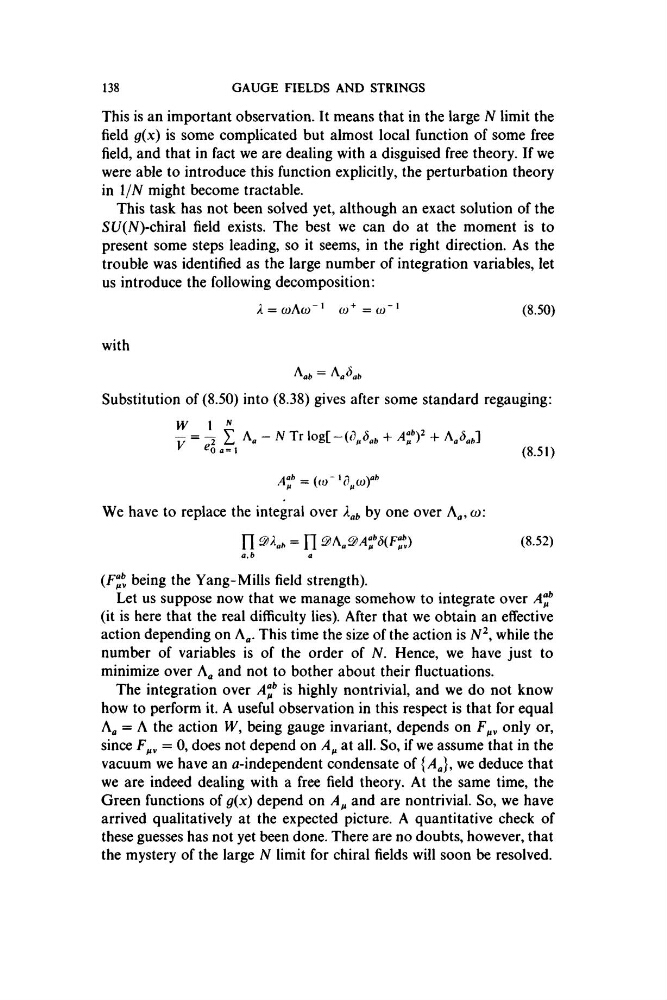
us introduce the following decomposition:
(8.50)
with
Aflb — ^a^ah
Substitution of (8.50) into (8.38) gives after some standard regauging:
(8.51)
W 1 ^
17 = ^ Z A, - N Tr \ogl-(c\S^, + A fY +
^
^0 a = 1
Af = (io-\\wY^
We have to replace the integral over
by one over A^, co:
n
= n
(8.52)
a ,h
a
(T"y being the Yang-Mills field strength).
Let us suppose now that we manage somehow to integrate over
(it is here that the real difficulty lies). After that we obtain an effective
action depending on A^. This time the size of the action is
while the
number of variables is of the order of N. Hence, we have just to
minimize over A„ and not to bother about their fluctuations.
The integration over
is highly nontrivial, and we do not know
how to perform it. A useful observation in this respect is that for equal
A^ = A the action W, being gauge invariant, depends on
only or,
since
= 0, does not depend on
at all. So, if we assume that in the
vacuum we have an «-independent condensate of {A^}, we deduce that
we are indeed dealing with a free field theory. At the same time, the
Green functions of g(x) depend on A ^ and are nontrivial. So, we have
arrived qualitatively at the expected picture. A quantitative check of
these guesses has not yet been done. There are no doubts, however, that
the mystery of the large N limit for chiral fields will soon be resolved.
GAUGE FIELDS AND STRINGS
This is an important observation. It means that in the large N limit the
field g(x) is some complicated but almost local function of some free
field, and that in fact we are dealing with a disguised free theory. If we
were able to introduce this function explicitly, the perturbation theory
in 1/N might become tractable.
This task has not been solved yet, although an exact solution of the
SL/(iV)-chiral field exists. The best we can do at the moment is to
present some steps leading, so it seems, in the right direction. As the
trouble was identified as the large number of integration variables, let
us introduce the following decomposition:
(8.50)
with
Aflb — ^a^ah
Substitution of (8.50) into (8.38) gives after some standard regauging:
(8.51)
W 1 ^
17 = ^ Z A, - N Tr \ogl-(c\S^, + A fY +
^
^0 a = 1
Af = (io-\\wY^
We have to replace the integral over
by one over A^, co:
n
= n
(8.52)
a ,h
a
(T"y being the Yang-Mills field strength).
Let us suppose now that we manage somehow to integrate over
(it is here that the real difficulty lies). After that we obtain an effective
action depending on A^. This time the size of the action is
while the
number of variables is of the order of N. Hence, we have just to
minimize over A„ and not to bother about their fluctuations.
The integration over
is highly nontrivial, and we do not know
how to perform it. A useful observation in this respect is that for equal
A^ = A the action W, being gauge invariant, depends on
only or,
since
= 0, does not depend on
at all. So, if we assume that in the
vacuum we have an «-independent condensate of {A^}, we deduce that
we are indeed dealing with a free field theory. At the same time, the
Green functions of g(x) depend on A ^ and are nontrivial. So, we have
arrived qualitatively at the expected picture. A quantitative check of
these guesses has not yet been done. There are no doubts, however, that
the mystery of the large N limit for chiral fields will soon be resolved.