

112
GAUGE FIELDS AND STRINGS
»PiC) = P exp (i)
dx"
= P exp
ds >l/x(s))
dx'*(s)\
d5 )
(7.1)
= lim 0 ( 1 + ^^/xj)Axp
Axj^O j
= E
d5i ds. ds^
dx^(s„)
dx^
ds„
A^(x(s„)).. — A^(x(s,))
ds.
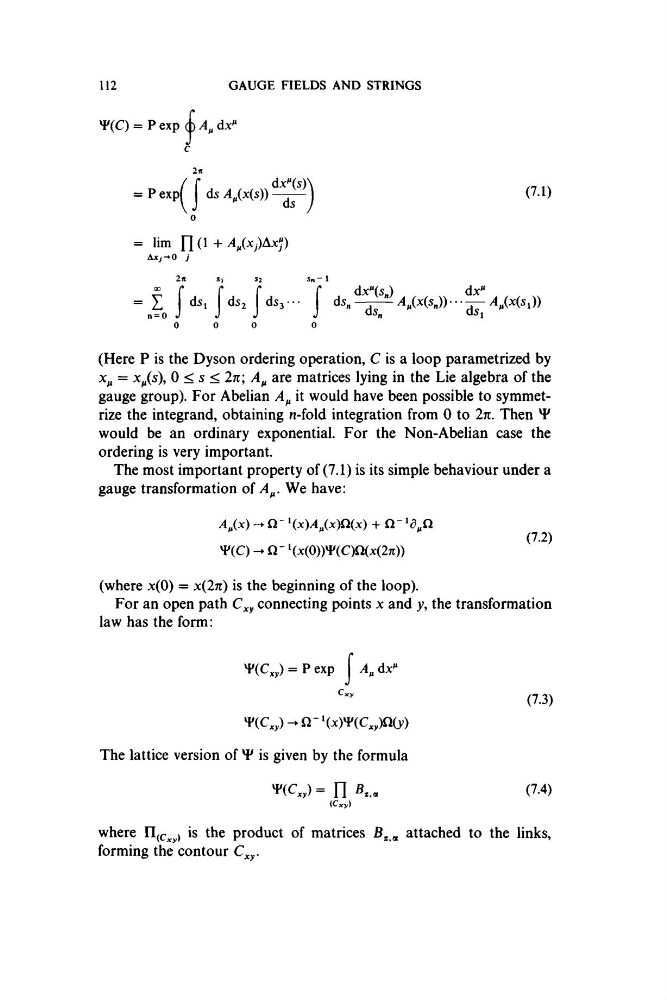
(Here P is the Dyson ordering operation, C is a loop parametrized by
0 < s < 2tc;
are matrices lying in the Lie algebra of the
gauge group). For Abelian A^ it would have been possible to symmetrize the integrand, obtaining n-fold integration from 0 to 2n. Then
would be an ordinary exponential. For the Non-Abelian case the
ordering is very important.
The most important property of (7.1) is its simple behaviour under a
gauge transformation of A^. We have:
A^(x) -+ Q \x)A^{x)Q{x) -f O
'P(C) - Q ' H^(0))'P(C)Q(x(27i))
(7.2)
(where x(0) = x(2t c ) is the beginning of the loop).
For an open path C^y connecting points x and y, the transformation
law has the form:
^ (C ,,) = P exp J ^.dx'^
Cxy
T(C,,)^Q-Hx)4>(C,,)Q(y)
The lattice version of 'F is given by the formula
T(c,,) = n K .
(C ,y )
(7.3)
(7.4)
where
is the product of matrices
, attached to the links,
forming the contour C .
GAUGE FIELDS AND STRINGS
»PiC) = P exp (i)
dx"
= P exp
ds >l/x(s))
dx'*(s)\
d5 )
(7.1)
= lim 0 ( 1 + ^^/xj)Axp
Axj^O j
= E
d5i ds. ds^
dx^(s„)
dx^
ds„
A^(x(s„)).. — A^(x(s,))
ds.
(Here P is the Dyson ordering operation, C is a loop parametrized by
0 < s < 2tc;
are matrices lying in the Lie algebra of the
gauge group). For Abelian A^ it would have been possible to symmetrize the integrand, obtaining n-fold integration from 0 to 2n. Then
would be an ordinary exponential. For the Non-Abelian case the
ordering is very important.
The most important property of (7.1) is its simple behaviour under a
gauge transformation of A^. We have:
A^(x) -+ Q \x)A^{x)Q{x) -f O
'P(C) - Q ' H^(0))'P(C)Q(x(27i))
(7.2)
(where x(0) = x(2t c ) is the beginning of the loop).
For an open path C^y connecting points x and y, the transformation
law has the form:
^ (C ,,) = P exp J ^.dx'^
Cxy
T(C,,)^Q-Hx)4>(C,,)Q(y)
The lattice version of 'F is given by the formula
T(c,,) = n K .
(C ,y )
(7.3)
(7.4)
where
is the product of matrices
, attached to the links,
forming the contour C .