

100
GAUGE FIELDS AND STRINGS
On a classical level, this action conserves an axial current:
dMy^y^^) = 0
(6.60)
However, if we consider the axial current which arises in the vacuum
when we apply the external field
then equation (6.60) will be untrue
because of the so-called quantum anomaly. Let us show how this comes
about. The partition function of fermions in the external field is given
by:
Z M =
-Í
exp{ —
d‘*x)
(6.61)
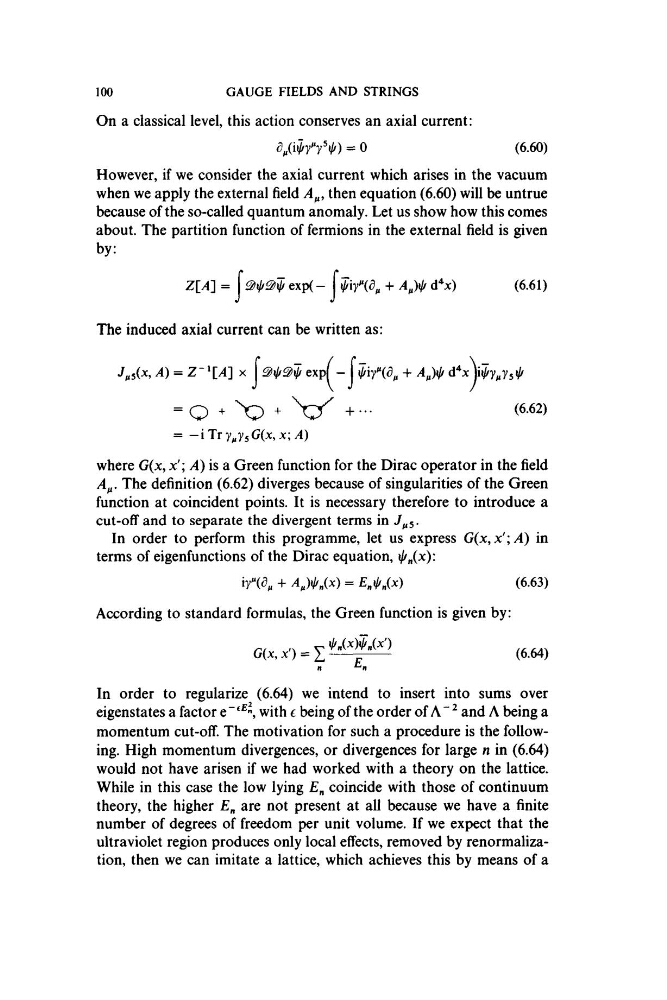
The induced axial current can be written as:
J ,5(x, A) = Z-'\_A-\ X
-Í
exp -
+ A^)>¡/
my^ysij/
x^ii
= Q +
+
= -iTry^y5G(x, XM)
(6.62)
where G(x, x'; A) is a Green function for the Dirac operator in the field
A^. The definition (6.62) diverges because of singularities of the Green
function at coincident points. It is necessary therefore to introduce a
cut-off and to separate the divergent terms in
In order to perform this programme, let us express G(x,x';A) in
terms of eigenfunctions of the Dirac equation, il/„{x):
iy^id^ + A^)il/„{x) =
(6.63)
According to standard formulas, the Green function is given by:
G(x, x') = X
(6.64)
In order to regularize (6.64) we intend to insert into sums over
eigenstates a factor
with e being of the order of
and A being a
momentum cut-off. The motivation for such a procedure is the following. High momentum divergences, or divergences for large n in (6.64)
would not have arisen if we had worked with a theory on the lattice.
While in this case the low lying E„ coincide with those of continuum
theory, the higher E„ are not present at all because we have a finite
number of degrees of freedom per unit volume. If we expect that the
ultraviolet region produces only local effects, removed by renormalization, then we can imitate a lattice, which achieves this by means of a
GAUGE FIELDS AND STRINGS
On a classical level, this action conserves an axial current:
dMy^y^^) = 0
(6.60)
However, if we consider the axial current which arises in the vacuum
when we apply the external field
then equation (6.60) will be untrue
because of the so-called quantum anomaly. Let us show how this comes
about. The partition function of fermions in the external field is given
by:
Z M =
-Í
exp{ —
d‘*x)
(6.61)
The induced axial current can be written as:
J ,5(x, A) = Z-'\_A-\ X
-Í
exp -
+ A^)>¡/
my^ysij/
x^ii
= Q +
+
= -iTry^y5G(x, XM)
(6.62)
where G(x, x'; A) is a Green function for the Dirac operator in the field
A^. The definition (6.62) diverges because of singularities of the Green
function at coincident points. It is necessary therefore to introduce a
cut-off and to separate the divergent terms in
In order to perform this programme, let us express G(x,x';A) in
terms of eigenfunctions of the Dirac equation, il/„{x):
iy^id^ + A^)il/„{x) =
(6.63)
According to standard formulas, the Green function is given by:
G(x, x') = X
(6.64)
In order to regularize (6.64) we intend to insert into sums over
eigenstates a factor
with e being of the order of
and A being a
momentum cut-off. The motivation for such a procedure is the following. High momentum divergences, or divergences for large n in (6.64)
would not have arisen if we had worked with a theory on the lattice.
While in this case the low lying E„ coincide with those of continuum
theory, the higher E„ are not present at all because we have a finite
number of degrees of freedom per unit volume. If we expect that the
ultraviolet region produces only local effects, removed by renormalization, then we can imitate a lattice, which achieves this by means of a