

TOPOLOGY OF GAUGE FIELDS AND RELATED PROBLEMS
99
individual instantons tend to grow and to overlap. The naive dilute gas
approximation is certainly inapplicable then, and we should expect
something like dissociation of dipole-like instantons to their elementary
constituents, as happened in the case of the /i-field. However, even one
loop computations on the multi-instanton background have not yet
been performed, and nothing similar to the Coulomb plasma of the
previous section has been discovered. This is connected partly with the
fact that multi-instanton solutions have not been explicitly parametrized up to now. I expect many interesting surprises await us, even on
the one loop level, in this hard problem.
There exists an interesting phenomenological description of the
instanton liquid, which explains some qualitative features of hadrons.
This approach! will not be discussed in this book.
So, our conclusion is that on the present level of understanding of
instanton dynamics, we cannot obtain any exact dynamical statements
concerning Non-Abelian gauge theory. In the case of /i-fields the
situation is slightly better, since we were able to demonstrate the
appearance of the mass gap on a qualitative level. Even in this case one
would like to have much deeper understanding of the situation. There
are reasons to believe that some considerable progress will be achieved
in the near future. In the case of gauge fields we have to pray for luck.
At the same time, the existence of fields with topological charge has a
deep qualitative influence on the dynamical structure of the theory. We
describe some of this in the next section.
6.3 Qualitative Effects of Instantons
The most dramatic manifestation of topological effects occurs when we
take account of the interaction of massless Dirac fermions with
instantons. We shall show in this section that instantons lead in this
case to violation of some apparent conservation laws. Qualitatively, the
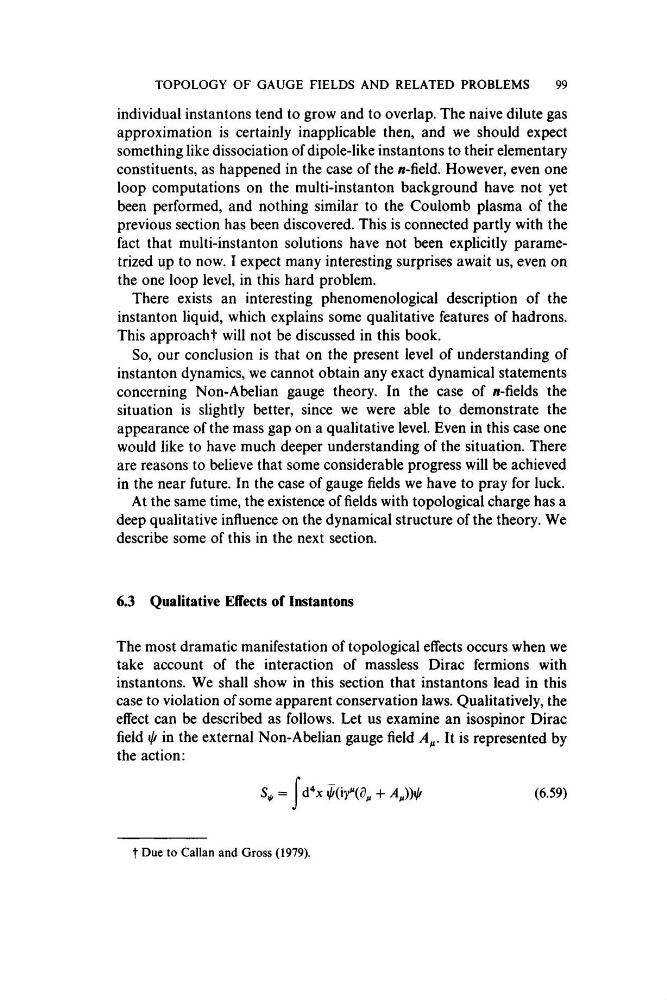
effect can be described as follows. Let us examine an isospinor Dirac
field { ¡ z in the external Non-Abelian gauge field A^. It is represented by
the action:
d * x
(6.59)
t Due to Callan and Gross (1979).
99
individual instantons tend to grow and to overlap. The naive dilute gas
approximation is certainly inapplicable then, and we should expect
something like dissociation of dipole-like instantons to their elementary
constituents, as happened in the case of the /i-field. However, even one
loop computations on the multi-instanton background have not yet
been performed, and nothing similar to the Coulomb plasma of the
previous section has been discovered. This is connected partly with the
fact that multi-instanton solutions have not been explicitly parametrized up to now. I expect many interesting surprises await us, even on
the one loop level, in this hard problem.
There exists an interesting phenomenological description of the
instanton liquid, which explains some qualitative features of hadrons.
This approach! will not be discussed in this book.
So, our conclusion is that on the present level of understanding of
instanton dynamics, we cannot obtain any exact dynamical statements
concerning Non-Abelian gauge theory. In the case of /i-fields the
situation is slightly better, since we were able to demonstrate the
appearance of the mass gap on a qualitative level. Even in this case one
would like to have much deeper understanding of the situation. There
are reasons to believe that some considerable progress will be achieved
in the near future. In the case of gauge fields we have to pray for luck.
At the same time, the existence of fields with topological charge has a
deep qualitative influence on the dynamical structure of the theory. We
describe some of this in the next section.
6.3 Qualitative Effects of Instantons
The most dramatic manifestation of topological effects occurs when we
take account of the interaction of massless Dirac fermions with
instantons. We shall show in this section that instantons lead in this
case to violation of some apparent conservation laws. Qualitatively, the
effect can be described as follows. Let us examine an isospinor Dirac
field { ¡ z in the external Non-Abelian gauge field A^. It is represented by
the action:
d * x
(6.59)
t Due to Callan and Gross (1979).