

94
GAUGE FIELDS AND STRINGS
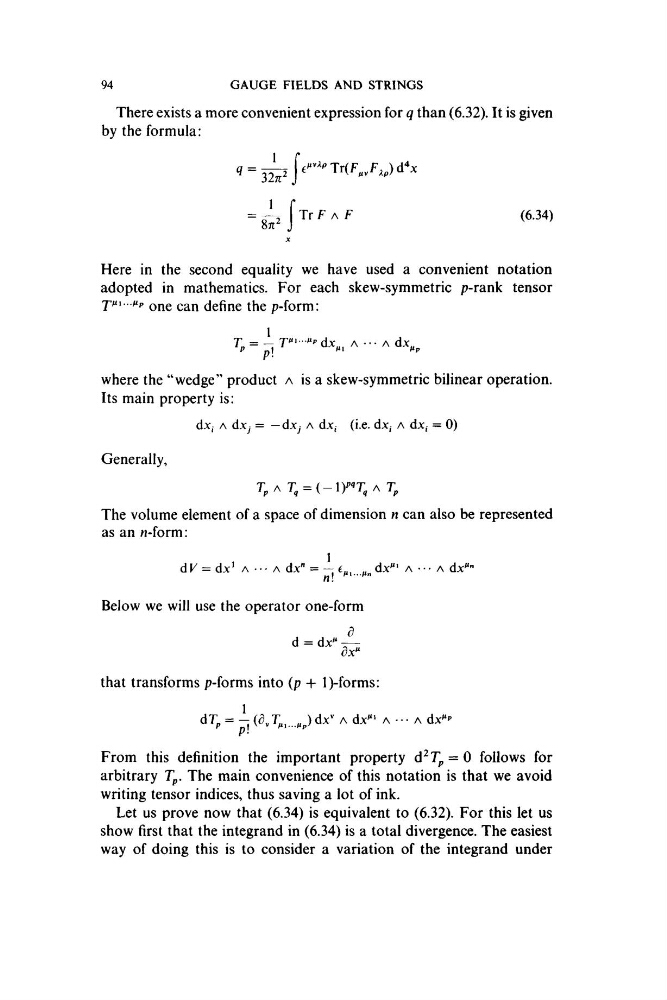
There exists a more convenient expression for q than (6.32). It is given
by the formula:
1
1
T rF A F
(6.34)
Here in the second equality we have used a convenient notation
adopted in mathematics. For each skew-symmetric p-rank tensor
7/^1 M p
define the p-form:
where the “wedge” product a is a skew-symmetric bilinear operation.
Its main property is:
Generally,
d x , A dx^ = — dXj A d x ,
(i.e. d x , a dXj = 0 )
T , A T = ( - \ y ^ T A T
The volume element of a space of dimension n can also be represented
as an n-form:
,
1
dK = dx^ A • • • A dx" = —
u dx'^^ a • • • a dx^”
Below we will use the operator one-form
d = dx'" dx^^
that transforms p-forms into (p H - l)-forms:
1
pi
dT, = - (d,T^^...Jdx^ A dx'^^ A ... A dx^^
From this definition the important property d^Tp = 0 follows for
arbitrary Tp. The main convenience of this notation is that we avoid
writing tensor indices, thus saving a lot of ink.
Let us prove now that (6.34) is equivalent to (6.32). For this let us
show first that the integrand in (6.34) is a total divergence. The easiest
way of doing this is to consider a variation of the integrand under
GAUGE FIELDS AND STRINGS
There exists a more convenient expression for q than (6.32). It is given
by the formula:
1
1
T rF A F
(6.34)
Here in the second equality we have used a convenient notation
adopted in mathematics. For each skew-symmetric p-rank tensor
7/^1 M p
define the p-form:
where the “wedge” product a is a skew-symmetric bilinear operation.
Its main property is:
Generally,
d x , A dx^ = — dXj A d x ,
(i.e. d x , a dXj = 0 )
T , A T = ( - \ y ^ T A T
The volume element of a space of dimension n can also be represented
as an n-form:
,
1
dK = dx^ A • • • A dx" = —
u dx'^^ a • • • a dx^”
Below we will use the operator one-form
d = dx'" dx^^
that transforms p-forms into (p H - l)-forms:
1
pi
dT, = - (d,T^^...Jdx^ A dx'^^ A ... A dx^^
From this definition the important property d^Tp = 0 follows for
arbitrary Tp. The main convenience of this notation is that we avoid
writing tensor indices, thus saving a lot of ink.
Let us prove now that (6.34) is equivalent to (6.32). For this let us
show first that the integrand in (6.34) is a total divergence. The easiest
way of doing this is to consider a variation of the integrand under