

TOPOLOGY OF GAUGE FIELDS AND RELATED PROBLEMS
93
From this fact we deduce:
-► g
+ o{\jx)
(6.29)
where g{x) e G.
If we bound our ^ = 4 Euclidean space by a large three-dimensional
sphere we obtain, according to (6.29), a map g{x): -► G. It is easy
to see that all such maps are classified by the integers for any G. Let us
prove this for G = SU{2). Any matrix g in this case can be written as:
^ = « 4 -h i/I • T
=
g^g = I
(6.30)
(6.31)
(here t are the Pauli matrices). Therefore, elements of the 5(7(2) group
are in one to one correspondence with points of the sphere 5^ defined
by the equation (6.31). The map of the 5^ which bounds the jc-space
onto 517(2) is therefore just the map 5^ -► 5^. In this latter case all the
arguments we had for 5^ -► 5^ in Section 6.1 are applicable. We have an
integer q which is equal to the number of coverings given by the integral
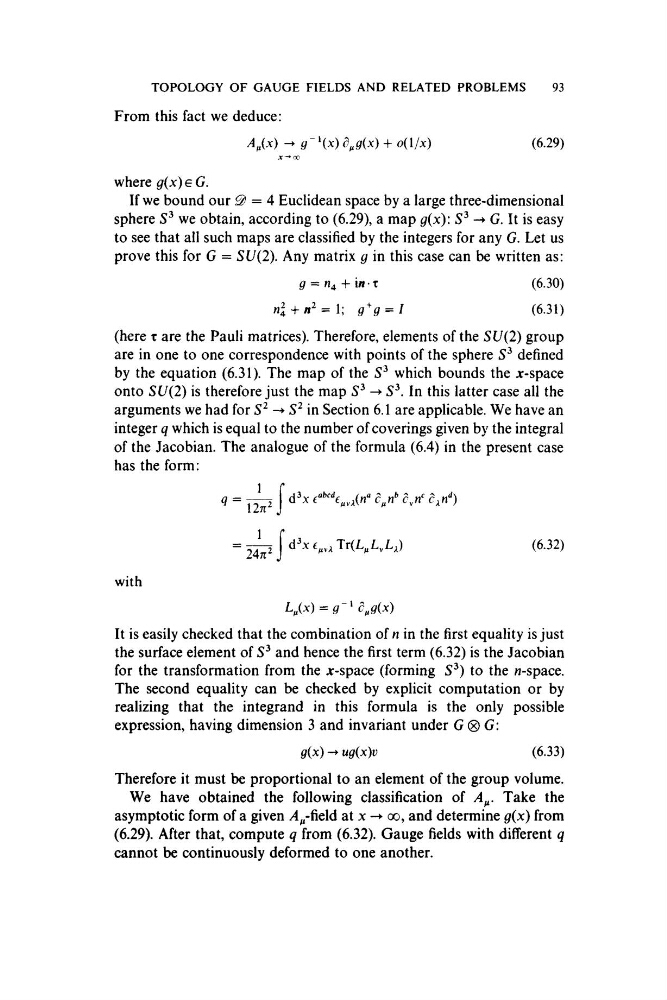
of the Jacobian. The analogue of the formula (6.4) in the present case
has the form:
ey)
1
2 ^
with
d^xe^,.yr(Ly,LJ
= g ^ c^g(x)
(6.32)
It is easily checked that the combination of n in the first equality is just
the surface element of 5^ and hence the first term (6.32) is the Jacobian
for the transformation from the jc-space (forming 5^) to the «-space.
The second equality can be checked by explicit computation or by
realizing that the integrand in this formula is the only possible
expression, having dimension 3 and invariant under G ® G:
g{x) -> ug{x)v
(6.33)
Therefore it must be proportional to an element of the group volume.
We have obtained the following classification of
Take the
asymptotic form of a given A^-field at x -► oo, and determine g(x) from
(6.29). After that, compute q from (6.32). Gauge fields with different q
cannot be continuously deformed to one another.
93
From this fact we deduce:
-► g
+ o{\jx)
(6.29)
where g{x) e G.
If we bound our ^ = 4 Euclidean space by a large three-dimensional
sphere we obtain, according to (6.29), a map g{x): -► G. It is easy
to see that all such maps are classified by the integers for any G. Let us
prove this for G = SU{2). Any matrix g in this case can be written as:
^ = « 4 -h i/I • T
=
g^g = I
(6.30)
(6.31)
(here t are the Pauli matrices). Therefore, elements of the 5(7(2) group
are in one to one correspondence with points of the sphere 5^ defined
by the equation (6.31). The map of the 5^ which bounds the jc-space
onto 517(2) is therefore just the map 5^ -► 5^. In this latter case all the
arguments we had for 5^ -► 5^ in Section 6.1 are applicable. We have an
integer q which is equal to the number of coverings given by the integral
of the Jacobian. The analogue of the formula (6.4) in the present case
has the form:
ey)
1
2 ^
with
d^xe^,.yr(Ly,LJ
= g ^ c^g(x)
(6.32)
It is easily checked that the combination of n in the first equality is just
the surface element of 5^ and hence the first term (6.32) is the Jacobian
for the transformation from the jc-space (forming 5^) to the «-space.
The second equality can be checked by explicit computation or by
realizing that the integrand in this formula is the only possible
expression, having dimension 3 and invariant under G ® G:
g{x) -> ug{x)v
(6.33)
Therefore it must be proportional to an element of the group volume.
We have obtained the following classification of
Take the
asymptotic form of a given A^-field at x -► oo, and determine g(x) from
(6.29). After that, compute q from (6.32). Gauge fields with different q
cannot be continuously deformed to one another.