

90
GAUGE FIELDS AND STRINGS
plasma with inverse temperature jS = 4tc. As was discussed in
Chapter 4, such a plasma has two different phases. For large j? the
charges form dipoles and the system is neutral, with long range
correlations (no mass gap). At some critical P (which is known to be
equal to 8tc ), dissociation of the dipoles occurs and for p <
= Sn we
have a plasma phase with Debye screening, and therefore a mass gap.
We conclude that owing to quantum effects instantons “melt” and
create a finite mass gap in the theory. Before discussing the validity of
the approximations made, let us give a very useful representation for
(6.19). It is based on the so-called bosonization formulas which we
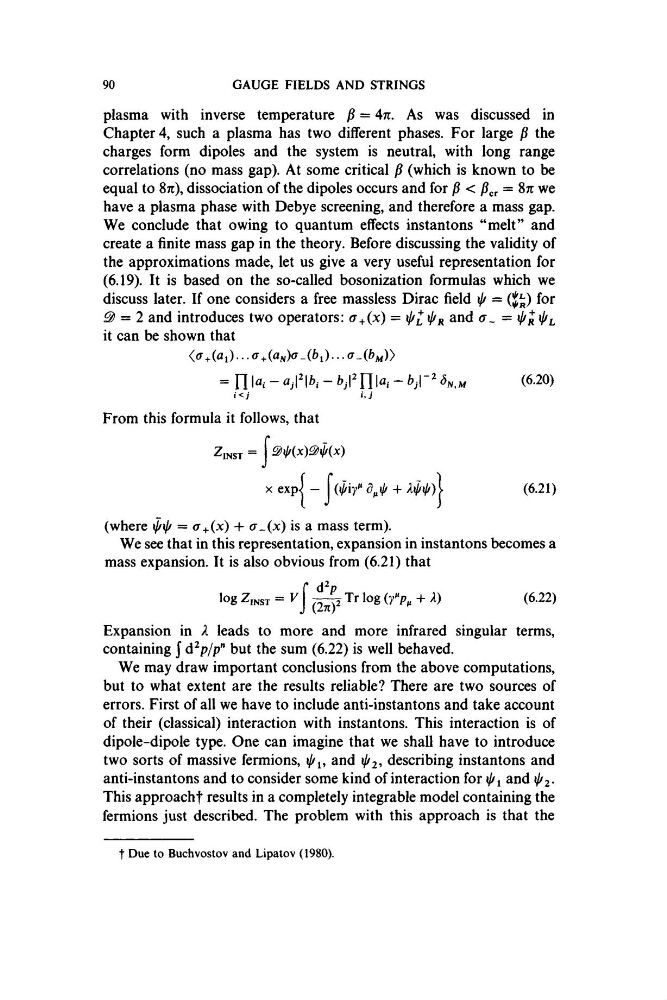
discuss later. If one considers a free massless Dirac field ij/ = (¡^¿) for
^ = 2 and introduces two operators: (t+(x) = ij/l
and
it can be shown that
(6.20)
From this formula it follows, that
2 inst=
X exp
(6.21)
(where ij/il/ = (t+(x) + cr_(x) is a mass term).
We see that in this representation, expansion in instantons becomes a
mass expansion. It is also obvious from (6.21) that
log
= V
Q P
(In)
2 Tr log
+ Á)
(6.22)
Expansion in A leads to more and more infrared singular terms,
containing | d^p/p” but the sum (6.22 ) is well behaved.
We may draw important conclusions from the above computations,
but to what extent are the results reliable? There are two sources of
errors. First of all we have to include anti-instantons and take account
of their (classical) interaction with instantons. This interaction is of
dipole-dipole type. One can imagine that we shall have to introduce
two sorts of massive fermions,
and ij/2 , describing instantons and
anti-instantons and to consider some kind of interaction for ipi and ^ 2 -
This approachf results in a completely integrable model containing the
fermions just described. The problem with this approach is that the
t Due to Buchvostov and Lipatov (1980).
GAUGE FIELDS AND STRINGS
plasma with inverse temperature jS = 4tc. As was discussed in
Chapter 4, such a plasma has two different phases. For large j? the
charges form dipoles and the system is neutral, with long range
correlations (no mass gap). At some critical P (which is known to be
equal to 8tc ), dissociation of the dipoles occurs and for p <
= Sn we
have a plasma phase with Debye screening, and therefore a mass gap.
We conclude that owing to quantum effects instantons “melt” and
create a finite mass gap in the theory. Before discussing the validity of
the approximations made, let us give a very useful representation for
(6.19). It is based on the so-called bosonization formulas which we
discuss later. If one considers a free massless Dirac field ij/ = (¡^¿) for
^ = 2 and introduces two operators: (t+(x) = ij/l
and
it can be shown that
(6.20)
From this formula it follows, that
2 inst=
X exp
(6.21)
(where ij/il/ = (t+(x) + cr_(x) is a mass term).
We see that in this representation, expansion in instantons becomes a
mass expansion. It is also obvious from (6.21) that
log
= V
Q P
(In)
2 Tr log
+ Á)
(6.22)
Expansion in A leads to more and more infrared singular terms,
containing | d^p/p” but the sum (6.22 ) is well behaved.
We may draw important conclusions from the above computations,
but to what extent are the results reliable? There are two sources of
errors. First of all we have to include anti-instantons and take account
of their (classical) interaction with instantons. This interaction is of
dipole-dipole type. One can imagine that we shall have to introduce
two sorts of massive fermions,
and ij/2 , describing instantons and
anti-instantons and to consider some kind of interaction for ipi and ^ 2 -
This approachf results in a completely integrable model containing the
fermions just described. The problem with this approach is that the
t Due to Buchvostov and Lipatov (1980).