

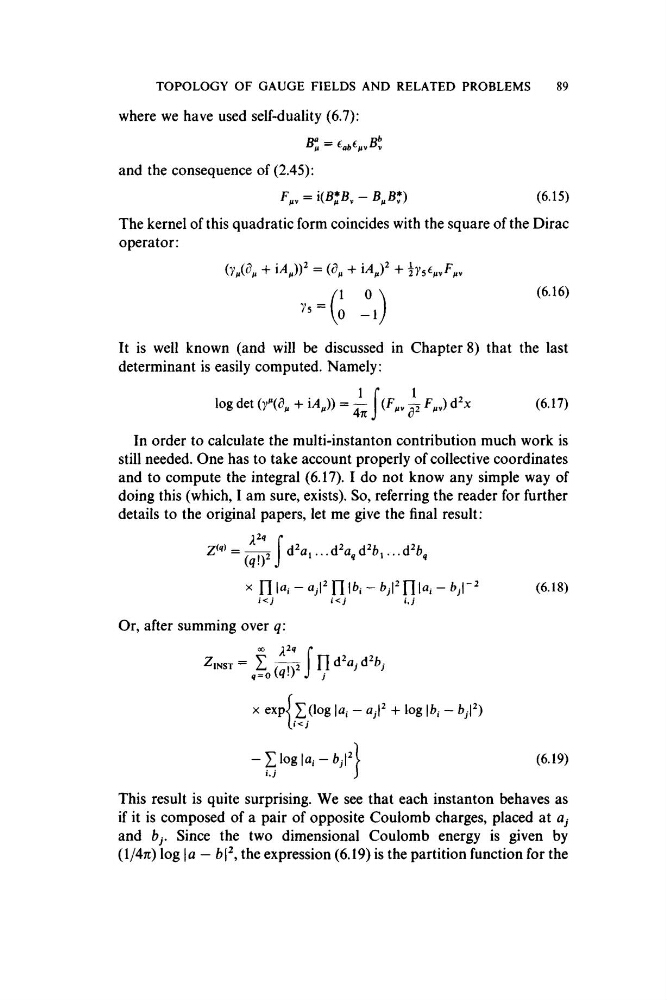
where we have used self-duality (6.7):
and the consequence of (2.45):
=
(6.15)
The kernel of this quadratic form coincides with the square of the Dirac
operator:
= (d^ -t- iA^)^ + i r s
f l
0 \
(6-16)
10 - 1,
TOPOLOGY OF GAUGE FIELDS AND RELATED PROBLEMS
89
75
It is well known (and will be discussed in Chapter 8) that the last
determinant is easily computed. Namely:
log det (y"(5 + iA)) =
1
An
(F^v ^ F^v) d^x
(6.17)
In order to calculate the multi-instanton contribution much work is
still needed. One has to take account properly of collective coordinates
and to compute the integral (6.17). I do not know any simple way of
doing this (which, I am sure, exists). So, referring the reader for further
details to the original papers, let me give the final result:
=
W
. ..d^üq d^b^. ..d^b^
‘
(6.18)
Or, after summing over q:
^ y
X exp) ^(log |u¡ - a / + log |6. . - 6/ )
0
(6.19)
This result is quite surprising. We see that each instanton behaves as
if it is composed of a pair of opposite Coulomb charges, placed at aj
and bj. Since the two dimensional Coulomb energy is given by
(1/47t) log |a — ftp, the expression (6.19) is the partition function for the
and the consequence of (2.45):
=
(6.15)
The kernel of this quadratic form coincides with the square of the Dirac
operator:
= (d^ -t- iA^)^ + i r s
f l
0 \
(6-16)
10 - 1,
TOPOLOGY OF GAUGE FIELDS AND RELATED PROBLEMS
89
75
It is well known (and will be discussed in Chapter 8) that the last
determinant is easily computed. Namely:
log det (y"(5 + iA)) =
1
An
(F^v ^ F^v) d^x
(6.17)
In order to calculate the multi-instanton contribution much work is
still needed. One has to take account properly of collective coordinates
and to compute the integral (6.17). I do not know any simple way of
doing this (which, I am sure, exists). So, referring the reader for further
details to the original papers, let me give the final result:
=
W
. ..d^üq d^b^. ..d^b^
‘
(6.18)
Or, after summing over q:
^ y
X exp) ^(log |u¡ - a / + log |6. . - 6/ )
0
(6.19)
This result is quite surprising. We see that each instanton behaves as
if it is composed of a pair of opposite Coulomb charges, placed at aj
and bj. Since the two dimensional Coulomb energy is given by
(1/47t) log |a — ftp, the expression (6.19) is the partition function for the