

compatible as well as to those coatings that have the required mechanical
and/orphysical properties.
1. What is the normal operating temperature and temperature range?
2. What peak temperatures can be reached during shutdown, startup,
process upset, etc.?
3. Will any mixing areas exist where exothermico rh eat of mixing
temperatures may develop?
4. What is the normal operating pressure?
5. What vacuumconditions andrange are possibleduring operation,
startup, shutdown,and upset conditions?
6. Is grounding necessary?
Other factors must also be considered before the final decisions can be made
as to which coating to use. After the previous questions have been answered,
there will still be several potential materials from which to choose.
Service-life expectation mustb ec onsidered. Different protective coating
options afford different degrees of protection for different periods of time at a
variety of costs. Factors such as maintenance cycle,o perating cycles,a nd
reliability of the coating must all be considered. Can the facility tolerate any
downtime for inspection and maintenance? If so, how often and for how long?
When these questionsh ave all been answered, an appropriate decision
can be made as to which coating material willb eu sed.
The size of the vesselmustalso be considered in the coating selection. If the
vessel is too large, it may not fit in ap articular vender’so ven for curing
the coating. Also, nozzle diameters 4in. or less are toosmall to spray-apply
al iquid coating. When al iningi st ob eu sed for corrosion protection, it is
necessary to reviewthe corrosion rate of the immersed environment on the
bare substrate.Assuming that the substrate is carbon steel with acorrosion
rate of less than 10 mil per year (mpy)atthe operating temperature, pressure,
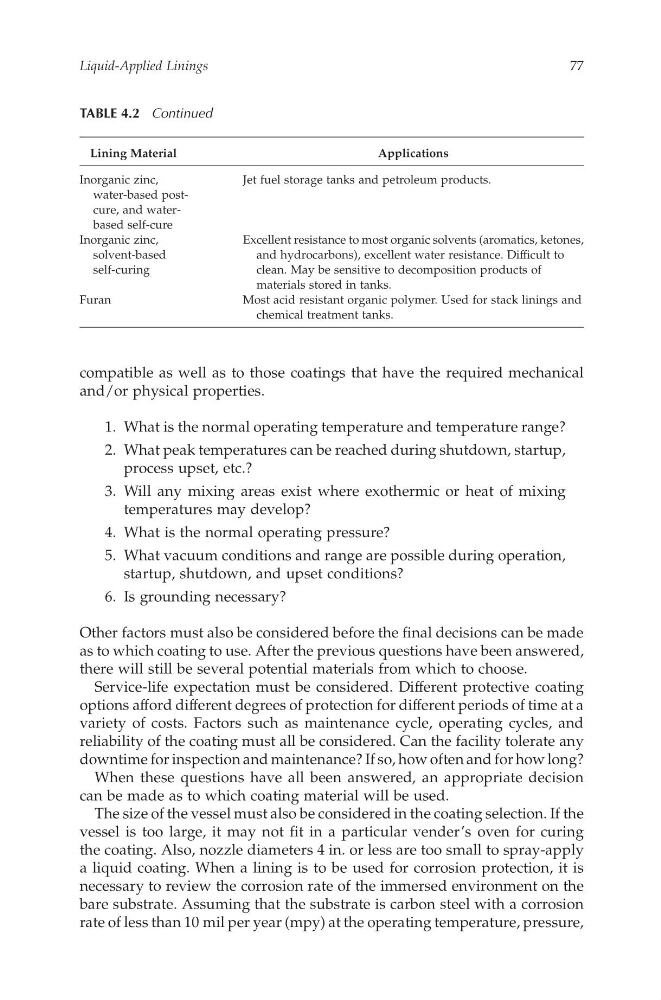
TABLE 4.2 Continued
Lining Material
Applications
Inorganic zinc,
water-based postcure, and waterbased self-cure
Jet fuel storage tanks and petroleum products.
Inorganic zinc,
solvent-based
self-curing
Excellent resistance to most organic solvents (aromatics, ketones,
and hydrocarbons), excellent water resistance. Difficult to
clean. May be sensitive to decomposition products of
materials stored in tanks.
Furan
Most acid resistant organic polymer.Used for stack linings and
chemical treatment tanks.
Liquid-Applied Linings
77
CAT8247—CHAPTER 4—17/10/2006—14:33—SRIDHAR—XML MODEL B–pp. 69–174
and/orphysical properties.
1. What is the normal operating temperature and temperature range?
2. What peak temperatures can be reached during shutdown, startup,
process upset, etc.?
3. Will any mixing areas exist where exothermico rh eat of mixing
temperatures may develop?
4. What is the normal operating pressure?
5. What vacuumconditions andrange are possibleduring operation,
startup, shutdown,and upset conditions?
6. Is grounding necessary?
Other factors must also be considered before the final decisions can be made
as to which coating to use. After the previous questions have been answered,
there will still be several potential materials from which to choose.
Service-life expectation mustb ec onsidered. Different protective coating
options afford different degrees of protection for different periods of time at a
variety of costs. Factors such as maintenance cycle,o perating cycles,a nd
reliability of the coating must all be considered. Can the facility tolerate any
downtime for inspection and maintenance? If so, how often and for how long?
When these questionsh ave all been answered, an appropriate decision
can be made as to which coating material willb eu sed.
The size of the vesselmustalso be considered in the coating selection. If the
vessel is too large, it may not fit in ap articular vender’so ven for curing
the coating. Also, nozzle diameters 4in. or less are toosmall to spray-apply
al iquid coating. When al iningi st ob eu sed for corrosion protection, it is
necessary to reviewthe corrosion rate of the immersed environment on the
bare substrate.Assuming that the substrate is carbon steel with acorrosion
rate of less than 10 mil per year (mpy)atthe operating temperature, pressure,
TABLE 4.2 Continued
Lining Material
Applications
Inorganic zinc,
water-based postcure, and waterbased self-cure
Jet fuel storage tanks and petroleum products.
Inorganic zinc,
solvent-based
self-curing
Excellent resistance to most organic solvents (aromatics, ketones,
and hydrocarbons), excellent water resistance. Difficult to
clean. May be sensitive to decomposition products of
materials stored in tanks.
Furan
Most acid resistant organic polymer.Used for stack linings and
chemical treatment tanks.
Liquid-Applied Linings
77
CAT8247—CHAPTER 4—17/10/2006—14:33—SRIDHAR—XML MODEL B–pp. 69–174