

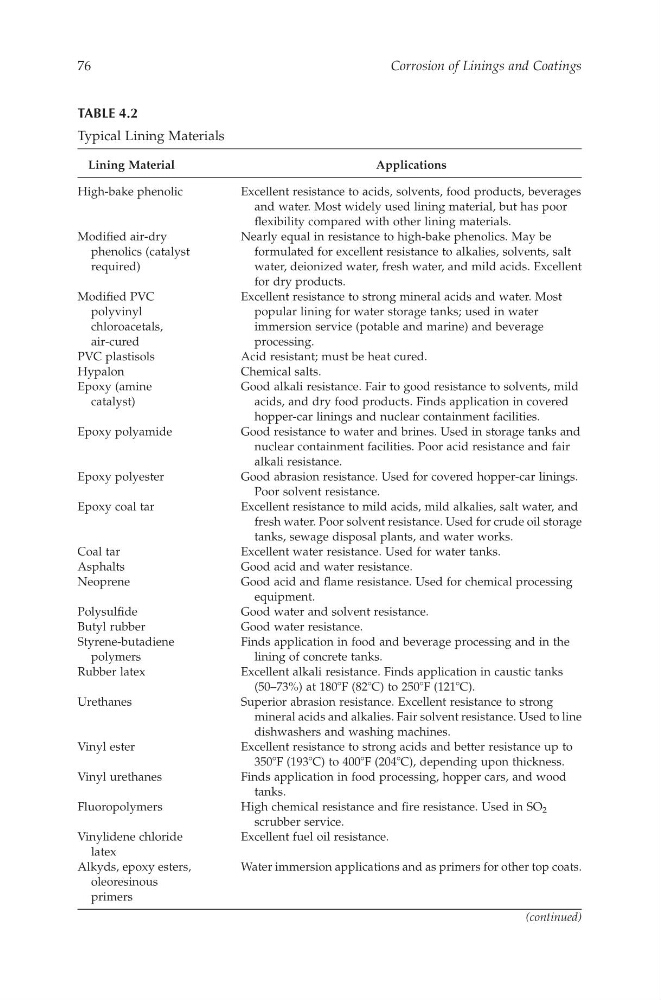
TABLE 4.2
Typical Lining Materials
Lining Material
Applications
High-bake phenolic
Excellent resistance to acids, solvents, food products, beverages
and water.Most widely used lining material, but has poor
flexibility compared with other lining materials.
Modified air-dry
phenolics (catalyst
required)
Nearly equal in resistance to high-bake phenolics. May be
formulated for excellent resistance to alkalies, solvents, salt
water,deionized water,fresh water,and mild acids. Excellent
for dry products.
Modified PVC
polyvinyl
chloroacetals,
air-cured
Excellent resistance to strong mineral acids and water.Most
popular lining for water storage tanks; used in water
immersion service (potable and marine) and beverage
processing.
PVC plastisols
Acid resistant; must be heat cured.
Hypalon
Chemical salts.
Epoxy (amine
catalyst)
Good alkali resistance. Fair to good resistance to solvents, mild
acids, and dry food products. Finds application in covered
hopper-car linings and nuclear containment facilities.
Epoxy polyamide
Good resistance to water and brines. Used in storage tanks and
nuclear containmentf acilities. Poor acid resistance and fair
alkali resistance.
Epoxy polyester
Good abrasion resistance. Used for covered hopper-car linings.
Poor solvent resistance.
Epoxy coal tar
Excellent resistance to mild acids, mild alkalies, salt water,and
fresh water.Poor solvent resistance. Used for crude oil storage
tanks, sewage disposal plants, and water works.
Coal tar
Excellent water resistance. Used for water tanks.
Asphalts
Good acid and water resistance.
Neoprene
Good acid and flame resistance. Used for chemical processing
equipment.
PolysulfideG ood water and solvent resistance.
Butyl rubber
Good water resistance.
Styrene-butadiene
polymers
Finds application in food and beverage processing and in the
lining of concrete tanks.
Rubber latex
Excellent alkali resistance. Finds application in caustic tanks
(50–73%) at 1808 F( 828 C) to 2508 F( 1218 C).
Urethanes
Superior abrasionresistance. Excellentr esistance to strong
mineral acids and alkalies. Fair solvent resistance. Used to line
dishwashers and washing machines.
Vinyl ester
Excellent resistance to strong acids and better resistance up to
3508 F( 1938 C) to 4008 F( 2048 C), dependingu pon thickness.
Vinyl urethanes
Finds application in food processing, hopper cars, and wood
tanks.
Fluoropolymers
High chemical resistance and fire resistance. Used in SO 2
scrubber service.
Vinylidene chloride
latex
Excellent fuel oil resistance.
Alkyds, epoxy esters,
oleoresinous
primers
Water immersion applications and as primersfor other top coats.
(continued)
Corrosion of Linings and Coatings
76
CAT8247—CHAPTER 4—17/10/2006—14:33—SRIDHAR—XML MODEL B–pp. 69–174
Typical Lining Materials
Lining Material
Applications
High-bake phenolic
Excellent resistance to acids, solvents, food products, beverages
and water.Most widely used lining material, but has poor
flexibility compared with other lining materials.
Modified air-dry
phenolics (catalyst
required)
Nearly equal in resistance to high-bake phenolics. May be
formulated for excellent resistance to alkalies, solvents, salt
water,deionized water,fresh water,and mild acids. Excellent
for dry products.
Modified PVC
polyvinyl
chloroacetals,
air-cured
Excellent resistance to strong mineral acids and water.Most
popular lining for water storage tanks; used in water
immersion service (potable and marine) and beverage
processing.
PVC plastisols
Acid resistant; must be heat cured.
Hypalon
Chemical salts.
Epoxy (amine
catalyst)
Good alkali resistance. Fair to good resistance to solvents, mild
acids, and dry food products. Finds application in covered
hopper-car linings and nuclear containment facilities.
Epoxy polyamide
Good resistance to water and brines. Used in storage tanks and
nuclear containmentf acilities. Poor acid resistance and fair
alkali resistance.
Epoxy polyester
Good abrasion resistance. Used for covered hopper-car linings.
Poor solvent resistance.
Epoxy coal tar
Excellent resistance to mild acids, mild alkalies, salt water,and
fresh water.Poor solvent resistance. Used for crude oil storage
tanks, sewage disposal plants, and water works.
Coal tar
Excellent water resistance. Used for water tanks.
Asphalts
Good acid and water resistance.
Neoprene
Good acid and flame resistance. Used for chemical processing
equipment.
PolysulfideG ood water and solvent resistance.
Butyl rubber
Good water resistance.
Styrene-butadiene
polymers
Finds application in food and beverage processing and in the
lining of concrete tanks.
Rubber latex
Excellent alkali resistance. Finds application in caustic tanks
(50–73%) at 1808 F( 828 C) to 2508 F( 1218 C).
Urethanes
Superior abrasionresistance. Excellentr esistance to strong
mineral acids and alkalies. Fair solvent resistance. Used to line
dishwashers and washing machines.
Vinyl ester
Excellent resistance to strong acids and better resistance up to
3508 F( 1938 C) to 4008 F( 2048 C), dependingu pon thickness.
Vinyl urethanes
Finds application in food processing, hopper cars, and wood
tanks.
Fluoropolymers
High chemical resistance and fire resistance. Used in SO 2
scrubber service.
Vinylidene chloride
latex
Excellent fuel oil resistance.
Alkyds, epoxy esters,
oleoresinous
primers
Water immersion applications and as primersfor other top coats.
(continued)
Corrosion of Linings and Coatings
76
CAT8247—CHAPTER 4—17/10/2006—14:33—SRIDHAR—XML MODEL B–pp. 69–174