

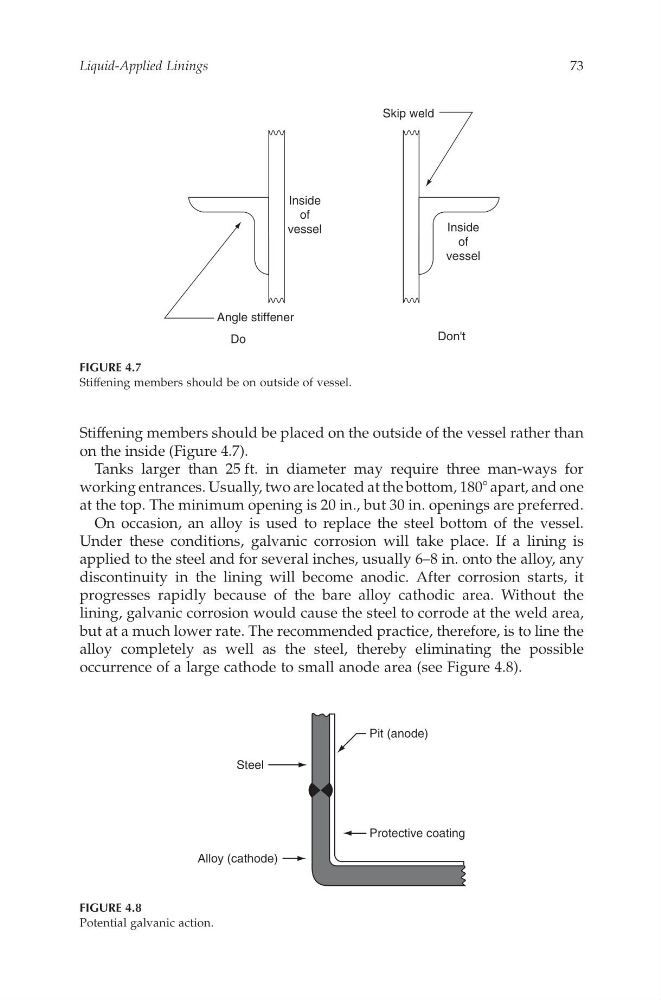
Stiffening members should be placed on the outsideofthe vessel ratherthan
on the inside (Figure 4.7).
Tanks larger than 25 ft. in diameter may requiret hree man-ways for
workingentrances. Usually,two are located at the bottom, 1808 apart, and one
at the top. The minimum opening is 20 in., but 30 in. openings are preferred.
On occasion, an alloy is used to replace the steel bottom of the vessel.
Under thesec onditions, galvanic corrosion will take place. If al iningi s
appliedtothe steel and for several inches, usually6–8 in. onto the alloy,any
discontinuity in the lining will become anodic. After corrosion starts, it
progresses rapidly because of the bare alloy cathodic area. Without the
lining,galvanic corrosion would cause the steel to corrode at the weld area,
but at amuchlower rate. The recommended practice,therefore, is to line the
alloy completely as well as the steel, thereby eliminating the possible
occurrence of al arge cathode to smalla node area (see Figure 4.8).
Skip weld
Inside
of
vessel
Inside
of
vessel
Angle stiffener
Do
Don't
FIGURE 4.7
Stiffening members should be on outside of vessel.
Pit (anode)
Protective coating
Steel
Alloy (cathode)
FIGURE 4.8
Potential galvanic action.
Liquid-Applied Linings
73
CAT8247—CHAPTER 4—17/10/2006—14:33—SRIDHAR—XML MODEL B–pp. 69–174
on the inside (Figure 4.7).
Tanks larger than 25 ft. in diameter may requiret hree man-ways for
workingentrances. Usually,two are located at the bottom, 1808 apart, and one
at the top. The minimum opening is 20 in., but 30 in. openings are preferred.
On occasion, an alloy is used to replace the steel bottom of the vessel.
Under thesec onditions, galvanic corrosion will take place. If al iningi s
appliedtothe steel and for several inches, usually6–8 in. onto the alloy,any
discontinuity in the lining will become anodic. After corrosion starts, it
progresses rapidly because of the bare alloy cathodic area. Without the
lining,galvanic corrosion would cause the steel to corrode at the weld area,
but at amuchlower rate. The recommended practice,therefore, is to line the
alloy completely as well as the steel, thereby eliminating the possible
occurrence of al arge cathode to smalla node area (see Figure 4.8).
Skip weld
Inside
of
vessel
Inside
of
vessel
Angle stiffener
Do
Don't
FIGURE 4.7
Stiffening members should be on outside of vessel.
Pit (anode)
Protective coating
Steel
Alloy (cathode)
FIGURE 4.8
Potential galvanic action.
Liquid-Applied Linings
73
CAT8247—CHAPTER 4—17/10/2006—14:33—SRIDHAR—XML MODEL B–pp. 69–174