

As erious problem develops, however,w hent he solution resistance
increases or the polarization resistance decreases enough to make the
solution resistance asignificant portion of the total resistance to currentflow
between the electrodes. In these cases,the accuracy of the LPR measurement
is affected.
This situation tends to occur at highc orrosion rates (low polarization
resistance) and in solutions with low conductivity (high solutionresistance)
and is manifested by the indicated( measured) corrosion rate being lower
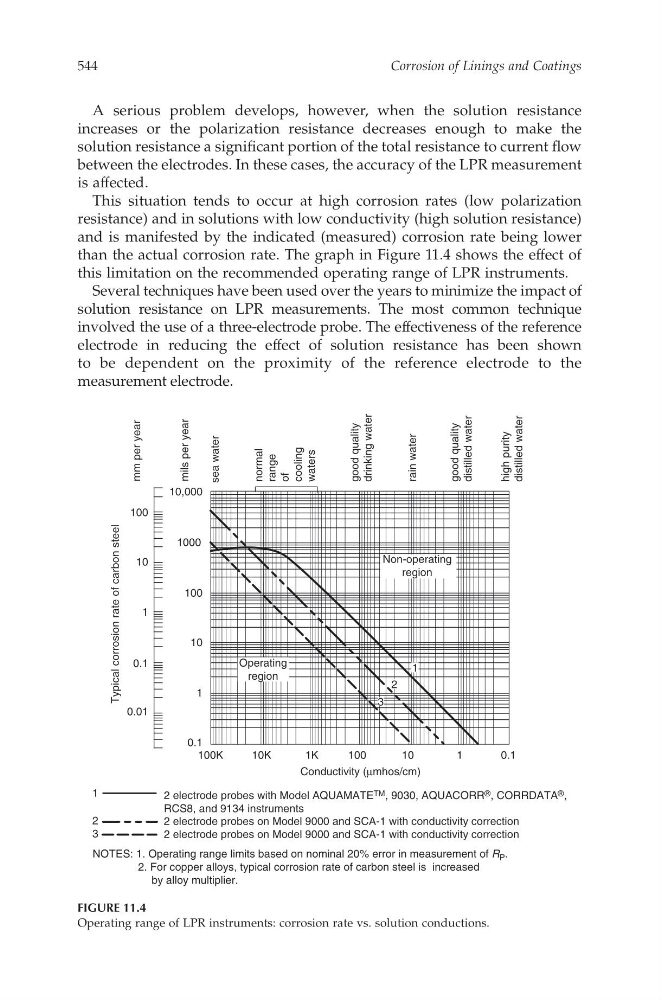
than the actual corrosion rate. The graph in Figure 11.4 shows the effect of
this limitation on the recommended operating range of LPR instruments.
Severaltechniqueshavebeenusedoverthe yearstominimizethe impact of
solution resistanceo nL PR measurements.T he most common technique
involved theuse of athree-electrode probe. Theeffectiveness of thereference
electrode in reducing the effect of solution resistance has been shown
to be dependent on thep roximity of the referencee lectrode to the
measurementelectrode.
100K
10K
1K
100
Conductivity ( μ mhos/cm)
10
10 .1
10,000
1000
100
100
10
1
10
1
0.1
0.1
0.01
mm per year
mils per year
sea water
normal
range
of
cooling
waters
good quality
drinking water
good quality
distilled water
high purity
distilled water
rain water
Typical corrosion rate of carbon steel
1
Operating
region
Non-operating
region
2electrode probes with Model AQUAMATE TM ,9030, AQUACORR ® ,CORRDATA ® ,
RCS8, and 9134 instruments
2electrode probes on Model 9000 and SCA-1 with conductivity correction
2electrode probes on Model 9000 and SCA-1 with conductivity correction
1
2
3
NOTES: 1. Operating range limits based on nominal 20% error in measurement of R P .
2. For copper alloys, typical corrosion rate of carbon steel is increased
by alloy multiplier.
2
1
3
FIGURE 11.4
Operating range of LPR instruments: corrosion rate vs. solution conductions.
Corrosion of Linings and Coatings
544
CAT8247—CHAPTER 11—6/10/2006—12:56—SRIDHAR—XML MODEL B–pp. 533–547