

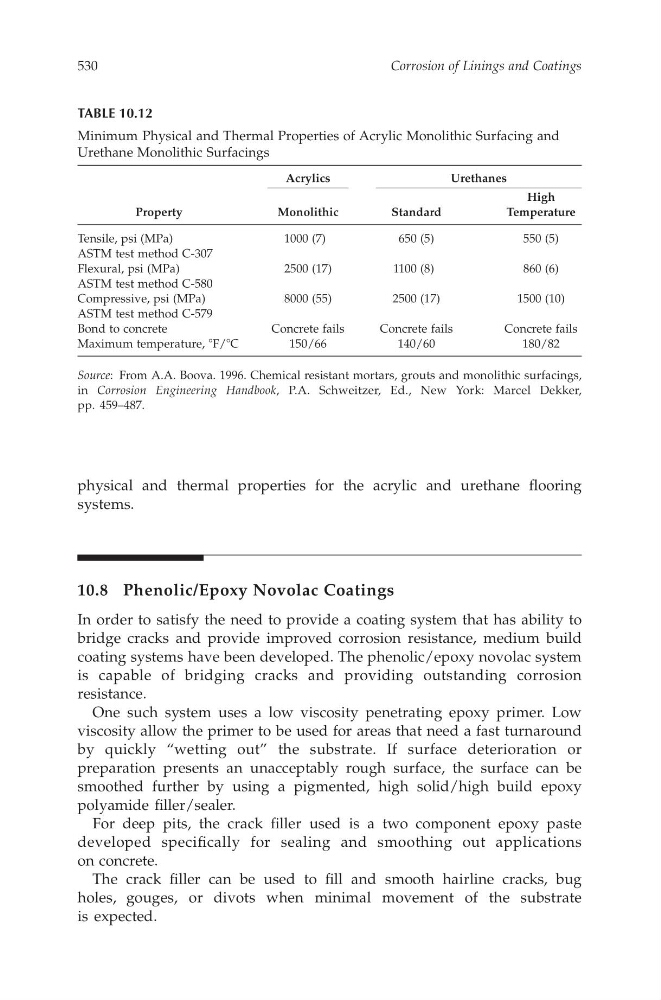
physical and thermal properties for the acrylic and urethane flooring
systems.
10.8P henolic/Epoxy Novolac Coatings
In order to satisfy the needt op rovide ac oating system that has ability to
bridge cracks and provide improved corrosion resistance, medium build
coating systems have been developed. The phenolic/epoxy novolac system
is capable of bridgingc racksa nd providingo utstanding corrosion
resistance.
One suchs ystem uses al ow viscosity penetratinge poxy primer. Low
viscosity allow the primer to be used for areas that need af ast turnaround
by quickly “wetting out”t he substrate. If surface deteriorationo r
preparation presents an unacceptably rough surface, the surfacec an be
smoothed furtherb yu sing ap igmented, high solid/highb uilde poxy
polyamide filler/sealer.
For deep pits, the crackfi ller used is at wo component epoxy paste
developed specifically fors ealing ands moothing outa pplications
on concrete.
The crack filler can be used to fill and smooth hairline cracks, bug
holes, gouges,o rd ivotsw henm inimal movement of the substrate
is expected.
TABLE 10.12
Minimum Physical and Thermal Properties of Acrylic Monolithic Surfacing and
Urethane Monolithic Surfacings
Acrylics
Urethanes
Property
Monolithic
Standard
High
Te mperature
Tensile, psi (MPa)
1000 (7)
650 (5)
550 (5)
ASTM test method C-307
Flexural, psi (MPa)
2500 (17)
1100 (8)
860 (6)
ASTM test method C-580
Compressive, psi (MPa)
8000 (55)
2500 (17)
1500 (10)
ASTM test method C-579
Bond to concrete
Concrete fails
Concrete fails
Concrete fails
Maximum temperature, 8 F/8 C1 50/66
140/60
180/82
Source:F romA .A. Boova. 1996. Chemical resistant mortars, grouts and monolithic surfacings,
in Corrosion Engineering Handbook,P .A.S chweitzer,E d., NewY ork: MarcelD ekker,
pp. 459–487.
Corrosion of Linings and Coatings
530
CAT8247—CHAPTER 10—6/10/2006—12:52—SRIDHAR—XML MODEL B–pp. 515–532
systems.
10.8P henolic/Epoxy Novolac Coatings
In order to satisfy the needt op rovide ac oating system that has ability to
bridge cracks and provide improved corrosion resistance, medium build
coating systems have been developed. The phenolic/epoxy novolac system
is capable of bridgingc racksa nd providingo utstanding corrosion
resistance.
One suchs ystem uses al ow viscosity penetratinge poxy primer. Low
viscosity allow the primer to be used for areas that need af ast turnaround
by quickly “wetting out”t he substrate. If surface deteriorationo r
preparation presents an unacceptably rough surface, the surfacec an be
smoothed furtherb yu sing ap igmented, high solid/highb uilde poxy
polyamide filler/sealer.
For deep pits, the crackfi ller used is at wo component epoxy paste
developed specifically fors ealing ands moothing outa pplications
on concrete.
The crack filler can be used to fill and smooth hairline cracks, bug
holes, gouges,o rd ivotsw henm inimal movement of the substrate
is expected.
TABLE 10.12
Minimum Physical and Thermal Properties of Acrylic Monolithic Surfacing and
Urethane Monolithic Surfacings
Acrylics
Urethanes
Property
Monolithic
Standard
High
Te mperature
Tensile, psi (MPa)
1000 (7)
650 (5)
550 (5)
ASTM test method C-307
Flexural, psi (MPa)
2500 (17)
1100 (8)
860 (6)
ASTM test method C-580
Compressive, psi (MPa)
8000 (55)
2500 (17)
1500 (10)
ASTM test method C-579
Bond to concrete
Concrete fails
Concrete fails
Concrete fails
Maximum temperature, 8 F/8 C1 50/66
140/60
180/82
Source:F romA .A. Boova. 1996. Chemical resistant mortars, grouts and monolithic surfacings,
in Corrosion Engineering Handbook,P .A.S chweitzer,E d., NewY ork: MarcelD ekker,
pp. 459–487.
Corrosion of Linings and Coatings
530
CAT8247—CHAPTER 10—6/10/2006—12:52—SRIDHAR—XML MODEL B–pp. 515–532