

2. Systems area vailable for indoor or outdoor installations.
3. The elastomeric quality of the systemsprovides underfoot comfort.
4. Theyh ave excellent sound-deadening properties.
5. Theyh ave excellent resistance to impact and abrasion.
6. Theya re excellent waterproof floorings ystemsf or above-grade
light and heavy dutyfl oors.
7. They arec apable of bridging Cracksi nc oncrete1 /16in.
(1.5 mm) wide.
As with the acrylics, the urethanes are intendedf or protection against
moderate to light corrosion environments. Standard systems are effective at
temperatures of 10 to 1408 F(K 24 to 608 C). High temperature systems are
available with ar ange of 10 to 1808 F(K 24 to 828 C).
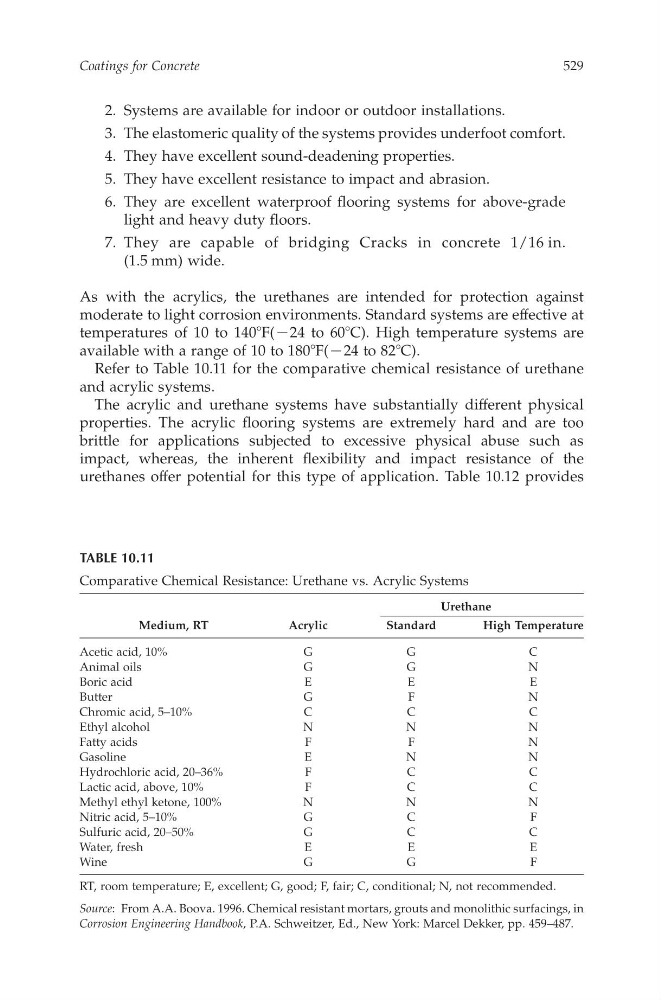
Refer to Table 10.11f or the comparative chemical resistance of urethane
and acrylic systems.
The acrylic and urethane systemsh ave substantially different physical
properties. The acrylicfl oorings ystemsa re extremely hard and are too
brittle for applications subjected to excessive physical abuse sucha s
impact, whereas, the inherent flexibility and impact resistance of the
urethanes offer potential for this type of application. Table 10.12 provides
TABLE 10.11
Comparative Chemical Resistance: Urethane vs. Acrylic Systems
Urethane
Medium, RT
Acrylic
Standard
High Te mperature
Acetic acid, 10%
GG
C
Animal oils
GG
N
Boric acid
EE
E
Butter
GF
N
Chromic acid, 5–10%
CC
C
Ethyl alcohol
NN
N
Fatty acids
FF
N
Gasoline
EN
N
Hydrochloric acid, 20–36%
FC
C
Lactic acid, above, 10%
FC
C
Methyl ethyl ketone, 100%
NN
N
Nitric acid, 5–10%
GC
F
Sulfuric acid, 20–50%
GC
C
Water,fresh
EE
E
Wine
GG
F
RT,room temperature; E, excellent; G, good; F, fair; C, conditional; N, not recommended.
Source:F rom A.A. Boova. 1996. Chemical resistant mortars, grouts and monolithic surfacings, in
Corrosion Engineering Handbook,P .A. Schweitzer,Ed., New York: Marcel Dekker,pp. 459–487.
Coatings for Concrete
529
CAT8247—CHAPTER 10—6/10/2006—12:52—SRIDHAR—XML MODEL B–pp. 515–532
3. The elastomeric quality of the systemsprovides underfoot comfort.
4. Theyh ave excellent sound-deadening properties.
5. Theyh ave excellent resistance to impact and abrasion.
6. Theya re excellent waterproof floorings ystemsf or above-grade
light and heavy dutyfl oors.
7. They arec apable of bridging Cracksi nc oncrete1 /16in.
(1.5 mm) wide.
As with the acrylics, the urethanes are intendedf or protection against
moderate to light corrosion environments. Standard systems are effective at
temperatures of 10 to 1408 F(K 24 to 608 C). High temperature systems are
available with ar ange of 10 to 1808 F(K 24 to 828 C).
Refer to Table 10.11f or the comparative chemical resistance of urethane
and acrylic systems.
The acrylic and urethane systemsh ave substantially different physical
properties. The acrylicfl oorings ystemsa re extremely hard and are too
brittle for applications subjected to excessive physical abuse sucha s
impact, whereas, the inherent flexibility and impact resistance of the
urethanes offer potential for this type of application. Table 10.12 provides
TABLE 10.11
Comparative Chemical Resistance: Urethane vs. Acrylic Systems
Urethane
Medium, RT
Acrylic
Standard
High Te mperature
Acetic acid, 10%
GG
C
Animal oils
GG
N
Boric acid
EE
E
Butter
GF
N
Chromic acid, 5–10%
CC
C
Ethyl alcohol
NN
N
Fatty acids
FF
N
Gasoline
EN
N
Hydrochloric acid, 20–36%
FC
C
Lactic acid, above, 10%
FC
C
Methyl ethyl ketone, 100%
NN
N
Nitric acid, 5–10%
GC
F
Sulfuric acid, 20–50%
GC
C
Water,fresh
EE
E
Wine
GG
F
RT,room temperature; E, excellent; G, good; F, fair; C, conditional; N, not recommended.
Source:F rom A.A. Boova. 1996. Chemical resistant mortars, grouts and monolithic surfacings, in
Corrosion Engineering Handbook,P .A. Schweitzer,Ed., New York: Marcel Dekker,pp. 459–487.
Coatings for Concrete
529
CAT8247—CHAPTER 10—6/10/2006—12:52—SRIDHAR—XML MODEL B–pp. 515–532