

available with halogen-free hardening systems, thereby,r emoving remote
possibility forcatalystpoisoning in certain chemical processes.
Chemical settingp otassium silicatem aterials ares upplieda st wo
component systems that comprise the silicate solution and the filler powder
and setting agent. Settingagents may be inorganic, organic, or acombination
of both. The properties of the coating are determined by the setting agent
and the alkali–silica ratio of the silicate used. Properties such as absorption,
porosity,s trength, and water resistance are affected by the choice of the
setting agent. Organic setting agents willb urn out at low temperatures,
thereby,increasing porosity and absorption. Organic setting agents are water
solubleand can be leached out if the coating is exposed to steam or moisture.
Coatings that use inorganic setting agents are water and moisture resistant.
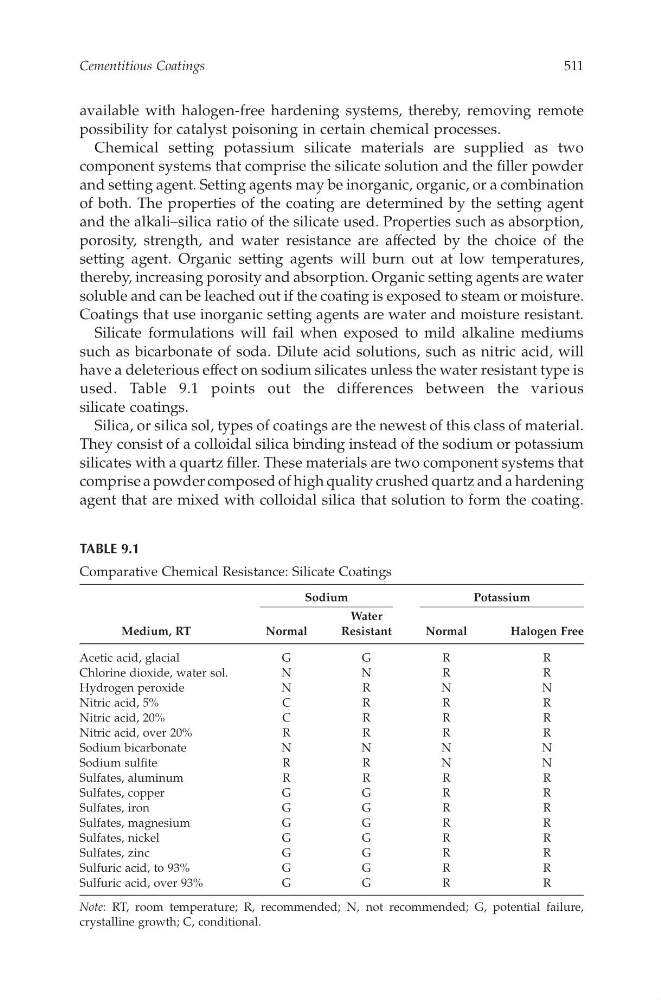
Silicate formulations willf ail when exposed to mild alkaline mediums
such as bicarbonate of soda. Dilute acids olutions, such as nitric acid, will
have adeleteriouseffect on sodium silicatesunless the water resistant type is
used.T able 9.1 points outt he differencesb etween the various
silicate coatings.
Silica, or silica sol, types of coatings are the newest of this class of material.
They consist of acolloidal silica binding instead of the sodiumorpotassium
silicates with aquartz filler. These materials are two component systems that
compriseapowder composed of highquality crushed quartz and ahardening
agent that are mixed with colloidal silica that solution to form the coating.
TABLE 9.1
Comparative Chemical Resistance: Silicate Coatings
Sodium
Potassium
Medium, RT
Normal
Water
Resistant
Normal
Halogen Free
Acetic acid, glacial
GGRR
Chlorine dioxide, water sol.
NNRR
Hydrogen peroxide
NRNN
Nitric acid, 5%
CRRR
Nitric acid, 20%
CRRR
Nitric acid, over 20%
RRRR
Sodium bicarbonate
NNNN
Sodium sulfite
RRNN
Sulfates, aluminum
RRRR
Sulfates, copper
GGRR
Sulfates, iron
GGRR
Sulfates, magnesium
GGRR
Sulfates, nickel
GGRR
Sulfates, zinc
GGRR
Sulfuric acid, to 93%
GGRR
Sulfuric acid, over 93%
GGRR
Note:R T, room temperature; R, recommended; N, not recommended; G, potential failure,
crystalline growth; C, conditional.
Cementitious Coatings
511
CAT8247—CHAPTER 9—6/10/2006—12:51—SRIDHAR—XML MODEL B–pp. 509–513
possibility forcatalystpoisoning in certain chemical processes.
Chemical settingp otassium silicatem aterials ares upplieda st wo
component systems that comprise the silicate solution and the filler powder
and setting agent. Settingagents may be inorganic, organic, or acombination
of both. The properties of the coating are determined by the setting agent
and the alkali–silica ratio of the silicate used. Properties such as absorption,
porosity,s trength, and water resistance are affected by the choice of the
setting agent. Organic setting agents willb urn out at low temperatures,
thereby,increasing porosity and absorption. Organic setting agents are water
solubleand can be leached out if the coating is exposed to steam or moisture.
Coatings that use inorganic setting agents are water and moisture resistant.
Silicate formulations willf ail when exposed to mild alkaline mediums
such as bicarbonate of soda. Dilute acids olutions, such as nitric acid, will
have adeleteriouseffect on sodium silicatesunless the water resistant type is
used.T able 9.1 points outt he differencesb etween the various
silicate coatings.
Silica, or silica sol, types of coatings are the newest of this class of material.
They consist of acolloidal silica binding instead of the sodiumorpotassium
silicates with aquartz filler. These materials are two component systems that
compriseapowder composed of highquality crushed quartz and ahardening
agent that are mixed with colloidal silica that solution to form the coating.
TABLE 9.1
Comparative Chemical Resistance: Silicate Coatings
Sodium
Potassium
Medium, RT
Normal
Water
Resistant
Normal
Halogen Free
Acetic acid, glacial
GGRR
Chlorine dioxide, water sol.
NNRR
Hydrogen peroxide
NRNN
Nitric acid, 5%
CRRR
Nitric acid, 20%
CRRR
Nitric acid, over 20%
RRRR
Sodium bicarbonate
NNNN
Sodium sulfite
RRNN
Sulfates, aluminum
RRRR
Sulfates, copper
GGRR
Sulfates, iron
GGRR
Sulfates, magnesium
GGRR
Sulfates, nickel
GGRR
Sulfates, zinc
GGRR
Sulfuric acid, to 93%
GGRR
Sulfuric acid, over 93%
GGRR
Note:R T, room temperature; R, recommended; N, not recommended; G, potential failure,
crystalline growth; C, conditional.
Cementitious Coatings
511
CAT8247—CHAPTER 9—6/10/2006—12:51—SRIDHAR—XML MODEL B–pp. 509–513