

9.1S ilicates
These materials are noted for their resistance to concentrated acids, except
hydrofluoric acid and similar fluorinated chemicals at elevated temperatures. They arealso resistant to many aliphatic and aromatic solvents. They
are not intended for use in alkaline or alternately acid and alkaline
environments. Thisc ategory of coatings includes:
1. Sodium silicate
2. Potassium silicate
3. Silica (silica sol)
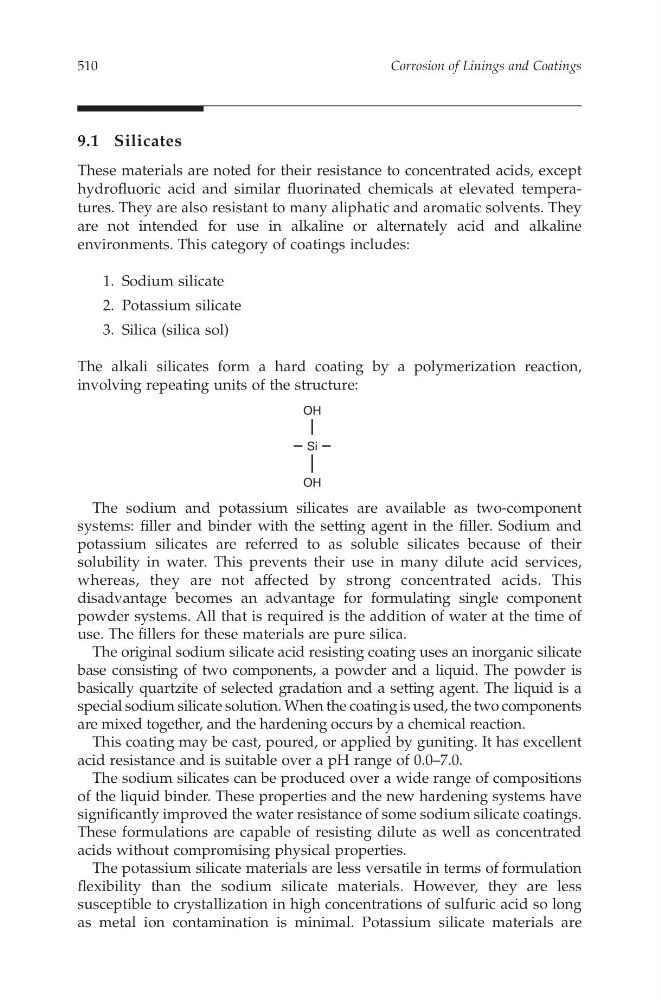
The alkali silicates form ah ard coating by ap olymerizationr eaction,
involving repeating units of the structure:
The sodium and potassium silicates are available as two-component
systems: filler and binder with the setting agent in the filler.S odium and
potassium silicatesa re referred to as soluble silicates because of their
solubility in water.T his prevents theiru se in manyd ilute acid services,
whereas, they aren ot affected by strong concentrateda cids.T his
disadvantage becomes an advantage for formulating single component
powder systems.A ll that is requiredi st he addition of water at the timeo f
use. The fillers for thesem aterials are pure silica.
Theoriginalsodiumsilicateacidresisting coatinguses an inorganicsilicate
base consisting of twoc omponents, ap owder andaliquid.T he powder is
basicallyq uartzite of selectedg radation andas ettinga gent.T he liquid is a
specialsodiumsilicatesolution. When thecoating is used,the twocomponents
aremixed together,and thehardeningoccurs by achemicalreaction.
This coating may be cast, poured, or appliedbyguniting. It has excellent
acid resistance and is suitable over ap Hr angeo f0 .0–7.0.
The sodiumsilicatescan be produced over awide range of compositions
of the liquidbinder.These properties and the newhardening systems have
significantly improved the water resistance of some sodiumsilicate coatings.
These formulations are capable of resisting dilute as well as concentrated
acidsw ithout compromising physical properties.
The potassium silicate materials are less versatileinterms of formulation
flexibility than thes odiums ilicatem aterials.H owever,t heya re less
susceptible to crystallization in highc oncentrations of sulfuric acid so long
as metal ion contamination is minimal. Potassium silicate materials are
OH
OH
Si
Corrosion of Linings and Coatings
510
CAT8247—CHAPTER 9—6/10/2006—12:51—SRIDHAR—XML MODEL B–pp. 509–513
These materials are noted for their resistance to concentrated acids, except
hydrofluoric acid and similar fluorinated chemicals at elevated temperatures. They arealso resistant to many aliphatic and aromatic solvents. They
are not intended for use in alkaline or alternately acid and alkaline
environments. Thisc ategory of coatings includes:
1. Sodium silicate
2. Potassium silicate
3. Silica (silica sol)
The alkali silicates form ah ard coating by ap olymerizationr eaction,
involving repeating units of the structure:
The sodium and potassium silicates are available as two-component
systems: filler and binder with the setting agent in the filler.S odium and
potassium silicatesa re referred to as soluble silicates because of their
solubility in water.T his prevents theiru se in manyd ilute acid services,
whereas, they aren ot affected by strong concentrateda cids.T his
disadvantage becomes an advantage for formulating single component
powder systems.A ll that is requiredi st he addition of water at the timeo f
use. The fillers for thesem aterials are pure silica.
Theoriginalsodiumsilicateacidresisting coatinguses an inorganicsilicate
base consisting of twoc omponents, ap owder andaliquid.T he powder is
basicallyq uartzite of selectedg radation andas ettinga gent.T he liquid is a
specialsodiumsilicatesolution. When thecoating is used,the twocomponents
aremixed together,and thehardeningoccurs by achemicalreaction.
This coating may be cast, poured, or appliedbyguniting. It has excellent
acid resistance and is suitable over ap Hr angeo f0 .0–7.0.
The sodiumsilicatescan be produced over awide range of compositions
of the liquidbinder.These properties and the newhardening systems have
significantly improved the water resistance of some sodiumsilicate coatings.
These formulations are capable of resisting dilute as well as concentrated
acidsw ithout compromising physical properties.
The potassium silicate materials are less versatileinterms of formulation
flexibility than thes odiums ilicatem aterials.H owever,t heya re less
susceptible to crystallization in highc oncentrations of sulfuric acid so long
as metal ion contamination is minimal. Potassium silicate materials are
OH
OH
Si
Corrosion of Linings and Coatings
510
CAT8247—CHAPTER 9—6/10/2006—12:51—SRIDHAR—XML MODEL B–pp. 509–513