

Ther esinsa re formed from polymers of acrylate esters,p rimarily
polymethyl methacrylate and polyethyl acrylate. Because the acrylate esters
do not contain tertiaryhydrogens attached directly to the polymer backbone
chain,they are exceptionally stable to oxygen and UV light.
Aw ider ange of monomers is available for use in designingas pecific
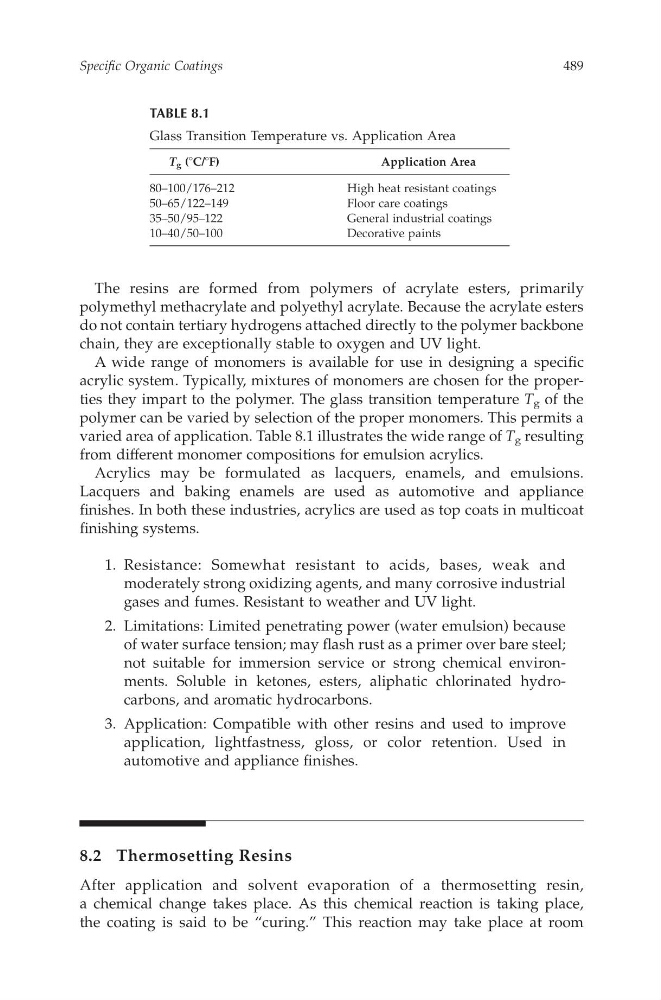
acrylic system.T ypically, mixtures of monomers arec hosen for the properties they impart to the polymer.T he glass transition temperature T g of the
polymercan be varied by selection of the proper monomers. Thispermits a
varied area of application. Table 8.1 illustrates the wide range of T g resulting
from different monomer compositionsf or emulsionacrylics.
Acrylicsm ay be formulateda sl acquers,e namels, ande mulsions.
Lacquers and baking enamels are used as automotive and appliance
finishes. In both theseindustries, acrylics are used as top coats in multicoat
finishing systems.
1. Resistance:S omewhatr esistantt oa cids,b ases, weak and
moderately strong oxidizing agents, and manycorrosive industrial
gases and fumes. Resistantt ow eatherand UV light.
2. Limitations:L imited penetratingp ower (water emulsion) because
of water surface tension; may flash rust as aprimer over bare steel;
not suitablef or immersions ervice or strong chemical environments. Soluble in ketones, esters, aliphatic chlorinated hydrocarbons, and aromatic hydrocarbons.
3. Application:C ompatiblew ith other resins and used to improve
application,l ightfastness, gloss, or color retention.U sedi n
automotive and appliance finishes.
8.2T hermosetting Resins
Aftera pplication ands olvente vaporation of at hermosetting resin,
ac hemical change takesp lace. As this chemical reaction is taking place,
the coating is said to be “curing.” Thisr eaction may take place at room
TABLE 8.1
Glass Transition Temperaturevs. Application Area
T g ( 8 C/8 F)
Application Area
80–100/176–212
High heat resistant coatings
50–65/122–149
Floor carec oatings
35–50/95–122
General industrial coatings
10–40/50–100
Decorative paints
Specific Organic Coatings
489
CAT8247—CHAPTER 8—17/10/2006—14:20—SRIDHAR—XML MODEL B–pp. 487–507
polymethyl methacrylate and polyethyl acrylate. Because the acrylate esters
do not contain tertiaryhydrogens attached directly to the polymer backbone
chain,they are exceptionally stable to oxygen and UV light.
Aw ider ange of monomers is available for use in designingas pecific
acrylic system.T ypically, mixtures of monomers arec hosen for the properties they impart to the polymer.T he glass transition temperature T g of the
polymercan be varied by selection of the proper monomers. Thispermits a
varied area of application. Table 8.1 illustrates the wide range of T g resulting
from different monomer compositionsf or emulsionacrylics.
Acrylicsm ay be formulateda sl acquers,e namels, ande mulsions.
Lacquers and baking enamels are used as automotive and appliance
finishes. In both theseindustries, acrylics are used as top coats in multicoat
finishing systems.
1. Resistance:S omewhatr esistantt oa cids,b ases, weak and
moderately strong oxidizing agents, and manycorrosive industrial
gases and fumes. Resistantt ow eatherand UV light.
2. Limitations:L imited penetratingp ower (water emulsion) because
of water surface tension; may flash rust as aprimer over bare steel;
not suitablef or immersions ervice or strong chemical environments. Soluble in ketones, esters, aliphatic chlorinated hydrocarbons, and aromatic hydrocarbons.
3. Application:C ompatiblew ith other resins and used to improve
application,l ightfastness, gloss, or color retention.U sedi n
automotive and appliance finishes.
8.2T hermosetting Resins
Aftera pplication ands olvente vaporation of at hermosetting resin,
ac hemical change takesp lace. As this chemical reaction is taking place,
the coating is said to be “curing.” Thisr eaction may take place at room
TABLE 8.1
Glass Transition Temperaturevs. Application Area
T g ( 8 C/8 F)
Application Area
80–100/176–212
High heat resistant coatings
50–65/122–149
Floor carec oatings
35–50/95–122
General industrial coatings
10–40/50–100
Decorative paints
Specific Organic Coatings
489
CAT8247—CHAPTER 8—17/10/2006—14:20—SRIDHAR—XML MODEL B–pp. 487–507