

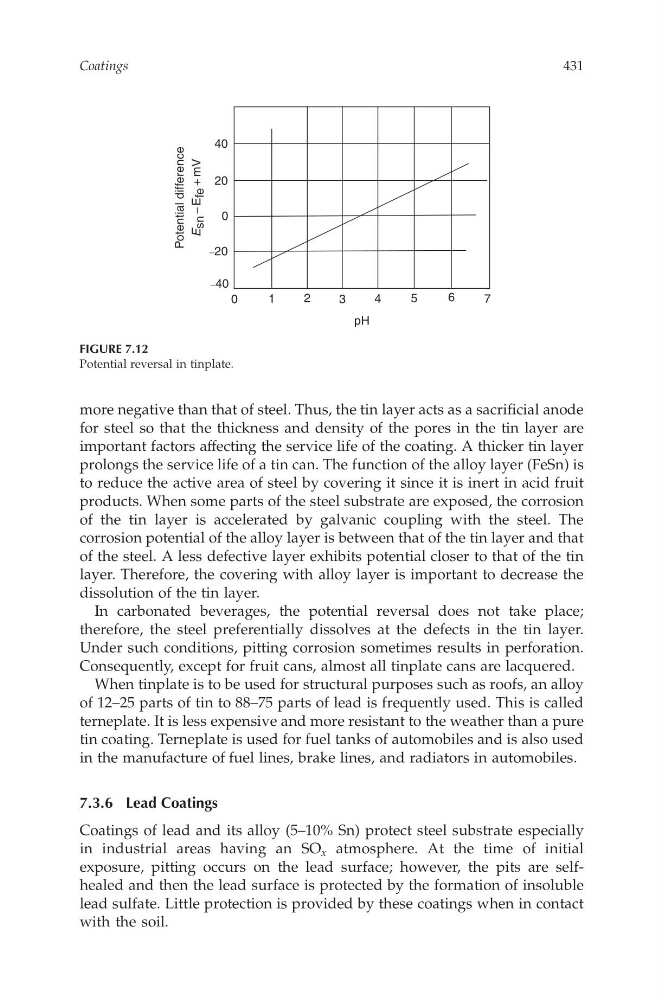
more negative than that of steel. Thus, the tin layer acts as asacrificial anode
for steel so that the thickness and density of the pores in the tin layer are
important factors affecting the service life of the coating. Athicker tin layer
prolongs the service life of atin can. The function of the alloy layer (FeSn) is
to reduce the active area of steel by covering it since it is inert in acidf ruit
products. When some parts of the steel substrate are exposed, the corrosion
of the tin layer is accelerated by galvanic coupling with the steel. The
corrosion potential of the alloy layer is between that of the tin layer and that
of the steel. Al ess defectivel ayer exhibits potential closer to that of the tin
layer.T herefore,t he covering with alloy layer is importantt od ecrease the
dissolution of the tin layer.
In carbonated beverages, the potential reversal does not take place;
therefore, the steel preferentially dissolves at the defects in the tin layer.
Under suchc onditions, pitting corrosion sometimes results in perforation.
Consequently,e xcept for fruit cans, almost all tinplate cans arel acquered.
When tinplate is to be used for structural purposes such as roofs, an alloy
of 12–25 parts of tin to 88–75 parts of lead is frequently used. Thisi sc alled
terneplate. It is less expensive and more resistant to the weatherthan apure
tin coating. Terneplate is used for fueltanks of automobiles and is also used
in the manufacture of fuel lines, brake lines, and radiators in automobiles.
7.3.6 Lead Coatings
Coatings of lead and its alloy (5–10% Sn) protect steel substrate especially
in industrial areas havinga nS O x atmosphere. At the time of initial
exposure, pitting occurs on the lead surface; however,t he pits are selfhealed and then the lead surface is protected by the formation of insoluble
lead sulfate. Little protection is provided by these coatings when in contact
with the soil.
40
20
0
− 20
− 40
0
1
2
3
4
5
6
7
pH
Potential difference
E sn
− E fe
+ mV
FIGURE 7.12
Potential reversal in tinplate.
Coatings
431
CAT8247—CHAPTER 7—17/10/2006—15:02—TRGANESH—XMLM ODEL B–pp. 403–485
for steel so that the thickness and density of the pores in the tin layer are
important factors affecting the service life of the coating. Athicker tin layer
prolongs the service life of atin can. The function of the alloy layer (FeSn) is
to reduce the active area of steel by covering it since it is inert in acidf ruit
products. When some parts of the steel substrate are exposed, the corrosion
of the tin layer is accelerated by galvanic coupling with the steel. The
corrosion potential of the alloy layer is between that of the tin layer and that
of the steel. Al ess defectivel ayer exhibits potential closer to that of the tin
layer.T herefore,t he covering with alloy layer is importantt od ecrease the
dissolution of the tin layer.
In carbonated beverages, the potential reversal does not take place;
therefore, the steel preferentially dissolves at the defects in the tin layer.
Under suchc onditions, pitting corrosion sometimes results in perforation.
Consequently,e xcept for fruit cans, almost all tinplate cans arel acquered.
When tinplate is to be used for structural purposes such as roofs, an alloy
of 12–25 parts of tin to 88–75 parts of lead is frequently used. Thisi sc alled
terneplate. It is less expensive and more resistant to the weatherthan apure
tin coating. Terneplate is used for fueltanks of automobiles and is also used
in the manufacture of fuel lines, brake lines, and radiators in automobiles.
7.3.6 Lead Coatings
Coatings of lead and its alloy (5–10% Sn) protect steel substrate especially
in industrial areas havinga nS O x atmosphere. At the time of initial
exposure, pitting occurs on the lead surface; however,t he pits are selfhealed and then the lead surface is protected by the formation of insoluble
lead sulfate. Little protection is provided by these coatings when in contact
with the soil.
40
20
0
− 20
− 40
0
1
2
3
4
5
6
7
pH
Potential difference
E sn
− E fe
+ mV
FIGURE 7.12
Potential reversal in tinplate.
Coatings
431
CAT8247—CHAPTER 7—17/10/2006—15:02—TRGANESH—XMLM ODEL B–pp. 403–485