

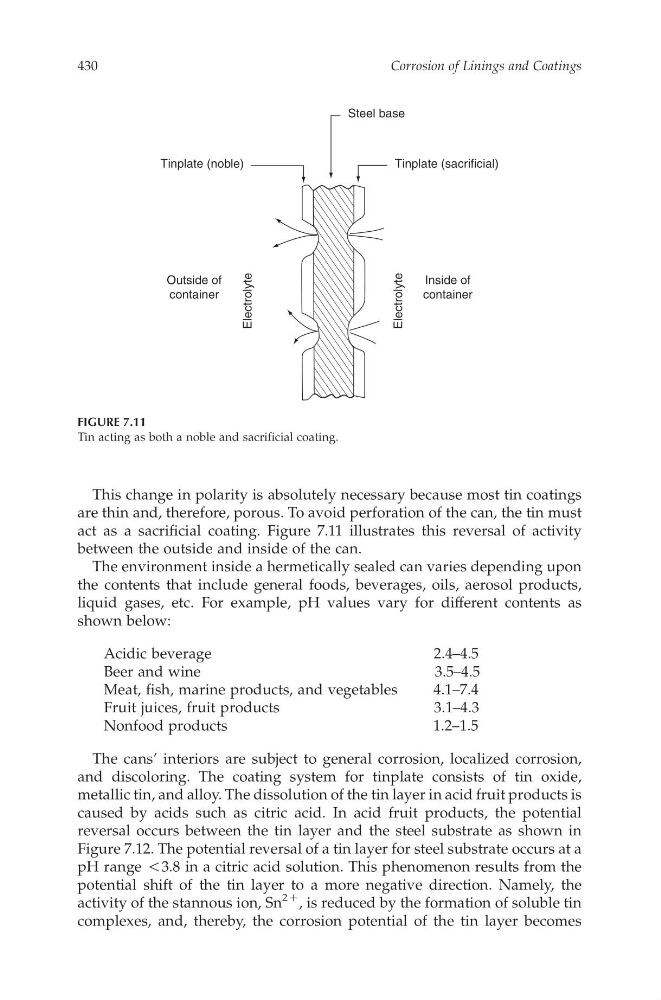
This changei np olarity is absolutely necessary because most tin coatings
are thin and, therefore, porous. To avoid perforation of the can, the tin must
act as as acrificial coating. Figure 7.11i llustrates this reversal of activity
between the outsidea nd inside of the can.
The environment inside ahermetically sealed can variesdependingupon
the contents that include general foods, beverages, oils,a erosol products,
liquidg ases, etc. For example, pH values vary for differentc ontents as
shown below:
Acidic beverage2 .4–4.5
Beer and wine
3.5–4.5
Meat, fish, marine products, and vegetables
4.1–7.4
Fruit juices, fruit products
3.1–4.3
Nonfood products
1.2–1.5
The cans’ interiors are subject to general corrosion, localized corrosion,
and discoloring. The coating system for tinplate consists of tin oxide,
metallic tin, and alloy. The dissolution of the tin layer in acid fruit products is
caused by acids sucha sc itric acid. In acid fruit products, the potential
reversal occurs between the tin layer and the steel substrate as shown in
Figure 7.12.The potential reversal of atin layer for steel substrate occurs at a
pH range ! 3.8 in ac itric acid solution. Thisp henomenon results from the
potential shift of the tin layer to am ore negative direction. Namely,t he
activity of the stannous ion,Sn
2 C
,isreduced by the formation of soluble tin
complexes, and, thereby,t he corrosion potential of the tin layer becomes
Steel base
Tinplate (noble)
Tinplate (sacrificial)
Outside of
container
Inside of
container
Electrolyte
Electrolyte
FIGURE 7.11
Tinacting as both anoble and sacrificialcoating.
Corrosion of Linings and Coatings
430
CAT8247—CHAPTER 7—17/10/2006—15:02—TRGANESH—XMLM ODEL B–pp. 403–485
are thin and, therefore, porous. To avoid perforation of the can, the tin must
act as as acrificial coating. Figure 7.11i llustrates this reversal of activity
between the outsidea nd inside of the can.
The environment inside ahermetically sealed can variesdependingupon
the contents that include general foods, beverages, oils,a erosol products,
liquidg ases, etc. For example, pH values vary for differentc ontents as
shown below:
Acidic beverage2 .4–4.5
Beer and wine
3.5–4.5
Meat, fish, marine products, and vegetables
4.1–7.4
Fruit juices, fruit products
3.1–4.3
Nonfood products
1.2–1.5
The cans’ interiors are subject to general corrosion, localized corrosion,
and discoloring. The coating system for tinplate consists of tin oxide,
metallic tin, and alloy. The dissolution of the tin layer in acid fruit products is
caused by acids sucha sc itric acid. In acid fruit products, the potential
reversal occurs between the tin layer and the steel substrate as shown in
Figure 7.12.The potential reversal of atin layer for steel substrate occurs at a
pH range ! 3.8 in ac itric acid solution. Thisp henomenon results from the
potential shift of the tin layer to am ore negative direction. Namely,t he
activity of the stannous ion,Sn
2 C
,isreduced by the formation of soluble tin
complexes, and, thereby,t he corrosion potential of the tin layer becomes
Steel base
Tinplate (noble)
Tinplate (sacrificial)
Outside of
container
Inside of
container
Electrolyte
Electrolyte
FIGURE 7.11
Tinacting as both anoble and sacrificialcoating.
Corrosion of Linings and Coatings
430
CAT8247—CHAPTER 7—17/10/2006—15:02—TRGANESH—XMLM ODEL B–pp. 403–485