

7.2M etallicCoatings
Metallic coatings are applied to metal substrates for several purposes.
Typical purposes includei mproved corrosionr esistance, wear resistance,
and appearance. Of primary concernisc orrosionresistance.
By providing ab arrier between the substrate and the environment or by
cathodically protecting the substrate,metallic coatings protect the substrate
from corrosion. Coatings of chromium, copper,and nickel provide increased
wear resistance and good corrosionresistance. However,these noblemetals
make the combination of the substrate (mostly steel or an aluminuma lloy)
with the protective layer sensitive to galvanically induced local corrosion.
Nonnoble metallic layerss uch as zinc or cadmium provide good cathodic
protection but show poor wear resistance.
Acoating of acorrosion resistant metal on acorrosion prone substrate can
be formed by variousmethods. The choice of coating material and selection
of an application method are determined by the end use.
7.2.1 Methods of Producing Coatings
7.2.1.1 Electroplating
This is one of the most versatile methods. The metal to be coated is madethe
cathode in an electrolytic cell. Ap otential is applied between the cathode
that the platingo ccurs on and the anode that may be the same metal or an
inert material such as graphite. This method can be used for all metals
that can be electrolytically reduced from the ionic state to the metallic state
when present in an electrolyte. Aluminum,t itanium, sodium, magnesium,
and calcium cannotb ee lectrodeposited from aqueous solutionb ecause
the competingc athodic reaction,2 H
C
C 2 e
K
Z H 2 ,i ss tronglyt hermodynamically favored and takes place in preference to the reduction of the
metal ion.T hese metals can be electrodeposited from conductingo rganic
Me
n +
e
−
e
−
Metallic film
Substrate
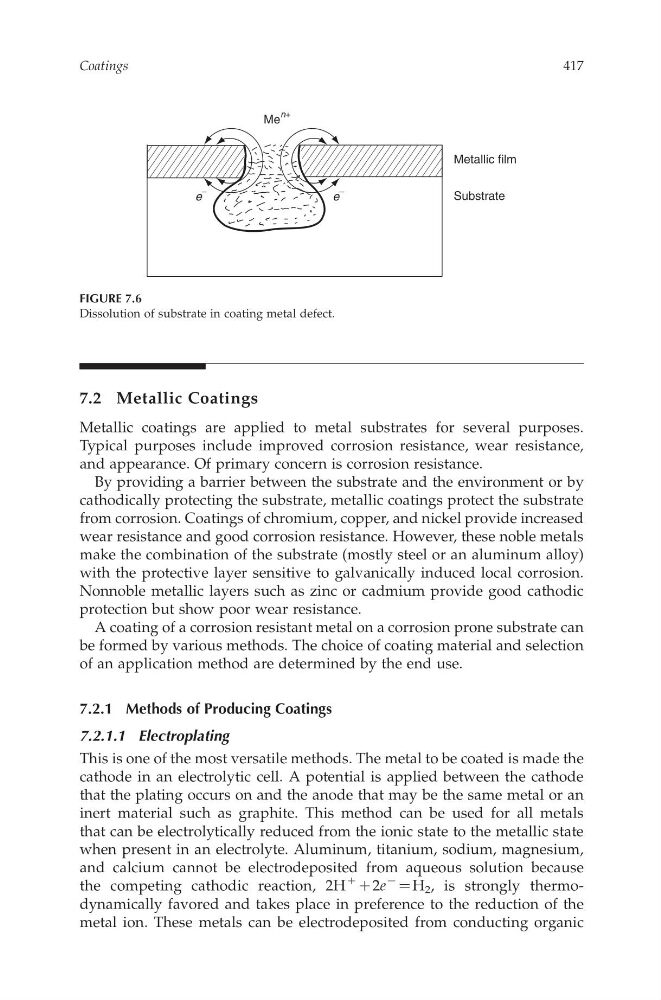
FIGURE 7.6
Dissolutionofsubstrate in coating metal defect.
Coatings
417
CAT8247—CHAPTER 7—17/10/2006—15:02—TRGANESH—XMLM ODEL B–pp. 403–485
Metallic coatings are applied to metal substrates for several purposes.
Typical purposes includei mproved corrosionr esistance, wear resistance,
and appearance. Of primary concernisc orrosionresistance.
By providing ab arrier between the substrate and the environment or by
cathodically protecting the substrate,metallic coatings protect the substrate
from corrosion. Coatings of chromium, copper,and nickel provide increased
wear resistance and good corrosionresistance. However,these noblemetals
make the combination of the substrate (mostly steel or an aluminuma lloy)
with the protective layer sensitive to galvanically induced local corrosion.
Nonnoble metallic layerss uch as zinc or cadmium provide good cathodic
protection but show poor wear resistance.
Acoating of acorrosion resistant metal on acorrosion prone substrate can
be formed by variousmethods. The choice of coating material and selection
of an application method are determined by the end use.
7.2.1 Methods of Producing Coatings
7.2.1.1 Electroplating
This is one of the most versatile methods. The metal to be coated is madethe
cathode in an electrolytic cell. Ap otential is applied between the cathode
that the platingo ccurs on and the anode that may be the same metal or an
inert material such as graphite. This method can be used for all metals
that can be electrolytically reduced from the ionic state to the metallic state
when present in an electrolyte. Aluminum,t itanium, sodium, magnesium,
and calcium cannotb ee lectrodeposited from aqueous solutionb ecause
the competingc athodic reaction,2 H
C
C 2 e
K
Z H 2 ,i ss tronglyt hermodynamically favored and takes place in preference to the reduction of the
metal ion.T hese metals can be electrodeposited from conductingo rganic
Me
n +
e
−
e
−
Metallic film
Substrate
FIGURE 7.6
Dissolutionofsubstrate in coating metal defect.
Coatings
417
CAT8247—CHAPTER 7—17/10/2006—15:02—TRGANESH—XMLM ODEL B–pp. 403–485