

layer,t he corrosionb ehavior is characterized by as ideways diversion.
Pitting corrosion is diverted laterally when it reaches the more noble semibright deposit. Thus, the behavior of bright nickelp rolongs the time for
pitting penetrationtor each the basem etal.
The most negative of all nickel deposits is trinickel. In the triplex layer
coating system, ac oating of trinickela pproximately 1 m mt hick, containing
0.1–0.25% sulfur is appliedb etween bright nickel ands emibright nickel
deposits. The high sulfur nickel layer dissolves preferentially,e ven when
pitting corrosion reaches the surfaceofthe semibright deposit. Since the high
sulfur layer reacts with the bright nickel layer,p itting corrosion does not
penetrate the high sulfur nickellayer in the tunneling form.The application
of ah igh sulfur nickels trike definitely improves the protective ability of
am ultistage nickelc oating.
7.1.6R esistance Control Protection
Resistance control protection is achieved by using organic compounds, such
as some paints, as coating materials. The coating layer delays the transito f
ionst ot he substrate thereby,i nhibiting the formationo fc orrosion cells.
Figure 7.6 illustrates the principles of resistance control protection by an
organic coating. The corrosion rate of iron is inhibited by the coating from
i corr of uncoated iront o i corr of coatediron.
− 300
− 350
− 400
− 450
Dull bright
nickelcoating
Semibright
nickelcoating
Bright
nickelcoating
Sulfur content wt%
Corrosion
potential
of
nickel,
mV,SCE
0.001
0.01
0.1
1.0
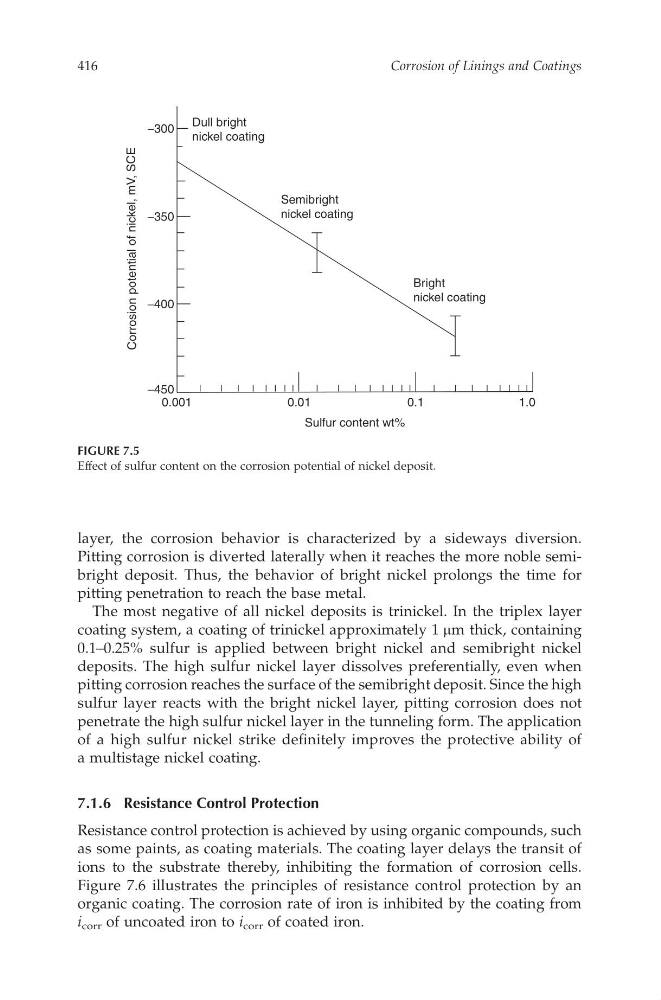
FIGURE 7.5
Effect of sulfur content on the corrosion potential of nickel deposit.
Corrosion of Linings and Coatings
416
CAT8247—CHAPTER 7—17/10/2006—15:02—TRGANESH—XMLM ODEL B–pp. 403–485
Pitting corrosion is diverted laterally when it reaches the more noble semibright deposit. Thus, the behavior of bright nickelp rolongs the time for
pitting penetrationtor each the basem etal.
The most negative of all nickel deposits is trinickel. In the triplex layer
coating system, ac oating of trinickela pproximately 1 m mt hick, containing
0.1–0.25% sulfur is appliedb etween bright nickel ands emibright nickel
deposits. The high sulfur nickel layer dissolves preferentially,e ven when
pitting corrosion reaches the surfaceofthe semibright deposit. Since the high
sulfur layer reacts with the bright nickel layer,p itting corrosion does not
penetrate the high sulfur nickellayer in the tunneling form.The application
of ah igh sulfur nickels trike definitely improves the protective ability of
am ultistage nickelc oating.
7.1.6R esistance Control Protection
Resistance control protection is achieved by using organic compounds, such
as some paints, as coating materials. The coating layer delays the transito f
ionst ot he substrate thereby,i nhibiting the formationo fc orrosion cells.
Figure 7.6 illustrates the principles of resistance control protection by an
organic coating. The corrosion rate of iron is inhibited by the coating from
i corr of uncoated iront o i corr of coatediron.
− 300
− 350
− 400
− 450
Dull bright
nickelcoating
Semibright
nickelcoating
Bright
nickelcoating
Sulfur content wt%
Corrosion
potential
of
nickel,
mV,SCE
0.001
0.01
0.1
1.0
FIGURE 7.5
Effect of sulfur content on the corrosion potential of nickel deposit.
Corrosion of Linings and Coatings
416
CAT8247—CHAPTER 7—17/10/2006—15:02—TRGANESH—XMLM ODEL B–pp. 403–485