

artificially; therefore, they will return to their original ores or to similar
metallic compounds when exposed to the atmosphere. For example, metallic
iron is oxidized to ferric oxyhydride in at hermodynamically stable state
(iron in the higher level of free energy is changed to lepidocrocite, g -FeOOH,
in the lower level):
4Fe C 3O 2 C 2H 2 O / 4FeOOH
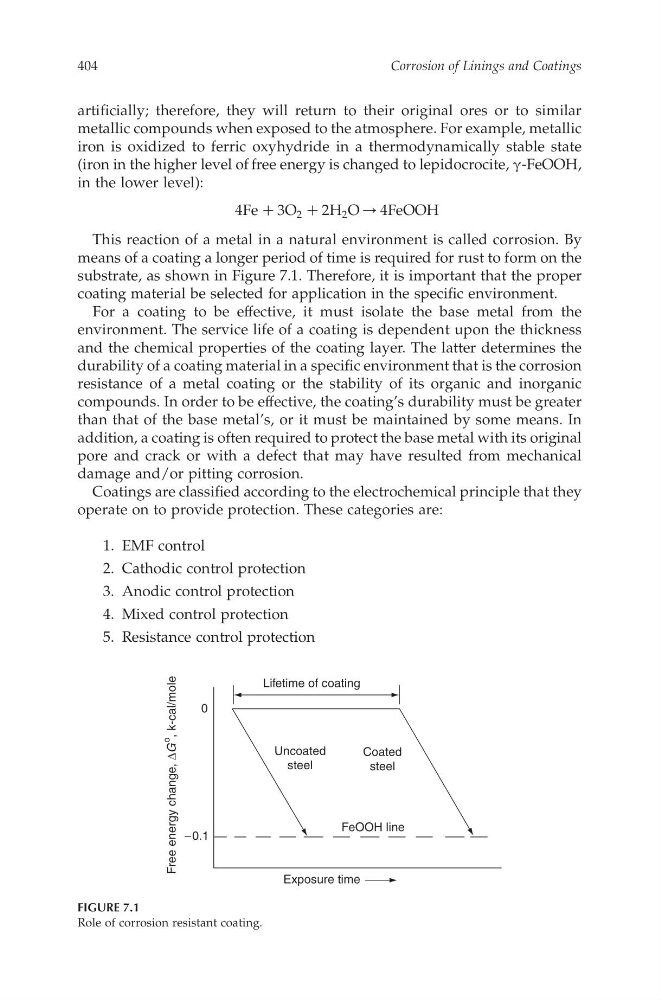
This reaction of am etal in an atural environment is called corrosion. By
means of acoating alonger period of time is requiredfor rusttoformonthe
substrate, as shown in Figure 7.1.T herefore, it is important that the proper
coating material be selected for applicationint he specific environment.
For ac oating to be effective,i tm usti solate the base metal from the
environment. The service life of ac oating is dependent upon the thickness
and the chemical properties of the coating layer.T he latter determines the
durability of acoating material in aspecificenvironment that is the corrosion
resistance of am etal coating or the stability of its organic and inorganic
compounds.Inorder to be effective, the coating’s durability must be greater
than that of the base metal’s, or it must be maintained by somem eans. In
addition, acoating is often requiredtoprotect the base metal with its original
pore and crack or with ad efect that may have resulted from mechanical
damagea nd/or pitting corrosion.
Coatings are classified according to the electrochemical principle that they
operate on to provide protection. These categories are:
1. EMF control
2. Cathodic controlp rotection
3. Anodic controlp rotection
4. Mixed control protection
5. Resistance control protection
Lifetime of coating
Uncoated
steel
Coated
steel
FeOOH line
Exposure time
0
− 0.1
Free energy change,
∆G
o
, k-cal/mole
FIGURE 7.1
Role of corrosion resistant coating.
Corrosion of Linings and Coatings
404
CAT8247—CHAPTER 7—17/10/2006—15:02—TRGANESH—XMLM ODEL B–pp. 403–485
metallic compounds when exposed to the atmosphere. For example, metallic
iron is oxidized to ferric oxyhydride in at hermodynamically stable state
(iron in the higher level of free energy is changed to lepidocrocite, g -FeOOH,
in the lower level):
4Fe C 3O 2 C 2H 2 O / 4FeOOH
This reaction of am etal in an atural environment is called corrosion. By
means of acoating alonger period of time is requiredfor rusttoformonthe
substrate, as shown in Figure 7.1.T herefore, it is important that the proper
coating material be selected for applicationint he specific environment.
For ac oating to be effective,i tm usti solate the base metal from the
environment. The service life of ac oating is dependent upon the thickness
and the chemical properties of the coating layer.T he latter determines the
durability of acoating material in aspecificenvironment that is the corrosion
resistance of am etal coating or the stability of its organic and inorganic
compounds.Inorder to be effective, the coating’s durability must be greater
than that of the base metal’s, or it must be maintained by somem eans. In
addition, acoating is often requiredtoprotect the base metal with its original
pore and crack or with ad efect that may have resulted from mechanical
damagea nd/or pitting corrosion.
Coatings are classified according to the electrochemical principle that they
operate on to provide protection. These categories are:
1. EMF control
2. Cathodic controlp rotection
3. Anodic controlp rotection
4. Mixed control protection
5. Resistance control protection
Lifetime of coating
Uncoated
steel
Coated
steel
FeOOH line
Exposure time
0
− 0.1
Free energy change,
∆G
o
, k-cal/mole
FIGURE 7.1
Role of corrosion resistant coating.
Corrosion of Linings and Coatings
404
CAT8247—CHAPTER 7—17/10/2006—15:02—TRGANESH—XMLM ODEL B–pp. 403–485