

7
Coatings
7.1I ntroduction to Coatings
Construction metals ares elected because of their mechanical properties
and machineability at al ow price,a lthough, they should also be corrosion
resistant. Ve ry seldom can these properties be met in one and the same
material. This is where coatings come into play.Byapplying an appropriate
coating, the basemetal with the good mechanical properties can be utilized
while the appropriate coating provides corrosion protection.
The majority of coatings are applied on external surfaces to protect the
metal from natural atmospheric corrosion, and atmospheric pollution.
On occasion, it may also be necessary to provide protection from accidental
spillsand/or splashes. In someinstances, coatings are applied internally in
vessels for corrosion resistance.
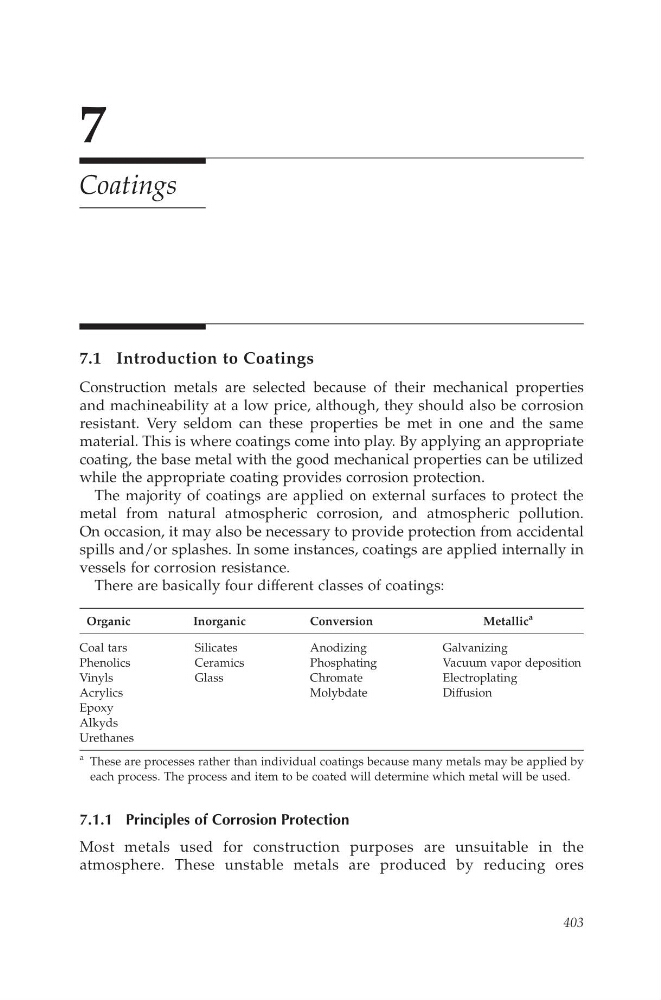
There are basically fourdifferent classes of coatings:
Organic
Inorganic
Conversion
Metallic
a
Coal tars
Silicates
Anodizing
Galvanizing
Phenolics
Ceramics
Phosphating
Vacuum vapor deposition
Vinyls
Glass
Chromate
Electroplating
Acrylics
Molybdate
Diffusion
Epoxy
Alkyds
Urethanes
a These are processes rather than individualcoatings because many metals may be applied by
each process. The process and item to be coated will determine which metal will be used.
7.1.1 Principles of Corrosion Protection
Most metals usedf or construction purposes areu nsuitable in the
atmosphere.T hese unstable metals arep roducedb yr educingo res
CAT8247—CHAPTER 7—17/10/2006—15:01—TRGANESH—XMLM ODEL B–pp. 403–485
403
Coatings
7.1I ntroduction to Coatings
Construction metals ares elected because of their mechanical properties
and machineability at al ow price,a lthough, they should also be corrosion
resistant. Ve ry seldom can these properties be met in one and the same
material. This is where coatings come into play.Byapplying an appropriate
coating, the basemetal with the good mechanical properties can be utilized
while the appropriate coating provides corrosion protection.
The majority of coatings are applied on external surfaces to protect the
metal from natural atmospheric corrosion, and atmospheric pollution.
On occasion, it may also be necessary to provide protection from accidental
spillsand/or splashes. In someinstances, coatings are applied internally in
vessels for corrosion resistance.
There are basically fourdifferent classes of coatings:
Organic
Inorganic
Conversion
Metallic
a
Coal tars
Silicates
Anodizing
Galvanizing
Phenolics
Ceramics
Phosphating
Vacuum vapor deposition
Vinyls
Glass
Chromate
Electroplating
Acrylics
Molybdate
Diffusion
Epoxy
Alkyds
Urethanes
a These are processes rather than individualcoatings because many metals may be applied by
each process. The process and item to be coated will determine which metal will be used.
7.1.1 Principles of Corrosion Protection
Most metals usedf or construction purposes areu nsuitable in the
atmosphere.T hese unstable metals arep roducedb yr educingo res
CAT8247—CHAPTER 7—17/10/2006—15:01—TRGANESH—XMLM ODEL B–pp. 403–485
403