

of NR. The major difference is that isoprene has no odor and, therefore, can
be used in the handlingo fcertain food products.
6.5.3 Neoprene
The maximum temperature that neoprene (CR) can be used under is
180–2008 F(82–938 C). Excellent service is experiencedincontact with aliphatic
compounds(methyl and ethyl alcohols, ethylene glycols, etc.), aliphatic
hydrocarbons, andm ostf reonr efrigerants.H owever,t he outstanding
properties of neoprene is its resistance to attack from solvents, waxes, fats,
oils, greases, and many other petroleum-based products. Dilute mineral
acids,inorganic salt solutions, and alkalies can also be handled successfully.
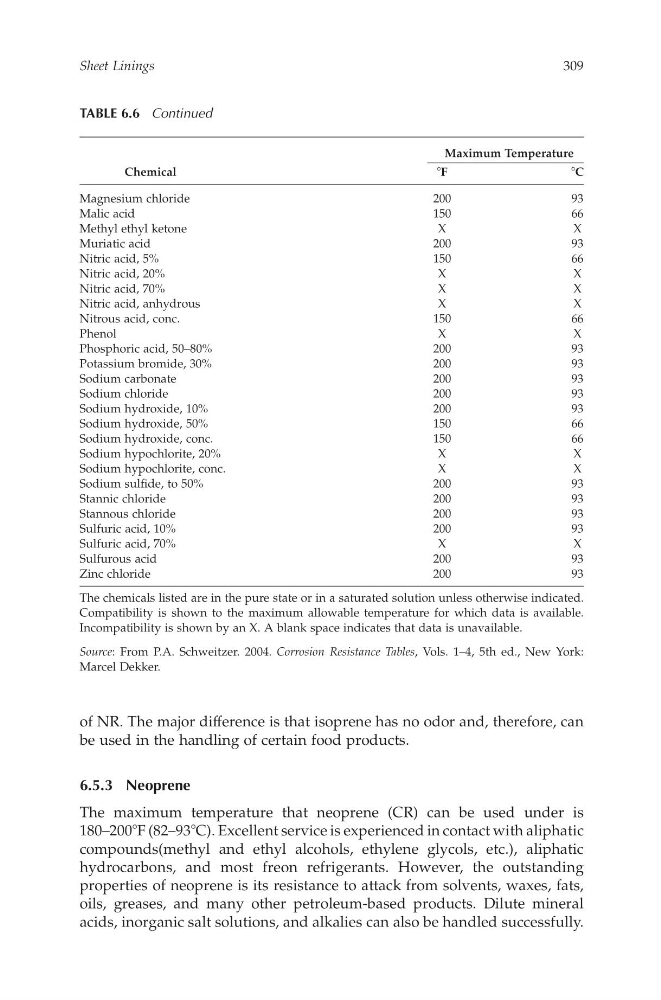
TABLE 6.6 Continued
Maximum Te mperature
Chemical
8 F
8 C
Magnesium chloride
200
93
Malic acid
150
66
Methyl ethyl ketone
XX
Muriatic acid
200
93
Nitric acid, 5%
150
66
Nitric acid, 20%
XX
Nitric acid, 70%
XX
Nitric acid, anhydrous
XX
Nitrous acid, conc.
150
66
Phenol
XX
Phosphoric acid, 50–80%
200
93
Potassium bromide, 30%
200
93
Sodium carbonate
200
93
Sodium chloride
200
93
Sodium hydroxide, 10%
200
93
Sodium hydroxide, 50%
150
66
Sodium hydroxide, conc.
150
66
Sodium hypochlorite, 20%
XX
Sodium hypochlorite, conc.
XX
Sodium sulfide, to 50%
200
93
Stannic chloride
200
93
Stannousc hloride2 00
93
Sulfuric acid, 10%
200
93
Sulfuric acid, 70%
XX
Sulfurous acid
200
93
Zinc chloride
200
93
The chemicalslisted are in the purestate or in asaturated solution unless otherwise indicated.
Compatibility is shown to the maximum allowable temperaturef or which data is available.
Incompatibility is shown by an X. Ab lank space indicates that data is unavailable.
Source:F romP .A. Schweitzer.2 004. Corrosion Resistance Ta bles,V ols. 1–4, 5th ed., New York:
Marcel Dekker.
Sheet Linings
309
CAT8247—CHAPTER 6—6/10/2006—12:28—SRIDHAR—XML MODEL B–pp. 287–402
be used in the handlingo fcertain food products.
6.5.3 Neoprene
The maximum temperature that neoprene (CR) can be used under is
180–2008 F(82–938 C). Excellent service is experiencedincontact with aliphatic
compounds(methyl and ethyl alcohols, ethylene glycols, etc.), aliphatic
hydrocarbons, andm ostf reonr efrigerants.H owever,t he outstanding
properties of neoprene is its resistance to attack from solvents, waxes, fats,
oils, greases, and many other petroleum-based products. Dilute mineral
acids,inorganic salt solutions, and alkalies can also be handled successfully.
TABLE 6.6 Continued
Maximum Te mperature
Chemical
8 F
8 C
Magnesium chloride
200
93
Malic acid
150
66
Methyl ethyl ketone
XX
Muriatic acid
200
93
Nitric acid, 5%
150
66
Nitric acid, 20%
XX
Nitric acid, 70%
XX
Nitric acid, anhydrous
XX
Nitrous acid, conc.
150
66
Phenol
XX
Phosphoric acid, 50–80%
200
93
Potassium bromide, 30%
200
93
Sodium carbonate
200
93
Sodium chloride
200
93
Sodium hydroxide, 10%
200
93
Sodium hydroxide, 50%
150
66
Sodium hydroxide, conc.
150
66
Sodium hypochlorite, 20%
XX
Sodium hypochlorite, conc.
XX
Sodium sulfide, to 50%
200
93
Stannic chloride
200
93
Stannousc hloride2 00
93
Sulfuric acid, 10%
200
93
Sulfuric acid, 70%
XX
Sulfurous acid
200
93
Zinc chloride
200
93
The chemicalslisted are in the purestate or in asaturated solution unless otherwise indicated.
Compatibility is shown to the maximum allowable temperaturef or which data is available.
Incompatibility is shown by an X. Ab lank space indicates that data is unavailable.
Source:F romP .A. Schweitzer.2 004. Corrosion Resistance Ta bles,V ols. 1–4, 5th ed., New York:
Marcel Dekker.
Sheet Linings
309
CAT8247—CHAPTER 6—6/10/2006—12:28—SRIDHAR—XML MODEL B–pp. 287–402