

properties. Hardener systems must be properly balanced for application at
thermalr angeso fa pproximately 60–90 8 F( 15–328 C). Theh igher the
temperature, the faster the set; the lower the temperature, the slower the
set.I mproper ambienta nd material temperaturec an also have a
deleterious effect on the quality of the final installation, i.e., adhesion to
brick,t ile or substrate,h igho rl ow,r ough or porous, or improperly
cured joints.
The most popular fillers used arecarbon,silica, and combinations thereof.
Baraytesh as been used in conjunction with carbon and silica for specific
end-use application. Irrefutably,c arbon is the most inert of the fillers;
consequently,inmany of the resin and sulfur systems, it is the fillerofchoice.
It provides resistance to most chemicals,i ncludings tronga lkalies,
hydrofluoric acid, and other fluorinec hemicals.
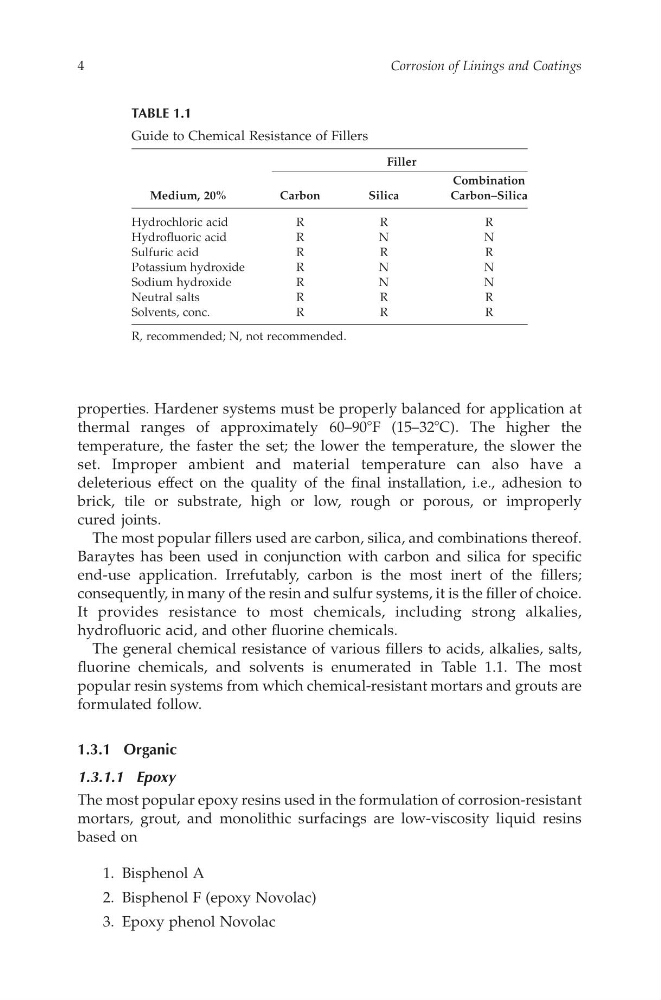
The general chemical resistance of various fillers to acids,a lkalies, salts,
fluorinec hemicals, and solventsi se numerated in Table 1.1.T he most
popular resin systems from whichchemical-resistant mortars and grouts are
formulated follow.
1.3.1O rganic
1.3.1.1 Epoxy
The mostpopular epoxy resins used in the formulation of corrosion-resistant
mortars, grout, and monolithic surfacings are low-viscosity liquidr esins
based on
1. Bisphenol A
2. Bisphenol F( epoxy Novolac)
3. Epoxy phenol Novolac
TABLE 1.1
Guide to Chemical Resistance of Fillers
Filler
Medium,20%
Carbon
Silica
Combination
Carbon–Silica
Hydrochloric acid
RR
R
Hydrofluoric acid
RN
N
Sulfuric acid
RR
R
Potassium hydroxide
RN
N
Sodium hydroxide
RN
N
Neutral salts
RR
R
Solvents, conc.
RR
R
R, recommended; N, not recommended.
Corrosion of Linings and Coatings
4
CAT8247—CHAPTER 1—6/10/2006—11:58—SRIDHAR—XML MODEL B–pp. 1–42
thermalr angeso fa pproximately 60–90 8 F( 15–328 C). Theh igher the
temperature, the faster the set; the lower the temperature, the slower the
set.I mproper ambienta nd material temperaturec an also have a
deleterious effect on the quality of the final installation, i.e., adhesion to
brick,t ile or substrate,h igho rl ow,r ough or porous, or improperly
cured joints.
The most popular fillers used arecarbon,silica, and combinations thereof.
Baraytesh as been used in conjunction with carbon and silica for specific
end-use application. Irrefutably,c arbon is the most inert of the fillers;
consequently,inmany of the resin and sulfur systems, it is the fillerofchoice.
It provides resistance to most chemicals,i ncludings tronga lkalies,
hydrofluoric acid, and other fluorinec hemicals.
The general chemical resistance of various fillers to acids,a lkalies, salts,
fluorinec hemicals, and solventsi se numerated in Table 1.1.T he most
popular resin systems from whichchemical-resistant mortars and grouts are
formulated follow.
1.3.1O rganic
1.3.1.1 Epoxy
The mostpopular epoxy resins used in the formulation of corrosion-resistant
mortars, grout, and monolithic surfacings are low-viscosity liquidr esins
based on
1. Bisphenol A
2. Bisphenol F( epoxy Novolac)
3. Epoxy phenol Novolac
TABLE 1.1
Guide to Chemical Resistance of Fillers
Filler
Medium,20%
Carbon
Silica
Combination
Carbon–Silica
Hydrochloric acid
RR
R
Hydrofluoric acid
RN
N
Sulfuric acid
RR
R
Potassium hydroxide
RN
N
Sodium hydroxide
RN
N
Neutral salts
RR
R
Solvents, conc.
RR
R
R, recommended; N, not recommended.
Corrosion of Linings and Coatings
4
CAT8247—CHAPTER 1—6/10/2006—11:58—SRIDHAR—XML MODEL B–pp. 1–42