

The silicones are used primarilya sl iningsf or high-temperature exhaust
stacks,ovens, and spaceh eaters.
References
1. P. A. Schweitzer.2 004. Corrosion Resistance Ta bles,5 th ed., vols. 1–4, New York:
Marcel Dekker.
2. J.S. Fry,C .N. Merriam, and W.H. Boyd. 1985. Chemistry and technology of
phenolic resins and coatings, in Symposium Series Applied Polymer Science,
Washington, DC: American Chemical Society.
3. R.T.M orrison and R.N. Boyd. 1973. OrganicC hemistry,3 rd ed., Boston: Allyn
Bacon.
4. P. A. Schweitzer.2000. Mechanical and Corrosion Resistant Properties of Plastics and
Elastomers,N ew York: Marcel Dekker.
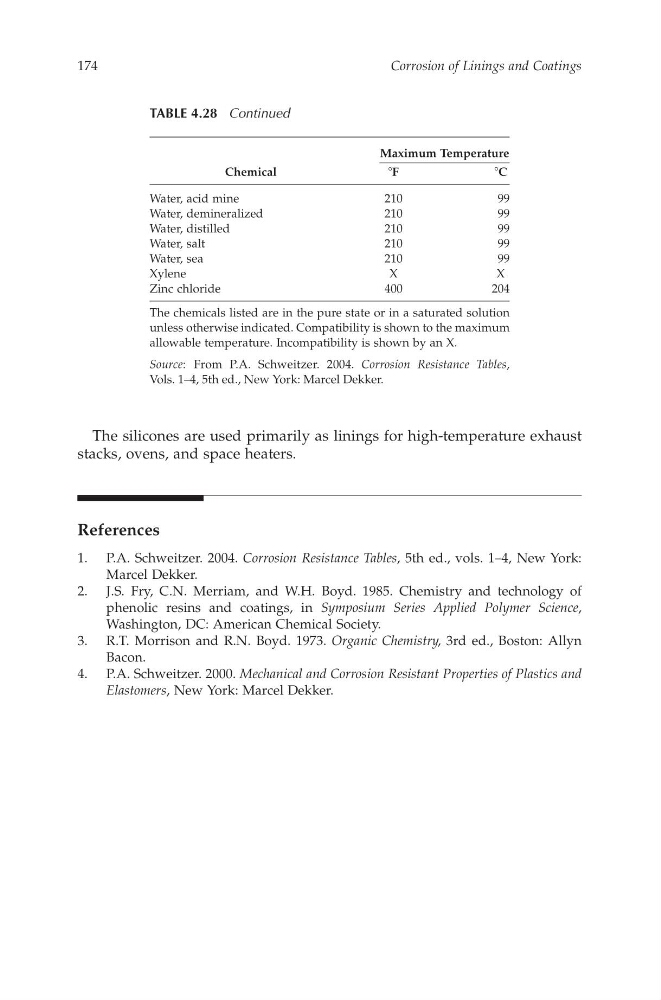
TABLE 4.28 Continued
Maximum Te mperature
Chemical
8 F
8 C
Water,acid mine
210
99
Water,demineralized2 10
99
Water,distilled
210
99
Water,salt
210
99
Water,sea
210
99
Xylene
XX
Zinc chloride
400
204
The chemicals listed are in the pures tate or in as aturated solution
unless otherwise indicated. Compatibility is shown to the maximum
allowable temperature. Incompatibilityi sshown by an X.
Source :F romP .A.S chweitzer. 2004. CorrosionR esistance Ta bles,
Vo ls. 1–4, 5th ed., New York: Marcel Dekker.
Corrosion of Linings and Coatings
174
CAT8247—CHAPTER 4—17/10/2006—14:36—SRIDHAR—XML MODEL B–pp. 69–174
stacks,ovens, and spaceh eaters.
References
1. P. A. Schweitzer.2 004. Corrosion Resistance Ta bles,5 th ed., vols. 1–4, New York:
Marcel Dekker.
2. J.S. Fry,C .N. Merriam, and W.H. Boyd. 1985. Chemistry and technology of
phenolic resins and coatings, in Symposium Series Applied Polymer Science,
Washington, DC: American Chemical Society.
3. R.T.M orrison and R.N. Boyd. 1973. OrganicC hemistry,3 rd ed., Boston: Allyn
Bacon.
4. P. A. Schweitzer.2000. Mechanical and Corrosion Resistant Properties of Plastics and
Elastomers,N ew York: Marcel Dekker.
TABLE 4.28 Continued
Maximum Te mperature
Chemical
8 F
8 C
Water,acid mine
210
99
Water,demineralized2 10
99
Water,distilled
210
99
Water,salt
210
99
Water,sea
210
99
Xylene
XX
Zinc chloride
400
204
The chemicals listed are in the pures tate or in as aturated solution
unless otherwise indicated. Compatibility is shown to the maximum
allowable temperature. Incompatibilityi sshown by an X.
Source :F romP .A.S chweitzer. 2004. CorrosionR esistance Ta bles,
Vo ls. 1–4, 5th ed., New York: Marcel Dekker.
Corrosion of Linings and Coatings
174
CAT8247—CHAPTER 4—17/10/2006—14:36—SRIDHAR—XML MODEL B–pp. 69–174