

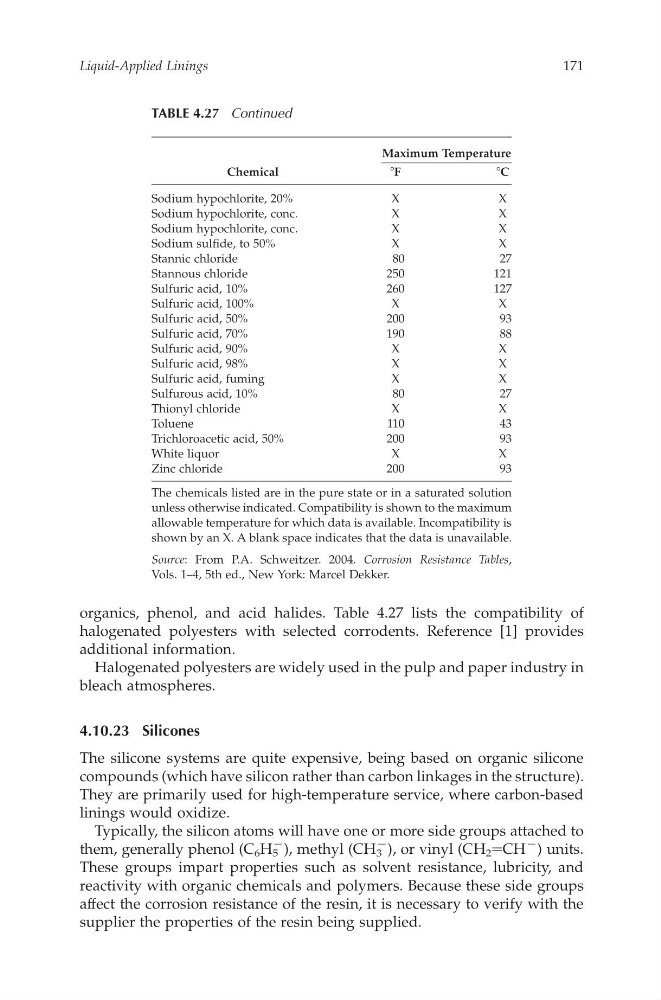
organics, phenol, and acid halides. Table 4.27 lists the compatibility of
halogenated polyesters with selected corrodents. Reference [1] provides
additional information.
Halogenated polyesters are widely used in the pulpand paperindustry in
bleach atmospheres.
4.10.23 Silicones
The silicone systemsa re quite expensive, beingb ased on organic silicone
compounds (which have silicon rather than carbon linkages in the structure).
They are primarilyu sed for high-temperature service,w here carbon-based
liningsw ould oxidize.
Typically, the silicon atoms will have oneormore side groups attached to
them, generally phenol(C 6 H 5
K
), methyl (CH 3
K
), or vinyl (CH 2 a CH
K
)units.
These groups impart properties such as solvent resistance, lubricity,a nd
reactivity with organic chemicals and polymers. Because these side groups
affect the corrosion resistance of the resin, it is necessary to verify with the
supplier the properties of the resin being supplied.
TABLE 4.27 Continued
Maximum Te mperature
Chemical
8 F
8 C
Sodium hypochlorite,2 0%
XX
Sodium hypochlorite,c onc.
XX
Sodium hypochlorite,c onc.
XX
Sodium sulfide, to 50%
XX
Stannic chloride
80
27
Stannous chloride
250
121
Sulfuric acid, 10%
260
127
Sulfuric acid, 100%
XX
Sulfuric acid, 50%
200
93
Sulfuric acid, 70%
190
88
Sulfuric acid, 90%
XX
Sulfuric acid, 98%
XX
Sulfuric acid, fuming
XX
Sulfurous acid, 10%
80
27
Thionyl chloride
XX
Toluene
1104 3
Trichloroacetic acid, 50%
200
93
White liquor
XX
Zinc chloride2 00
93
The chemicals listed are in the pure state or in as aturated solution
unless otherwise indicated. Compatibility is shown to the maximum
allowable temperaturefor which data is available. Incompatibilityis
shown by an X. Ablank space indicates that the data is unavailable.
Source:F rom P. A. Schweitzer.2 004. Corrosion ResistanceT ables ,
Vols. 1–4, 5th ed., New York: Marcel Dekker.
Liquid-Applied Linings
171
CAT8247—CHAPTER 4—17/10/2006—14:36—SRIDHAR—XML MODEL B–pp. 69–174
halogenated polyesters with selected corrodents. Reference [1] provides
additional information.
Halogenated polyesters are widely used in the pulpand paperindustry in
bleach atmospheres.
4.10.23 Silicones
The silicone systemsa re quite expensive, beingb ased on organic silicone
compounds (which have silicon rather than carbon linkages in the structure).
They are primarilyu sed for high-temperature service,w here carbon-based
liningsw ould oxidize.
Typically, the silicon atoms will have oneormore side groups attached to
them, generally phenol(C 6 H 5
K
), methyl (CH 3
K
), or vinyl (CH 2 a CH
K
)units.
These groups impart properties such as solvent resistance, lubricity,a nd
reactivity with organic chemicals and polymers. Because these side groups
affect the corrosion resistance of the resin, it is necessary to verify with the
supplier the properties of the resin being supplied.
TABLE 4.27 Continued
Maximum Te mperature
Chemical
8 F
8 C
Sodium hypochlorite,2 0%
XX
Sodium hypochlorite,c onc.
XX
Sodium hypochlorite,c onc.
XX
Sodium sulfide, to 50%
XX
Stannic chloride
80
27
Stannous chloride
250
121
Sulfuric acid, 10%
260
127
Sulfuric acid, 100%
XX
Sulfuric acid, 50%
200
93
Sulfuric acid, 70%
190
88
Sulfuric acid, 90%
XX
Sulfuric acid, 98%
XX
Sulfuric acid, fuming
XX
Sulfurous acid, 10%
80
27
Thionyl chloride
XX
Toluene
1104 3
Trichloroacetic acid, 50%
200
93
White liquor
XX
Zinc chloride2 00
93
The chemicals listed are in the pure state or in as aturated solution
unless otherwise indicated. Compatibility is shown to the maximum
allowable temperaturefor which data is available. Incompatibilityis
shown by an X. Ablank space indicates that the data is unavailable.
Source:F rom P. A. Schweitzer.2 004. Corrosion ResistanceT ables ,
Vols. 1–4, 5th ed., New York: Marcel Dekker.
Liquid-Applied Linings
171
CAT8247—CHAPTER 4—17/10/2006—14:36—SRIDHAR—XML MODEL B–pp. 69–174